Blogs
|
It’s a bit out of date but this ‘learnographic’ highlights some of the strengths and weaknesses of HTML5. Click to enlarge.
John Curran
.
Blog
.
<span class='date ' tip=''><i class='icon-time'></i> Jul 15, 2015 06:19am</span>
|
|
Reviews of stock music sites for people who produce online learning, presentations and videos. Post from: The eLearning CoachBest Stock Music For Multimedia Projects
Connie Malamed
.
Blog
.
<span class='date ' tip=''><i class='icon-time'></i> Jul 15, 2015 06:19am</span>
|
|
Remembering and forgetting are crucial aspects of learning. Some things to remember inside.Post from: The eLearning Coach20 Things To Remember About Forgetting
Connie Malamed
.
Blog
.
<span class='date ' tip=''><i class='icon-time'></i> Jul 15, 2015 06:19am</span>
|
|
Conventional e-learning relies on the SCORM module (sometimes called the SCO - ‘shareable content object’ by those in the business). The SCORM module is a good concept - effectively an online learning activity that includes interactions and assessment that can be delivered via any SCORM compatible LMS (effectively all LMS’). But there are some serious limitations to SCORM so are there other ways to develop e-learning or online learning that don’t require the use of SCORM?
Yes there are, and they are becoming increasingly popular for a number of reasons.
I’m currently working with WillowDNA where we are busy ‘unpacking’ e-learning and creating what we call ‘learning pathways’. This isn’t a new term but there are some nuances to the way we are designing and building learning pathways online.
Why unpack SCORM? Well there are some key things that SCORM doesn’t support and the most important of these in my view is interaction with other learners or with a facilitator or trainer. By packing everything into a single object (the SCO) SCORM also creates barriers to access. You really enjoyed a video you saw or liked the scenario at the end - you can’t access these unless you are within the SCORM module.
Online learning pathways allow for a wider range of learning activities organised in a more flexible format. They can still include SCORM objects of course but the SCORMs are generally much shorter. Learning pathways can also incorporate existing assets such as documents, videos or web based resources.
So what does an online learning pathway look like and what learning activities are possible?
Here’s a graphic that illustrates the pathway approach.
Creating learning pathways isn’t exactly rocket science but they do need some insightful learning design if they are to be truly successful. Designing online learning pathways requires the skills of an instructional designer combined with the skills of a good face-to-face trainer or facilitator.
Learning pathways come in a variety of types depending upon the level of learner to learner and learner to trainer interaction. There are four basic types:
Autonomous
This has no social elements at all. It performs the same type of tasks as conventional e-learning. The advantage is that it can be completed independently by the learner so it’s good for compliance or other types of basic knowledge acquisition.
Social
This adds learner to learner interaction into the mix. To be successful this type of pathway needs to have a number of learners working through the material at the same time. We call a learner group in this context a ‘cohort’. The cohort can be loosely connected - for example they don’t all need to start and finish on a specific date/time. Adding a social element really helps transform e-learning from something that you do on your own to something where you can genuinely interact with others and hopefully learn from them as well as from the course materials.
Supported
This adds both learner to learner interaction and also facilitator or trainer support. The facilitation can be light touch but adding it enables social activities to be included in the learning mix (for example a workplace assignment). Supported learning paths can also include synchronous (live) events such as webinars.
Blended
This mixes online elements and face-to-face elements. This is ideal where you have a course where some elements are best done face-to-face whilst others are ideally suited to being delivered online. This type of learning path can also adopt a ‘flipped classroom’ approach with knowledge building activities done online prior to a face-to-face workshop where skills or techniques are practised.
I’ll look at the various types of pathway in more depth in a future post.
The only downside is that pathways generally need to be designed with a specific learning platform (LMS or VLE) in mind.
Willow have their own platform - called unsurprisingly Pathway - but learning pathways can also be created on other platforms. Moodle is good at supporting the pathway approach. But of course a pathway is less simple to move between platforms so it’s less flexible than a SCORM module if you want to distribute it across the planet. But in practice most online learning is bespoke for the organisation and the audience - it is rarely shipped and distributed (unless you are attempting to compete with an off-the-shelf provider such as SkillSoft). On the positive side many of the ‘activities’ in a learning pathway are even more transferable - PDF files, video files, audio, and SCORM lessons can all be moved and re-used simply and easily. It’s just the ‘conversations’ that will need re-creating but then they are unique to each learner cohort anyway.
John Curran
.
Blog
.
<span class='date ' tip=''><i class='icon-time'></i> Jul 15, 2015 06:19am</span>
|
|
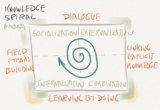
The Nonaka and Takeuchi Knowledge Spiral (click on the image to learn more)
For about five years around the turn of the century most of my days were spent helping clients manage their knowledge. Back in 2000 knowledge management (KM) was really big. Every year I’d head off to Amsterdam for the obligatory industry conference, KM Europe. We even had our own home grown conference, KM UK, with pretty much the same people but with less impressive venues. Then suddenly things went quiet - KM Europe was suddenly cancelled in 2005, KM UK limped along (and is still going today). KM had lost its way. The promises hadn’t been fulfilled. Of course KM just didn’t disappear overnight - it just degraded gracefully. One client, a very large UK multinational, shed their KM teams and announced that KM was now ‘embedded in the business’.
KM still goes on but it’s likely to be on the margins and not essential for peak organisational performance whereas in 2000 KM really was positioned as a game changer.
So what happened? That’s a good question and one which this post is my first attempt at exploring why KM failed to deliver on its early promises. And why do this sort of navel gazing now? Because knowledge management appears to be making a comeback but this time it has a shiny new suit and it’s called social learning.
The KM wave was initially driven by big tech - the idea that an organisation could somehow manage its knowledge was attractive in an economy where knowledge was as important as capital. But knowledge was elusive and the most valuable forms of knowledge refused to be stored in corporate databases. The response from most practitioners was a more people centric approach. The valuable knowledge resides in people’s heads so the best way to surface it is via conversations in communities - communities of practice and communities of interest.
Before I go into why I think social learning and KM are very closely related let’s take a very quick tour of the fundamentals of KM.
What is Knowledge Management (KM)?
"Knowledge management (KM) comprises a range of strategies and practices used in an organization to identify, create, represent, distribute, and enable adoption of insights and experiences. Such insights and experiences comprise knowledge, either embodied in individuals or embedded in organizations as processes or practices." Source: Wikipedia
Just like we love to debate the actual meaning of the word ‘learning’ KM people loved to debate the meaning of the word ‘knowledge’ and in particular how knowledge is different to ‘information’ and ‘data’. The knowledge pyramid graphic (see below) was seen frequently in KM circles. Most KM people used to work in ‘information management’ so you can see why the definition was so important. I don’t want to go into this debate here but one really critical thing to understand if you have any hope of applying KM is the difference between explicit and tacit knowledge.
Explicit and Tacit Knowledge
Explicit knowledge is knowledge that can be codified in some way (written down, stored in a visual, or embedded in a process). Explicit knowledge is good because although it is created by people it can be stored in a system. In our case a KM system but more of that later. How does explicit knowledge differ from information? Good question (see the debate on information versus knowledge mentioned above).
Tacit knowledge is knowledge, sometimes called know-how, that resides in people’s heads and is hard to codify (write down). Why is it hard to write down? Usually because it is either complex or contextual or simply because those who have it don’t actually recognise its value (unconscious competence).
Systems Centric or People Centric?
The rise of KM was largely driven by the desire of organisations to capture as much explicit knowledge as they could and store it in a system so that it could easily be shared with others. This systems centric KM became dominant in the early days because it was fuelled by considerable investment from big tech who were re-positioning their information products as KM systems (OpenText, Documentum, Autonomy etc.). The problem facing systems centric KM was the fact that it relied on people to make it work. How could organisations get their people, and in particular their ‘experts’ to share what they knew?
To address the people issue we had people centric KM. This view of KM recognised that if people were to share knowledge it had to be both explicit and tacit and the best way to do this effectively was through direct communication in networks. Specifically networks that were created around a specific topic or area of interest or practice. These networks became known as communities of interest (COI) or communities of practice (COP). In fact the term COP had been around before (see refs below) - it was simply co-opted into the language of KM.
The Perfect KM System
The perfect KM system combined both the systems and people centric approaches and acted as a store for explicit knowledge and a connector for tacit knowledge. If you didn’t know something you logged into the KM system and did a search and that search would either tell you what you wanted to know or it identified someone who would have the answer. BP called it their ‘yellow pages’ and even spun a commercial product (called unsurprisingly ‘Connect‘) out of the ground breaking working they did in KM.
KM had sorted knowledge sharing. In future, organisations would be less reliant on people who knew key stuff but didn’t share that stuff effectively. In practice there were lots of problems when it actually came to making KM work in practice and unsurprisingly most of those problems revolved around people’s behaviours and attitudes to sharing what they know.
In my next post, ‘Why Social Learning Won’t Work‘, I’ll look at what went wrong with the KM dream and why understanding why KM didn’t deliver on its initial promise has some useful lessons for those of us attempting to introduce social learning into organisations.
In the third and final post, ‘Why Social Learning Will Work‘, I’ll explore some ways we might be able to get social learning working for us by starting small and looking for quick wins.
Learn More:
KM at Wikipedia
COPs at Wikipedia
David Gurteen’s Knowledge Management Community
John Curran
.
Blog
.
<span class='date ' tip=''><i class='icon-time'></i> Jul 15, 2015 06:19am</span>
|
|
Want to speed up the learning process? Here's one approach.Post from: The eLearning CoachMetalearning, The Four Hour Chef, and Instructional Design
Connie Malamed
.
Blog
.
<span class='date ' tip=''><i class='icon-time'></i> Jul 15, 2015 06:19am</span>
|
|
Get inspired! Create some time for reading.Post from: The eLearning Coach10 Books For Learning Professionals To Read In 2013
Connie Malamed
.
Blog
.
<span class='date ' tip=''><i class='icon-time'></i> Jul 15, 2015 06:18am</span>
|
|
In January there are two big learning technology shows in the UK. One, Learning Technologies, is aimed at the commercial and public sector market while the other, BETT, is aimed at the education market. I go along to both but Learning Technologies is the real e-learning show. BETT has always been about classroom technologies, not about online learning, but things might be changing. I was invited to attend some sessions aimed at corporate customers and I see that this year there is a new zone dedicated to ‘Workplace Learning’. I’ve had a quick scan of the exhibitors and apart from a couple of Moodle implementors there doesn’t appear to be much in the way of online learning. I thought that with the rise of the MOOC and sites like Coursera and Udemy there might have been some new stuff happening at BETT which challenged the belief that the classroom is ALWAYS best. Apparently not and that’s an opportunity missed in my e-book.
Learn More:
Blog post on BETT 2012
BETT 2013
Learning Technologies 2013
John Curran
.
Blog
.
<span class='date ' tip=''><i class='icon-time'></i> Jul 15, 2015 06:18am</span>
|
|
A radically new approach to learning but would it work outside of education?
…new visions of learning better suited to the increasing complexity, connectivity, and velocity of our new knowledge society. We now have the capability to reimagine where, when, and how learning takes place.
http://connectedlearning.tv/
The post New Model Learning appeared first on Designed For Learning.
John Curran
.
Blog
.
<span class='date ' tip=''><i class='icon-time'></i> Jul 15, 2015 06:18am</span>
|
|
Our community found these articles most valuable for sharing.Post from: The eLearning CoachMost Shared Articles on The eLearning Coach in 2012
Connie Malamed
.
Blog
.
<span class='date ' tip=''><i class='icon-time'></i> Jul 15, 2015 06:18am</span>
|