Blogs
|
Here's a nice article, sponsored by Adobe, and written by Allison Rossett and Antonia Chan (2008, June) that provides some very nice descriptions and examples about engaging eLearning design. Check it out.
Will Thalheimer
.
Blog
.
<span class='date ' tip=''><i class='icon-time'></i> Jul 15, 2015 02:54pm</span>
|
|
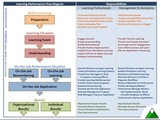
For almost a decade I've been building a model of how learning works to prompt performance. Each iteration gets better (in my unbiased opinion). Here's the latest one--this one has the advantage of pointing out the responsibilities learning professionals have AND the responsibilities that learners' managers and the workplace have in creating on-the-job results.
You can use this model for two purposes:
As a visual metaphor for how learning works to drive on-the-job performance and results.
As a job aid to assign responsibilities and tasks.
This graphic draws on many sources, many I'm probably unaware of. It draws from the wisdom of authors such as Wick, Pollock, Jefferson, and Flanagan of Six Disciplines of Breakthrough Learning fame, and Tim Mooney and Rob Brinkerhoff from the new book Courageous Training (which is great by the way, I'll review it within the next month).
It also draws from countless researchers on learning, memory, instruction, and cognition who have helped me understand learning at a deep level, enabling me to add to models that don't fully include wisdom on how learning and cognition really work to drive remembering.
Also, I'd like to thank my many clients who have enabled me a great real-world workshop in which to think deeply about how learning works in a practical reality. I'd particularly like to thank my friends at Walgreens, and especially Anne Laures who commented on an earlier version of this model.
Download Learning-Performance_Diagram_v2.pdf.
As always, this is a work in progress, so let me know what you like and what I might be missing. Note, of course, that human learning and performance is too complicated to include every factor of relevance. My goal is to create a model simple enough to be easily understood and precise enough to be useful and provide practical learning-to-performance improvement.
Oh, if you have to give it a name, you might call it the Learning-to-Performance Landscape Model, but I'll probably come up with a better name.
Will Thalheimer
.
Blog
.
<span class='date ' tip=''><i class='icon-time'></i> Jul 15, 2015 02:54pm</span>
|
|
I've been busy again thinking about the nexus between LEARNING and LEARNING MEASUREMENT.
You can peruse some of my previous thoughts on learning measurement by clicking here.
Here is a brand new article that I wrote for the eLearning Guild on how to evaluate Learning 2.0 stuff. Note: Learning 2.0 is defined (by the eLearning Guild) as: The idea of learning through digital connections and peer collaboration, enhanced by technologies driving Web 2.0. Users/Learners are empoweredto search, create, and collaborate, in order to fulfill intrinsic needs to learn new information. Evaluating Learning 2.0 differs from evaluating traditional Learning 1.0 training for many reasons, one of which is that Learning 2.0 enables (encourages) learners to create their own content.
Steve Wexler, Director of Research and Emerging Technologies at the eLearning Guild, and I are leading a Webinar on Thursday September 4th on the current state of eLearning Measurement. We've got some new data that we're hot to share.
Finally, Roy Pollock, one of the authors of the classic book, Six Disciplines of Breakthrough Learning, and I are leading a one-day symposium on measuring learning at the eLearning Guild's DevLearn 2008 conference in November. It's a great chance to go to one of the best eLearning conferences around while working with Roy and I in a fairly intimate workshop, wrangling with the newest thinking in how to measure learning. Choose Symposium S-4. Note that it may not show Roy's information there yet--the Guild is still working on the webpage--but let me assure you that Roy and I are equal partners in this one.
Will Thalheimer
.
Blog
.
<span class='date ' tip=''><i class='icon-time'></i> Jul 15, 2015 02:54pm</span>
|
|
Judith Gustafson just left an excellent comment on an earlier blog post. She let us know about a presentation at the Association of (AECT) Educational Communications and Technology conference in 2002.
Click here for the PPT presentation by Tony Betrus and Al Januszewski of the State University of New York at Potsdam that does a great job of describing what Edgar Dale meant to convey with his cone, AND shows numerous examples of how the cone has been used improperly with the numbers added.
Here is my original post on this.
Will Thalheimer
.
Blog
.
<span class='date ' tip=''><i class='icon-time'></i> Jul 15, 2015 02:54pm</span>
|
|
I started Work-Learning Research 10 years ago in August. Since that time, I've been translating learning research into practical recommendations for learning professionals. Unfortunately, it's not easy. It takes a major change initiative in most instructional-development shops. It takes time. It takes leadership. It often takes a helping hand. Why? Because we have to completely change our mindsets. For example, I've recently been using a model I'm calling Situation-Based Learning Design. It is research-based but because it is translated and crafted into a conceptually useful framework, my clients and audiences have found it eye-opening. More importantly, they have been able to see its applicability. BUT, even though the ideas in the model are easy, it is extremely difficult to move a whole work team to the new method. It takes time, perseverance, and guidance. We all fall back on our topic-based learning-design mental models. To develop new mental models aligned with the research is a worthwhile slog, but it is a slog nonetheless.
Recently I've been designing workshops around the Situation-Based Learning Design notion. My clients see me present the concept at a conference and want a workshop in their own company. Nothing I have done in my ten years as President of Work-Learning Research has been so satisfying. I've learned a few things over the years, correcting mistakes in my delivery. SMILE. One reason that the Situation-Based Learning Design is having such an impact now is that it's a simple research-based model that immediately makes sense to people. The other reason for impact is that we're able to build workshops that enable people to begin changing the way they do learning design. Finally, more and more learning professionals understand that for training (even their own training) to be effective, it has to be designed more like a change initiative than a course.
Will Thalheimer
.
Blog
.
<span class='date ' tip=''><i class='icon-time'></i> Jul 15, 2015 02:54pm</span>
|
|
Politics yuck, politics tricks, politics risk, politics fix, politics rules, politics is. Truth is, politics is the hand-to-hand application of anecdotal and scientific wisdom on human learning and cognition.
Here in the United States, we are in the middle of an exciting and critical Presidential election campaign. I love observing politics because I find it intriguing from a learning-and-cognition standpoint. Here are some things we (as learning professionals) can learn from the political wizards.
Repetition is worth repeating.
Space your repetitions over time.
Have powerful messengers repeat the key messages.
Authentic messengers are listened to longer and with more engagement.
Messengers who lose credibility (or integrity) are doomed.
Prioritize your messages. Brand your messages into a potent theme.
Vary the delivery of your messages, but stay consistent in the underlying message and theme.
Learning messages that are aligned with on-the-ground realities are the most powerful. It is only the very rarest of incumbents who can overcome a bad economy. It is only the rarest of learning messages that can overcome irrelevance or everyday business distractions.
When your efforts or credibility are attacked, fight back hard and fast. When candidates are attacked, they attack back, disputing the assertions. If your training efforts are impugned or criticized anywhere in your company, go on the offensive. Dispute the claims immediately and publicly. Let people know public criticism of your efforts will be met with vigorous rebuttals. Pull the criticizer aside privately and ask them not to continue their claims. Explain your realities. Educate them about the learning enterprise. Send out communications to key stakeholders disputing the claims, if not directly then indirectly by highlighting successes. After stopping the bleeding, listen to the complaints to see if there is truth in them. Fix the problems as soon as you can. Go back to the complainers and tell them how you fixed the problems. Ask the complainers for their support and ideas going forward. Remind them of your need for resources, support, etc. Help them solve their business problems. If you do get public complaints, see those as a warning sign that you are screwing up big time. Reach out and get better feedback on how you're doing and how you're doing politically. Build better feedback into your learning measurements and designs. Remember, if you're a leader of the learning enterprise in your company, you have a responsibility to ensure that the learning-and-performance efforts will work. If your training efforts have a bad reputation, the learning will never get the support it needs to move from learning to application and you'll never get the resources you need to get real results.
Bottom line: Embrace politics; it's only human.
Will Thalheimer
.
Blog
.
<span class='date ' tip=''><i class='icon-time'></i> Jul 15, 2015 02:54pm</span>
|
|
I often get asked by people in our field (the learning-and-performance field) about how to select a graduate school and how to approach graduate school once in. Maybe because I spent so much time in graduate school (10 years), I think I can offer some ideas:
Start reading the research now to find out whose research you admire, etc.
The ideal is to find a professor you want to work with, although this is very difficult.
Find a program that is well-respected and offers several professors who are top notch. Go to a school with an active colloquy or open research-discussion sessions.
If you can, go to one of the best schools. It will help you later as you network your way to career postings you want.
Expect a long and difficult haul. Expect wonderful rewards if you put in the effort.
Avoid professors who are evil. Seriously, there are some who are just dysfunctional. Ask for student references and talk to real students who have gone through the program. Ask for the good the bad the ugly.
Find a program with a very strong research methodology approach. If you graduate without knowing how to evaluate research, you won't do anybody any good. I've seen too many smart people who just shy away from the whole research enterprise because they've never been prepared for it.
Get a reading list of the articles and books used in the required courses. Ask around to see if these are written by the top thinkers in the field. Do not confuse "top thinkers" with "most-popular thinkers."
My own bias is to focus on the fundamentals of learning at the same time focusing on what is practical, but this is hard to find.
Be prepared to have a very thick skin. Be open to ideas. Relish them, but stick to your guns if you know deep down that you've got an intriguing idea.
Ask the professors what journals they publish in. Determine if these are top tier or lesser tier journals. Aim for the top tier.
Beware of the programs labeled as "adult learning, curriculum studies" and the like. These often are weak in the foundations of human learning (but not always). If you go to a school focused on instructional technology, make sure you find one with good background in learning.
If you want to build learning interventions when you get out of school, don't just focus on academics, build stuff while in graduate school that you can show to prospective employers later.
Note that the best development shops are very skeptical of graduates of instructional-design programs because many come out of those programs with rigidly inflexible mental models of how to build learning. This unbearable hardness of being is often combined with an arrogance that leaves these graduates with little ability to learn. Bottom line: Find a school, and adopt an attitude, that is inquisitive, open, skeptical, and hungry for knowledge. Find a way to test your ideas and learning interventions using valid methods so you can get the feedback loops you need to continually improve what you're doing and thinking.
Begin to take control of your learning now, before you get into school. In the doctoral program, it's 95% you.
Realize that when you start reading in the field, it will feel like you are a complete idiot. This is normal as you learn the language of the thinkers and researchers. On the other hand, as you learn more and more, don't forget how the real world talks.
Most of the time, but not always, PhD degrees are more research-oriented than EdD degrees, which is a good thing.
Note that I write these recommendations because I believe we need many more people in our field who can bridge the gap between research and practice. If you're completely not cut out to do research, that's fine. Be practical. But get yourself enough research background so you can evaluate research claims when you see them. Beware of a fear of research. Fear usually comes from a lack of exposure. Expose yourself.
Will Thalheimer
.
Blog
.
<span class='date ' tip=''><i class='icon-time'></i> Jul 15, 2015 02:54pm</span>
|
|
FREE Brown Bag
Learning Webinoshes
My
Brown Bag Learning webinoshes are short, intimate webinars covering one
essential topic in human learning and performance. I add questions, learning
myths, and question-and-answer sessions (where you can ask me anything) to
the mix to keep things interesting. These Brown Bag Learning experiences are
provided using a "Subscription Learning" methodology, so that themes
will be repeated over time for deeper, more impactful learning.
Upcoming Schedule:
Friday
November 7th, Noon U.S. East Coast Time
Can
We Improve Our Smile Sheets?
Link
to Register: https://www1.gotomeeting.com/register/345686876
Friday
November 21st, Noon U.S. East Coast Time
Does
Context Matter?
Link
to Register:
https://www1.gotomeeting.com/register/796752726
New: Now Available
through both the phone and VOIP so folks from around the world can attend.
Will Thalheimer
.
Blog
.
<span class='date ' tip=''><i class='icon-time'></i> Jul 15, 2015 02:54pm</span>
|
|
This Friday the Chicagoland Learning Leaders are meeting in their annual conference.
This is a fantastic group and I know that some of my smartest Chicago-area
clients are going to be there in droves. Unfortunately, I can't make it, but I
heard great things about this last year and if you're in the Chicago area this
is not to be missed. Click
here for more information. It's their 7th Annual Conference, so they must
know what they're doing!!
Will Thalheimer
.
Blog
.
<span class='date ' tip=''><i class='icon-time'></i> Jul 15, 2015 02:54pm</span>
|
|
As a person whose career focuses so much on learning, I can't help but notice when learning plays a part in the larger world, and especially in the life of my family, community, and country.My wife and I, and our daughter, live in the United States. Last night our country elected a new President, Barack Obama. Right after Republican-party candidate John McCain conceded the election in a very gracious speech, with Democratic-party candidate Barack Obama due to speak to the nation to acknowledge his victory, my wife and I decided to wake up our 5-year-old daughter (she's almost six--a few months really matter at her age).Both my wife and I have been strong Obama supporters in the general election. For weeks, our daughter has been asking about the election. "Who are you going to vote for?" "Is mommy going to vote for him too?" The questions are repeated and keep coming over time. You can feel her trying to learn how the world works, how we fit into the world. Last night at dinner she said, "I hope Iraq Obama wins." We're still working on getting her to say "Barack."As we put her to bed, we asked her whether we should wake her up to tell her who won. She said yes. A little after 11PM, I walked upstairs to her room. In her darkened room she was lying across the bed, her orange sheet covering her body, her bare feet sticking out past the side of the mattress. "Alena, Obama won. Do you want to come downstairs to see him speak?" She popped right up, which is unusual as she usually gets up in a slow series of sleepy disgruntlements. She zoomed downstairs and nudged her way inbetween her mommy and daddy.We had to wait for Obama to appear. As we gloried in the moment last night, with our daughter between us,
my wife and I were happy parents, proud of our country. Our daughter got to hear the same pledge of allegiance that she
says in her kindergarten classroom every morning. "Do you know
what song that is Alena?" "No." "That's the national anthem. That's our
country's song." During the wait for Obama, the announcers kept talking about the historic moment, how we were electing our first black President, how women and African Americans hadn't always had the right to vote. Tired, with her head laying on her mommy, then on daddy, then peeking over the sheets laying across us on the couch, she watched and listened and continued to shift back and forth."What color skin do you have to have to be President?", she asked. "Any color. You can have any color skin. In the past, a black person couldn't be President, but now they can." "What color skin did they have to have?" "They had to have white skin." "I have both colors (she has some of her mother's Colombian skin)." "Yes, you do, just like him." We point at the TV where Barack Obama is speaking. A moment of quiet reflection. "But a woman can't be President." "Oh yes, a woman can be President. You can be President if you want to." Another moment of quiet reflection, longer this time. Her quiet was surprising because usually when we tell her she can be anything she wants to be, she immediately interrupts and tells us she wants to be a veterinarian because she loves animals.Alena was riveted to the two Obama girls as they took the stage. When they didn't come out later when the Obamas and Bidens took the stage, she asked where the girls were. I'm going to bet that my daughter remembers this election. I remember President Kennedy getting shot and killed when I was a little younger than she is now. I remember my mom in tears and not being able to watch cartoons because adult shows preempted the cartoons on the TV. Alena did ask last night if there were any kid shows of the Obama speech. Alas, no..., perhaps a lost opportunity for learning.Even as a learning expert, it's hard for me to fully fathom how tiny moments have profound learning effects for kids. Some of it is surely emotional and social. Seeing all the faces with tears of joy around the country must have had an impact. Seeing how one's parents cry, beam, and do uncharacteristic things (waking the kids in the middle of the night) must have an effect. Hearing the announcers glow with special rhetoric must make a difference. Seeing all the different types of faces on the stage, brown, white, and in between. Youngsters like the Obama girls. Elders like Biden's fragile steely mom. Hearing Obama's eloquence, his example of the 106 year-old woman voter born before women could vote, must have made a difference. And new research on learning tells us that learning something just before sleeping helps cement that learning. So many factors at play.I can't help wondering what other wonderful teachable moments we have in store for us. How many teachable moments have already occurred. How this affects not only our children, but us; not only our country, but people around the world. How this has changed us forever.
Will Thalheimer
.
Blog
.
<span class='date ' tip=''><i class='icon-time'></i> Jul 15, 2015 02:54pm</span>
|