Blogs
|
© 2014 Mike Kniec, Flickr | CC-BY | via Wylio
Here are new additions to The Best Sites To Learn About Walls That Separate Us:
Syrians Crash Through a Fence Between War and Refuge is a photo gallery from The Atlantic.
These 14 walls continue to separate the world is from The Washington Post.
10 Grim Separation Walls From Around The World is from List Verse.
Larry Ferlazzo
.
Blog
.
<span class='date ' tip=''><i class='icon-time'></i> Jul 16, 2015 06:13am</span>
|
|
Every month I make a few short lists highlighting my choices of the best resources I through (and learned from) Twitter, but didn’t necessarily include them in posts here on my blog.
I’ve already shared in earlier posts several new resources I found on Twitter — and where I gave credit to those from whom I learned about them. Those are not included again in post.
If you don’t use Twitter, you can also check-out all of my "tweets" on Twitter profile page.
You might also be interested in The Best Tweets Of 2015 - So Far.
[View the story "June’s (2015) Best Tweets — Part Three" on Storify]
Larry Ferlazzo
.
Blog
.
<span class='date ' tip=''><i class='icon-time'></i> Jul 16, 2015 06:13am</span>
|
|
© 2008 Ginny, Flickr | CC-BY-SA | via Wylio
July 4th is Independence Day in the United States.
You might be interested in The Best Websites For Learning About The Fourth Of July.
Larry Ferlazzo
.
Blog
.
<span class='date ' tip=''><i class='icon-time'></i> Jul 16, 2015 06:13am</span>
|
|
© 2011 Sean Lucas, Flickr | CC-BY | via Wylio
I’ve written a lot in this blog and in my books about using inductive learning with students (see The Best Resources About Inductive Learning & Teaching). It’s one of my favorite instructional strategies.
And, I’ve written an equal amount about the importance of transfer of learning — in other words, facilitating student "transfer" of something they learned in one lesson to another situation (see The Best Resources For Learning About The Concept Of "Transfer" — Help Me Find More).
Now Education Week has highlighted a study that used that inductive concept - though, surprisingly, they called it "sorting" instead of "inductive learning" - in teaching science. And they found that it was more effective in promoting transfer than direct instruction.
One common way to use the inductive method is through "text data sets," which a short piece of text that students categorize. You can read more about this particular method and see links to examples in "Thinking Like A Scientist Can Help Overcome Allure Of Appearances."
In the study covered by Ed Week, though, the scientists just used cards sharing different scientific concepts instead of a typical few sheets of paper with the examples.
One thing I found particularly intriguing and I hadn’t really read about in other studies of the inductive method was that it was its effect on transfer:
…the students who had sorted the cards were significantly better at applying the concept to new situations.
You might also be interested in The Best Posts Questioning If Direct Instruction Is "Clearly Superior."
Larry Ferlazzo
.
Blog
.
<span class='date ' tip=''><i class='icon-time'></i> Jul 16, 2015 06:13am</span>
|
|
© 2006 Jacob Haas, Flickr | CC-BY-ND | via Wylio
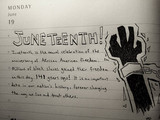
Juneteenth this year is being used in many communities to remember the nine people murdered in Charleston yesterday.
Here are a few resources on the day, and please feel free to share additional ones:
Juneteenth celebration resonates in wake of Charleston, S.C., tragedy is from USA Today.
The Black American Holiday Everyone Should Celebrate but Doesn’t is from Slate.
Juneteenth Is for Everyone appeared in The New York Times.
Juneteenth: 150 Years Ago, Black America Got Its Own Independence Day is from The Root.
What Happened After the First Juneteenth is from TIME.
What Is Juneteenth? is by Henry Louis Gates, Jr.
Larry Ferlazzo
.
Blog
.
<span class='date ' tip=''><i class='icon-time'></i> Jul 16, 2015 06:12am</span>
|
|
Fusion, the innovative online news magazine, has just begun a free daily "Today In History" video series that’s slighter "edgier" than others on The Best "Today In History" Sites list.
Here’s their video playlist page where you’ll be able to access all of them, and here’s the first one for today:
Larry Ferlazzo
.
Blog
.
<span class='date ' tip=''><i class='icon-time'></i> Jul 16, 2015 06:11am</span>
|
|
© 2014 Southbank Centre, Flickr | CC-BY | via Wylio
Jon Stewart interviewed Malala Yousafzai last night. Here’s the two part interview that I’m adding to The Best Resources On Malala Yousafzai:
The Daily ShowGet More: Daily Show Full Episodes,The Daily Show on Facebook,Daily Show Video Archive
The Daily ShowGet More: Daily Show Full Episodes,The Daily Show on Facebook,Daily Show Video Archive
Larry Ferlazzo
.
Blog
.
<span class='date ' tip=''><i class='icon-time'></i> Jul 16, 2015 06:10am</span>
|
|
[View the story "Some #CharlestonSyllabus Highlights" on Storify]
Larry Ferlazzo
.
Blog
.
<span class='date ' tip=''><i class='icon-time'></i> Jul 16, 2015 06:09am</span>
|
|
© 2012 opensource.com, Flickr | CC-BY-SA | via Wylio
There was a conference in the UK yesterday which featured Carol Dweck. It sounds like she made some interesting points, particularly around what she called a "False Growth Mindset." Here are some reports on that talk, along with other resources. I’m adding all of them to The Best Resources On Helping Our Students Develop A "Growth Mindset":
Praise the taking on of challenge, perseverance, new strategies, recovery from setbacks, says Dweck. Also praise improvement and learning.
— David Weston (@informed_edu) June 19, 2015
Why the ‘false growth mindset’ explains so much is from The Learning Spy.
The Mindset Journey is from Drowning in the Shallow.
Blog post on our new #mindset intervention paper: What we did, what we found, and what's next! @davepaunesku http://t.co/NkRNtZIhle
— PERTS (@pertslab) June 15, 2015
Very useful for anyone interested in Growth Mindsets https://t.co/h0YJpu8WcY
— Carl Hendrick (@C_Hendrick) June 14, 2015
Math educators! @joboaler has developed a week of math lessons and #growthmindset videos: https://t.co/3mrdndn0pB https://t.co/S5HaESKAZ6
— PERTS (@pertslab) June 1, 2015
Larry Ferlazzo
.
Blog
.
<span class='date ' tip=''><i class='icon-time'></i> Jul 16, 2015 06:09am</span>
|
|
I had the pleasure of having a half-hour Skyped conversation with a group of Texas teachers earlier this month, and invited Dan Perez to write about it:
Dan Perez comes from the Lamar Consolidated ISD in Rosenberg, TX. Dan was a 6th grade Science teacher for eight years prior to transitioning to his new adventure this year as an Instructional Technology Specialist.
Connecting Texas to California
Two weeks ago our district hosted a week long mini technology PD conference for our teachers called INTERACT (Integrating Technology Realistically Among Classroom Teachers). This year we included a time frame for teachers to discuss various topics of interests. Prior to the conference, teachers read snippets of an assigned book relating to their selected topic in order to prep for our conversation with various educational experts. Enter the topic of meaningful student motivation, Larry Ferlazzo, and his book, Helping Student Motivate Themselves.
Our group met for about an hour and a half, part of which would include a live conversation with Larry via Skype. Prior to our conversation with him, we reflected on our reading assignments and came up with questions to ask. We had questions relating to student ownership, intrinsic rewards, goal setting, dealing with disruptive students, and reassessments.
When we connected with Larry, we discussed the importance of getting to know your students’ hopes and dreams. He mentioned we need to "lead with our ears, instead of our mouths." It’s difficult for students to "buy in" if we’re not listening. We also need to be flexible with our assignments relating to their dreams. This allows their work to be more meaningful and thus keeping the students’ interests. Dreams, meaningful work, and conversations regarding second chances can also help students who are often apathetic towards school work.
Acknowledging improvements in student work is essential. Students need to see individual progress, and they need to be conversed with it as well. One teacher shared how she’s changed the way she grades assignments by pointing out what the student got correct versus what they got wrong. Some teachers also mentioned how they don’t grade with red pens either.
In relation to goal setting, our teachers loved the concept of Daniel Pink’s One Sentence Project mentioned by Larry. Teacher’s want to invoke this where students will write one sentence on what they hope people will say about them in the future. Our group also discussed Malcolm Gladwell’s 10,000 hour rule, where it will take 10,000 hours of practice in order to achieve mastery. All of this was to reinforce the topic of creating measureable realistic goals. Our teachers discussed how they respect students’ dreams, but they want them to come up with a "Plan B".
For other questions, conversations with students seem to be the answer. Whether it’s with the class as whole relating to classroom discipline issues or a one on one conversation with a student regarding behavior or academic concerns, heartfelt conversations are key.
Our conversation with Larry was exciting and participants enjoyed hearing his input as these opportunities don’t happen often. Larry input was truly humble and honest. He mentioned how he was there to share, but also to learn. He never tried to "fake" an answer and would mention if he didn’t know an answer to a question.
Larry Ferlazzo
.
Blog
.
<span class='date ' tip=''><i class='icon-time'></i> Jul 16, 2015 06:09am</span>
|