Blogs
|
Nina Leeke, co-author of International Express, provides ideas for a lively lesson or homework activity around this topic. It’s also the subject of the International Express Digital Poster Competition, which challenges adult students to produce a digital poster around this theme.
Like the majority of teachers, I like to personalise lessons and make them as relevant to my students as possible. Students usually find it easier to talk about things within their own experience and are more motivated to do so, and the language learnt as a consequence is likely to be more useful for them. As I generally teach in-company classes, we spend a lot of time talking about the students’ jobs and everyday work. But it’s also interesting to broaden the scope and look beyond the workplace. The local town or city is a topic which everyone has an opinion on, as we experience our environment day by day. The International Express Digital Poster Competition neatly brings these subjects together. It challenges adult learners to produce a digital poster illustrating the impact of English on their local town or city, and they must include something about the local work environment and social life. The topic provides plenty of engaging content for a lesson or two! Here are some ideas to get you started:
Take in some prompts to initiate the discussion. For example, you could choose English-language tourist leaflets, menus, photos of billboards or signs, workplace material such as company documents, newsletters, and emails, videos or recordings of spoken English such as public transport announcements, workplace conversations, or conversations with tourists.
Alternatively, you could set the question as a homework assignment. Ask learners to keep their eyes and ears open for evidence of the impact of English on their locale and report back in an upcoming lesson.
If English is a strong workplace requirement where you are, you could start by asking learners about changes in the job market and workplace over the years. What skills are necessary for their jobs? How is English used in their workplace? A good starting point is to take in local job adverts or have learners research job ads online.
Interviews and surveys always provide a lot of language practice - especially those question forms which students so often struggle with. Learners can create surveys or interview questions on the topic and then interview each other, their colleagues, or people on the street. Your students could then present their findings in graph form - which would provide content for the digital poster if you decide to produce one.
Have a debate! Start by brainstorming the pros and cons of the local impact of English. Then divide the group into two teams, for and against the motion English has had a positive impact on … (name of your town/city). This fun activity should facilitate useful language practice of agreeing, disagreeing and the language of cause and effect.
Once your students have come up with enough ideas on this theme, it’s time to get them started on producing their digital poster. For many learners, this activity will represent a break from the usual routine, which is usually motivating in itself. The learners I tried it out with - one of my in-company classes - were excited by the change! Plus participants can enjoy the visual appeal and the hands-on nature of the task. Digital posters also represent a good opportunity for task-based learning and collaboration. The results can be displayed either online or physically, and learners can present their poster to their peers.
If you and your students are new to the medium, the following tips may be useful:
Provide your class with some examples first, either by finding them online or creating something yourself. Alternatively, you can have learners look for digital posters for homework and share their favourites in the next class. To avoid too wide a search, you can specify a site for learners to look at. For example, choose a topic on the glogster education samples page. Much of the material on this site has been produced by school-age students, but you will find content relevant to adults too.
The examples should give learners ideas on the possibilities for content, for example, photos, text, and illustrations. If they haven’t come up already, you may also like to suggest the use of word clouds, mind maps and infographics. Free resources to try include wordle.net, www.mindmaple.com and www.easel.ly.
Ask learners to select which posters they like best and why. Analyse the elements of a good digital poster, for example, interesting content and simple rules for presentation (such as not too much clutter, and text that is easy to read with appropriate fonts and colours).
Simple software to use includes PowerPoint, Word, Photoshop and Google Drive (go to create/drawing). Glogster has more opportunities for multimedia content and is designed for educational use. There is a limited free version (which includes advertising) as well as various subscription options.
You may wish to create some content guidelines or a template in order to focus the learners and prevent them from feeling overwhelmed by the possibilities. If you use Glogster, there are various templates to choose from. If you are using other software, you could impose boundaries by specifying the number of different items on the page, or the mix of text/pictures/graphics. Conversely, you may well wish to give your learners the freedom to do whatever they like, if they are not the kind to be spoilt by choice!
Allow enough time for learners to ‘play’ with the technology! If you are like me, they will be more adept at using it than you are! However, they will still need time to experiment.
Having said the above, ensure that learners get their content ideas down on paper first! Otherwise they may spend most of their time trying out presentation options rather than thinking about their message and content.
So, if you are looking for ways to link your classroom to the wider world, the International Express Digital Poster Competition provides the perfect opportunity. Digital posters present a good opportunity for task-based learning and collaboration - and they are fun to produce! I hope some of these ideas inspire you, and good luck with your competition entries!
We’re awarding an iPad and an OUP business writing folder to the winning teacher. Each member of the winning class (up to twenty five students) will receive an OUP laptop sleeve and the Oxford Advanced Learner’s Dictionary Ninth Edition. Visit the competition website to find out how to enter.Filed under: Adults / Young Adults, Business & English for Specific Purposes, Multimedia & Digital Tagged: Competition, Educational technology, English Language Teaching, International Express, Nina Leeke, Online posters, Task-based language learning
Oxford University Press ELT blog
.
Blog
.
<span class='date ' tip=''><i class='icon-time'></i> Jul 23, 2015 08:46am</span>
|
|
(With apologies to Richardson, Redgrave et al)Tomorrow, Learning Anorak Ltd begins its third year of existence, so I thought I'd share some reflections on the journey to date.I have found the flexibility of being able to work my own hours enormously liberating. At one stage, I had a project that had overrun (not my fault, honest!) and two more that had just begun. One of them was a small piece of work, while the other two were pretty hefty. By dint of putting in stupid hours, I was able to meet the (revised) deadlines on all of them. Because of the way invoicing works, there is mileage in doing this. However, when you work for 'the man', you get paid what you get paid, regardless of the hours you put in. Also, once you start putting in hours like that, the expectation will be that you continue to do so, which is not good for your health or your family life. I knew that my contracts would come to an end and that there might be a quiet period to follow.I have been able to attend a morning Pilates class once a week, and ferry my sons to and from the station for school. When my Mom came over for my graduation, I was able to take time out to spend with her, and we travelled hither and yon, taking in the sights.My own learning journey has been more flexible, since I don't have to apply for time out or budget every time I want to sign up for something. On the flip side, however, without a behemoth L&D department with learning resources (and yes, even courses) on offer, I have had to track down my own, and this isn't always easy or quick.I have found the isolation difficult to deal with. Those who know me personally will know that I am a gregarious soul, not designed to spend huge chunks of time alone. When I am rushed off my feet, this isn't too much of a problem, but when I have down time, it can be quite dire.I am also frustrated by my own limitations. If something falls outside of my skill set, it falls outside of Learning Anorak's skill set. Of course there are ways around this situation:I could join forces with someone who already has those skills or I could sub-contract that work to someone/an organisation who specialises in that area. There is a subtle difference between those two things, and I belong to a massive international, informal network (of which you are part, by the way) with all manner of possibilities. But sometimes, there isn't the time to find someone or to negotiate a contract with an organisation before an answer is needed.I suck monumentally at the accounts side of the business. So I engaged a firm of accountants. We got off to a very shaky start and have only just hit our stride after a very frank meeting yesterday afternoon. It has taken a while, but I now have confidence that I am in the hands of someone who understands and will cater to my level of ineptitude.One of the most significant experiences was earlier this year, when I was right royally played by a wilier organisation who used me to gain a foothold in Europe. That was the beginning of a very lean period, during which my accountant even tentatively used the L-word. I have been advised by many people who know about these things, that I had a case to take legal action. However, I knew (as did the other party, no doubt) that being 'just me' meant that spending time on building my case would mean taking time away from the pursuit of much needed work to take up the slack that now faced me. We also both knew that I didn't have the readies to appoint a lawyer, whereas they probably have several on retainer. The fact that we are based on two different continents added another obstacle. I decided to let it go.I also find that being 'just me' means that, when I hit a personal rough patch, my business hits a rough patch. I am able to zone things out if I am working on a specific project, but if I'm just fiddling about with admin-type things, it's easy to lose motivation.On a personal level, being home-based also means there is a danger of not leaving the office. It takes real discipline, when I'm 'in the zone' (for want of a less cliched term), to down tools and go and prepare dinner for my family. I'm a pretty good cook and I enjoy preparing food, but, when I'm caught up in something, it's a real wrench to set it aside. I consciously remind myself that my family is the reason that I work, not an intrusion upon it.At this moment, I have just begun a new project which will keep the meter running for a few months. But the process of drumming up new business is also something I find daunting. Once contact has been made, I'm fine. It's the identification of leads I struggle with. In this, I have truly come to value my network. Most leads are referrals from people I know.So there you have it, two years and counting. A no holds barred account. If you're also a solo act, much of this will be known to you (please share). If you're thinking of going it alone, you may have thought about these things already (please share), but if you haven't, I hope that I have given you some food for thought.
Karyn Romeis
.
Blog
.
<span class='date ' tip=''><i class='icon-time'></i> Jul 23, 2015 08:46am</span>
|
|
As Halloween is nearly upon us, Stacey Hughes, teacher trainer in the Professional Development team at OUP, has been busy creating a collection of ghostly classroom activities for you to use with your class.
It seems that everyone likes a scary story. As autumn days grow shorter and darker, forcing us indoors, this is the perfect time to tell ghost stories.
Ghost stories and tales of the supernatural have been around for centuries and are a feature of nearly every culture. Though many people may not believe in ghosts today, stories about haunted castles, enchanted ruins and spooky spectres are still very popular.
Why do we like to be scared so much? One theory is that frightening stories cause a release of adrenaline which makes us feel a ‘rush’. Adrenaline is the same hormone that is released in a fight or flight situation, and, because there is no real danger, we enjoy this ‘thrill’. So we tell ghost stories around the campfire, go to frightening movies, read chilling novels - all in search of a spine-tingling sensation.
As Halloween approaches why not use this opportunity to incorporate some ghostly language and tasks into your lessons? We have put together a variety of photocopiable activities that can be used at various levels and with different age groups.
Click the links below to find activities to use with your students.
Activities
Scary collocations
Ghoulish word forms
Frightful idioms
Monster match (young learners)
Spooky CLOZE 1 (high intermediate and above)
Spooky CLOZE 2 (pre-intermediate and above)
Read a ghost story
Write a ghost story
Shadowy web quest
More resources
Check Oxford Magazine’s Special Halloween Corner for thrilling Pre-Primary and Primary classroom ideas.
Happy Halloween!
Filed under: Adults / Young Adults, Cultural Studies, Grammar & Vocabulary, Pronunciation, Teenagers, Young Learners Tagged: Classroom activities, EFL, Halloween, Primary, Secondary, Stacey Hughes, Teaching Resources, Upper Primary, Worksheets, Young Learners
Oxford University Press ELT blog
.
Blog
.
<span class='date ' tip=''><i class='icon-time'></i> Jul 23, 2015 08:45am</span>
|
|
The learning journey embarked on by both father and son here is worth so much more than the outcome of the exercise can begin to reflect. This pushes all my geek-parent buttons!
Karyn Romeis
.
Blog
.
<span class='date ' tip=''><i class='icon-time'></i> Jul 23, 2015 08:44am</span>
|
|
This is the third of a four-part series of articles from Verissimo Toste, an Oxford teacher trainer, about establishing a positive learning environment in the classroom. Here he shares some exercises to help establish expectations of general behaviour from students.
We have shown our students what kind of behaviour we expect from them as they enter the classroom. Now, let’s discuss what kind of behaviour we expect from them in general.
When I first walked into a class of 36 10-year-olds armed with my knowledge of EFL and many good intentions, I was not aware how completely unprepared I was for the experience. Looking back, I am happy to say, "I survived." I can also say that I learned a lot. I went into that classroom as their English teacher, when I should have gone in as their teacher. I thought behaviour was someone else’s responsibility. It wasn’t. So, I needed to establish what I expected from my students in our classroom. So, how do you want your students to behave in your class? What do you expect them to do? How will you let them know of your expectations?
Talk to them about it.
Having shown them what I expected in the first 10 minutes, it was time to talk to them about it. Keep the conversation positive. Avoid the words "rules" and "don’t". Tell them that you consider them responsible people, that they are part of a group, and that every group needs to know what is expected of them in order to work better. With some laughter and wicked smiles, they all agreed.
When students understand why they are doing something, they can do it better. So, talk to them about that routine in the first 10 minutes of class.
- Exercise on the board
By having the exercise on the board, they have something to do when they come in. Tell them that you’ve been a student too and you know that the more time they take to start, the less work they will have. Wasting time means less work. You want to take away that waste of time.
- Warm up to the language
By working individually on a simple exercise they start thinking in English and stop thinking in their own language. It is like warming up slowly before playing a sport or a musical instrument. Remind them that the exercise is easy, based on language they have done and seen before.
- Revision of language learned
As the exercise and the language are both familiar, it is good revision of the language before starting on new material. Tell your students that it is normal to forget. Everyone forgets. But, everyone forgets different things. As a group they know the material, so as a group, they can help each other remember.
- Working as a group
As everyone is working on the exercise, students who know the answer say it to the rest of the class. If they don’t know an answer, or they are not sure, all they have to do is listen. Together, everyone will have the right answers at the end of the activity.
- Opportunity to practice speaking
Tell them you understand that speaking in English is not always easy for everyone. By beginning the class with a simple exercise in which everyone has the answers, they have an opportunity to speak using simple language. This will give them confidence for more complex speaking activities later on in the lesson. It is like training during the week before a big football game on Sunday, or practicing a musical instrument before playing at a concert.
- Everyone can do it
Remind them that the activity at the beginning of the class is based on effort, not on knowledge. Everyone can do it. What they don’t know, they will get by listening to others in the class. They can improve their pronunciation in the same way - listening to others who give the answers. Reinforce the idea that, if they want to, everyone can do this.
"I am a responsible person."
When you have finished the discussion, take out a piece of blank , white paper and write in large letters, "I am a responsible person" in the centre of the page. For older students, at a higher level of English, I would write, "I am a responsible person and deserve to be treated as one." Ask them to sign it, if they agree with the sentence. Some students may not sign just to see if you will notice, some to see what you will do, and others, (especially teenagers), because they enjoy having a "rebellious" nature. At this point, simply collect the paper and put it up in the classroom.
By discussing what you do in class and why, you are already treating your students as responsible people. You are showing them that what you do is to help them, because you believe they can do it. You are establishing a positive learning environment because you believe all of them can and will learn.
Next week I will be covering establishing expectations for the lessons in general.Filed under: Professional Development, Skills, Teenagers, Young Learners Tagged: Behaviour, Classroom, Classroom management, Learning environment, Motivation, Teaching problems, Verissimo Toste
Oxford University Press ELT blog
.
Blog
.
<span class='date ' tip=''><i class='icon-time'></i> Jul 23, 2015 08:44am</span>
|
|
I have just been speaking to Paul Simbeck-Hampson (he gets around, doesn't he?) about QR codes and both of us have been waxing enthusiastic. In fact, I wouldn't be surprised if he posts about them too!In case you're not familiar with them, a QR code is a kind of variation on a bar code, only instead of bars, it has tiny squares of black and white, in which information can be embedded. The information can be text, or a URL, or even audio.With the means to scan these codes, all manner information can be shared. Paul and I have both loaded an app onto our smartphones that reads and generates these codes. He has an Android, while I have an iPhone. If our conversation is anything to go by, the Android version seems to be better.Also, Google translate has a QR feature (and an app for Androids). Using the smartphone, you can scan and decode the code for the word you have looked up.We were discussing possible learning applications for these codes and I shared about a speaker at the eLearning Africa conference in May (it pains me that I can't remember his name, even though he and I spoke at the same session), in whose organisation QR codes are being used to overcome language barriers. The code may be placed upon an item of furniture, for example. When scanned, this reveals the name of the item of furniture in the desired language, together with an audio of the correct pronunciation. I guess you could link to a list of the words for that item in any number of languages.Similarly, the codes are being attached to informational posters in the office, containing a translation of the content in the user's language.Just think about the potential applications:shipping consignmentsmuseum exhibitstourist attractionsbird identification rings...I reckon the list is only restricted by the imagination! Talk about ubiquitous learning!
Karyn Romeis
.
Blog
.
<span class='date ' tip=''><i class='icon-time'></i> Jul 23, 2015 08:44am</span>
|
|
Shaun Wilden, a freelance teacher trainer and expert in teaching with tablets, shares his advice for teachers on making the most of the interactivity of digital coursebooks from Oxford Learner’s Bookshelf.
Part 2 - How interactivity in e-books supports independent learning, pair work and whole class learning
Welcome back. How did your first lesson go? Did the students get to grips with their new digital coursebooks? Are you finding the right balance of use and non-use? I trust that by now the routine of using a different form of book is kicking in and it’s beginning to feel a little bit more normal. You’ve also realised that the digital aspects of your book can augment your usual teaching practice.
With that in mind let’s look at a lesson. We’ll use the e-book version of Headway Beginner, but you can apply the ideas to any coursebook you are using. If you’re not using e-books at the moment, and you’d like to try out the ideas in this post, just download the app for iPad or Android tablets, or go to www.oxfordlearnersbookshelf.com and try the free samples.
Let’s jump into the book and look at page 36, which is a vocabulary and pronunciation lesson based on the topic of languages and nationalities. In doing this lesson you are focusing the students on developing their knowledge of how to refer to different nationalities and language in English. By the end of the lesson, the students will have been introduced to a lexical set of nationalities and languages and had the opportunity to practice the pronunciation of each. The lesson also revises question forms which appeared earlier in the unit.
Here’s a quick question for you, how many ways are there of getting to page 36? One would be to swipe through the pages (albeit that would take some time). Before you read on, stop and as I said in part one, have a play.
Answer alert! You can use the tool bar on the left of the page, and the page thumbnails and numbers at the bottom. Add swipe, bookmarks, and search and there is a navigation method to suit pretty much everyone.
Getting started with my lesson, I project my iPad onto a bigger screen and pinch zoom the photos so that they fill the screen and remove the text. I don’t want them distracted by the text at the moment. Getting the students to look at the picture, I elicit which country they think it is (they did countries in a previous lesson so this is revision). Using the pen tool, I can write some of their answers on the page as in the picture below.
Once the students have the idea, I ask them to work in pairs and with one of their tablets look at the photos and write which country they think it is. We then get answers by again looking at my projected tablet. As the students are looking up I use the first picture to move from country to nationality leading into exercise 1, in which students have to match the countries and nationality. To complete this exercise students can use the pen tool.
Whether the course book is paper or digital it is important for the teacher to mix up how the students are working. This helps meet the differing learning needs of the students. Since we began with the students working as a class, heads-up with me, I ask them to do exercise 1 working on their own tablet. However since I don’t want it be a test-like atmosphere I encourage the students to support each other. I think this is important, as I want the students to learn to be independent and not always rely on their teacher for answers. If you remember from the first post I like my students working in islands. I think this helps them work with each other. In this lesson, since the answers are in an audio script, the students don’t need me to formally check the answers. I can promote learner independence while at the same time having the space to help those students who need it, by getting them to play the audio on their tablet.
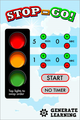
However, there is a danger when encouraging them to work like this that students might take a long time to complete the exercise. As I don’t want them to take forever I change the projection on my tablet from the coursebook to a traffic light timer (for example Stop go or Traffic Light). The students then know that while the light is green they can work on the task, as the time expires the light will change to red signaling the end of the task. Being freed up like this I find I can give students more individual attention.
Since one of my favourite classroom techniques is drilling, once we’re all ready students put their tablets aside and we do some choral drilling. To add a fun element to this, I open the ‘too noisy’ app (iOS and Android). This is an app often used to show a class that it’s making too much noise. However since I want the students to be confident when they drill I turn this on the head and get them to make as much noise as possible so that the app goes off the scale.
Digital coursebooks have the ability for students to record themselves so rather than having to put individual students on the spot, once I am satisfied with the group drilling, it’s back to the ‘listen and repeat’ part of exercise 1 on page 36.
Here’s another quick question for you. There are two ways the students can record themselves in the digital coursebook. Do you know both? Answer alert! Student can record themselves using the audio note or by using the recorder that comes up when a student listens to audio.
More confident students, who do not need to refer back to a model, can practise the pronunciation into the audio note. Alternatively students can listen to the audio, tap record and say the word after each one is said by the coursebook. They can then play it back along side the audio to check their pronunciation.
One additional feature of digital coursebook audio is that the pace can be changed. If you look at the image above, you can see the plus and minus button on the audio toolbar. Students who have difficulty in listening can slow the listening down and those who want a bit of extra challenge can speed it up. If you were running a listening lesson from the front of the class you wouldn’t be able to allow so much flexibility to the students. Additionally this slow and fast can help a student with pronunciation. Slowing down highlights how the word is said, speeding up helps students reach a natural rhythm.
A similar approach can be taken with exercise 3, which this time asks the students to match country and language in order to make true sentences. However given the students have been working in their books for a while now if you are looking for a bit of variety, it could be done in a more traditional way such as using cut up paper prepared in advance. Either way after doing exercise 3 as preparation, it’s time for my students to ‘test’ themselves. Books off, they make sentences (orally) for their group as per the model. However rather than always making true sentences, students can make them true or false for their classmates to decide.
Finally we finish the page by doing the pairwork in exercise 4. Rather than asking them to reopen their tablets, you can use your projected coursebook to orientate and instruct the students. Students then do the task to get the idea and practice. However this first run through is also a rehearsal for recording.
Once the students are ready, going back to the audio note they record themselves doing exercise 4. They can then listen back and assess their own performance. You can help, guide and point them in the right direction before asking them to do the task for a third time (again recording) to note improvements.
There you go, a lesson using a digital coursebook. Not too dissimilar to what you’ve done before the digitalization is it? But before the naysayers pipe up, look at what the digital coursebook added. First of all the material was in one place so no need for extra audio equipment or finding a way to project large images to work in plenary. We added the ability for the students to record themselves, we didn’t have to control audio so they could work at their own pace. As a teacher I could work specifically with those that needed extra help while others could get on with a task. We still did group and pair work and we still got to do some good old-fashioned drilling.
Hopefully by now you’re getting into the swing of using the tablet. There are some obvious digital follow ups. By that I mean activities we can give the students as extension activities, just as you would do when using a paper-based coursebook. Obviously you can choose the ones that best suit your class but here are a couple of things to get you started.
As a class follow up for vocabulary I use the Socrative app to create a nationality or language quiz. The students can then play the team game. (When you download the app look through what it can do). You will see a game called space race. This makes for a fun way to end the lesson and review the lexis of the lesson. By connecting to Socrative through their tablets they are automatically playing in teams which provides a different interaction to those already used in the lesson. If you are new to Socrative, note that there are two apps: one for the teacher and one for students. After creating an account, you log in to the teacher version to create and run the game. The students join in on the student version of the app.
Homework will be getting the students to use an app such as fotobabble to create their own photo as per the examples on page thirty-six. They take a selfie and then use the language of the lesson to talk about themselves. Here that task not only uses the coursebook as the impetus but also because students have to record their audio (for other students) it gives a communicative focus to the language revision. If students cannot take their tablet home, they can do this on their mobile phones or computer. Alternatively, another task is to get the students to take photos of things of different origins e.g. An English dictionary, Italian food. If you set this for homework, students come to the next lesson with photos that not only revise the language of the lesson but sets up the next lesson perfectly!
Right, there’s a lot for you to get trying out. Feel free to leave me a comment saying what worked or didn’t.
Filed under: Adults / Young Adults, Multimedia & Digital, Teenagers Tagged: Android tablets, Apps, E-books, EdTech, iPad, mlearning, Mobile learning, Oxford Learner's Bookshelf, Shaun Wilden, Tablet devices, Technology in education
Oxford University Press ELT blog
.
Blog
.
<span class='date ' tip=''><i class='icon-time'></i> Jul 23, 2015 08:43am</span>
|
|
Thanks again to Paul Simbeck-Hampson for the link to this video about a creative use of QR codes.Forget about the content of the book in the example. Think laterally. Consider the possibilities! Here we have the potential for a book that self-updates. Just as you do with web pages, when something changes, you update the source material, and the user accesses the most up to date information.Just in time information.As a teaching and learning resource, this is dynamite!!!!Later edit: At Paul's suggestion (see comments below), I am including this video which shows some of the potential usage of the technology:
Karyn Romeis
.
Blog
.
<span class='date ' tip=''><i class='icon-time'></i> Jul 23, 2015 08:42am</span>
|
|
John Hughes has co-authored a number of titles for OUP including three levels in the Business Result series, Successful Meetings, and Successful Presentations. He will be giving a practical workshop on how to write materials at the upcoming BESIG conference in Bonn on 15th November. This is the first of two blog posts in which John explores three key areas which he believes underpin effective materials writing.
If you want to write your own EFL materials, where do you begin? Let’s start with a question: What do most established EFL materials writers have in common? First of all, they’ve all taught for a number of years and they are fairly confident about what will and won’t work in the classroom. Secondly, throughout their teaching career, they have always loved creating their own materials. Thirdly, most materials writers that I know have also spent time working as teacher trainers. In fact, I personally believe some kind of teacher training experience should be a requirement for all materials writers; it’s only by working with and observing other teachers that you can really understand how to write materials for use by other teachers.
Finally, I think that all effective materials writers understand - either knowingly or unknowingly - how to write materials that are at the correct level, aimed at the appropriate context, and organised into a series of stages which flow to form a cohesive and complete lesson. In this first of two blog posts, I’ll look at level in more detail.
When we talk about the level of the material, we are usually referring to whether you can use it with an elementary, intermediate or advanced student. So knowing how to write for different levels requires that you have experience of teaching at lots of different levels. In addition to that, there are some tools that can help you. For example, if you are writing or adapting a text for reading materials then you can assess the level of the text with a tool like the Oxford Text Checker. By putting the text into the text checker it will show you which words are not within the top 2000 or 3000 keywords of English. As a result, you can decide how to adapt the level of the text and which vocabulary could be taught as new.
As well as considering the language level, materials writers also need to think about the cognitive level of the students; for example, writing materials for young learners is quite different to writing for adults. Also, there’s the danger that when we write materials for students with a low language level, we write materials which treat the students as if they have low intelligence. Even materials for elementary levels must still be intrinsically interesting, and motivating; in other words, if you are writing for grown-up adults, then the material should feel ‘grown-up’.
Level in materials writing also refers to the level of an exercise or task. In other words, the exercise or task itself must be achievable. So if you ask students to fill the gaps in a conversation while listening but there are too many gaps, it becomes impossible - regardless of their language level. Similarly, if you write a speaking practice task which requires more than three sentences of instructions, then the task is probably overly complex for use by the teacher and students.
So level is a key part of writing EFL materials, and in my next post we’ll look at how it links in with the skills of writing materials with context and flow.
© John Hughes ELT Ltd 2014. Unauthorized use and/or duplication of this material without express and written permission from this blog’s author and/or owner is strictly prohibited. Excerpts and links may be used, provided that full and clear credit is given to the authors with appropriate and specific direction to the original content.Filed under: Adults / Young Adults, Business & English for Specific Purposes, Professional Development Tagged: BESIG conference, Course materials, EFL, John Hughes, Materials writing, Oxford 3000, Oxford Text Checker
Oxford University Press ELT blog
.
Blog
.
<span class='date ' tip=''><i class='icon-time'></i> Jul 23, 2015 08:42am</span>
|
|
This is the last of a four-part series of articles from Verissimo Toste, an Oxford teacher trainer, about establishing a positive learning environment in the classroom. Here he shares some practical ways to minimise disruptions during classes.
What do you expect from your students? Sit down for a few moments and think about your classes. Think about where you are as the class begins. What are you doing? Where are the students? What are they doing? As you think about the class, note down anything you would like to improve. Don’t worry if it’s easy or difficult. Just note it down. Then, look back at your notes and decide on 3 to 5 points you want to work on immediately.
After reflecting on my classes of about 25 teenagers, these were the four aims I came up with:
- The classroom is in order.
- Students are ready for class.
- Classes begin more efficiently.
- Students participate actively during the lesson.
Remember, these are aims. I took them to my classes and wrote them on the board. I told my students this is what I expected from them. I got a lot of blank looks. They had heard this before. There was nothing they could really disagree with. But what do they mean? What does "the classroom is in order" mean? Can you picture it?
It is important to be able to visualise the difference between how things are now and how you expect them to be. Why is the classroom not in order? Define each aim so that students can see when it is not being met. For my classes, "the classroom is in order" meant that:
- The chairs are in their places.
- The desks are clean and in their place.
- The board is clean.
Anyone looking at the classroom can see if these 3 aims are being met.
Having the classroom in order based on these 3 aims may seem very simple and obvious. Let me explain why it was important. My students came into my class with the results of the previous class still evident. Having left in a hurry, there were fallen chairs, desks at different angles, books and other materials from previous lessons on their desks, notes still written on the board. This was affecting the beginning of my lessons, so it became important to begin the class with the classroom in order.
With the idea of making each aim visually clear, discuss each one with your students. These are the results of the discussion with my students:
Students are ready for class
- There are no materials on the desk, except those needed for the English lesson.
- The student has his class book, workbook, and notebook.
- The student has pen, pencil, and rubber.
The reason for these aims was the number of disruptions in class based on not having the materials they needed. Equally important, materials from other lessons meant that many students’ desks were disorganised. This was affecting their focus on the material in my lessons. My students already had a problem focussing on the lesson with these distractions.
Classes begin more efficiently
- The student is on time.
- The student enters in an orderly way.
- The student leaves in an orderly way.
What does "on time" mean? This greatly depends on the situation in your school. Some schools use a two-bell system and, in this case, being on time is being in class before the second bell rings. Many schools use the bell to call students (and the teacher) into class. Some schools do not use a bell system, at all. What is important is that you and your students agree and that it is obvious to all when a student is late. Based on the one bell system, my students arrived in the classroom at about the same time I did, walked in as I did, and went to their desks, as I did.
What does "in an orderly way" mean? Again, discuss this with your students. It could mean no running. It could mean going straight to their desks. It could even mean, not using their own language when they enter the English classroom.
Students participate actively during the lesson
- The student listens actively.
- The student works when necessary.
Initially, listening "actively" was difficult for my students to visualise. "How do you know we are listening actively?" they asked me. But based on the routine I wrote about here in a previous blog post, "A positive learning environment: the first 10 minutes (part 2)", they quickly understood that they would need to listen to each other in order to participate in the class.
"when necessary" also became a point of discussion. Originally the aim was for students to be engaged in the lesson. This proved very difficult for larger classes with a greater degree of mixed abilities and learning preferences. My students felt they should not be punished if they had finished an exercise and were waiting for others. I accepted this, and so I took on the responsibility of keeping them all engaged. It was a challenge.
Responsibility Skills
Rather than calling them classroom rules, I labelled them "responsibility skills". I made a poster with the aims and put it up in my classrooms. By having the poster with the aims in the classroom, I did not need to repeat or remind. I could simply look at the poster, and then look at the student. They understood what was wrong, because they could see it as easily as I could.
Then, it was a matter of being patient as students adjusted to the new expectations. Over time, about 3 months for me, these became part of the class routine, for which I congratulated them.Filed under: Professional Development, Teenagers, Uncategorized, Young Learners Tagged: Behaviour, Classroom, Classroom management, Learning environment, Motivation, Teaching problems, Verissimo Toste
Oxford University Press ELT blog
.
Blog
.
<span class='date ' tip=''><i class='icon-time'></i> Jul 23, 2015 08:41am</span>
|