Blogs
|
One of the things I talked about at the CODE International Symposium in Japan last week was a framework for locating educational practices. The framework has two dimensions: teacher-centered vs. student-centred learning (i.e. where the locus of control is for the learning process) and content-based vs. activity-based learning. I then showed how this could be used to map different types of learning across formal, non-formal and informal learning context. So in the lower left hand side fairly didactic approaches, such as a traditional lecture presentation are located. Here the control is very much teacher-centred and the main learning is via delivery of content. Adopting more activity-based approaches, but still within formal educational contexts, shifts to the upper left hand quadrant - i.e. approaches such as problem-based, case-based, scenario-based or inquiry learning. The teacher is usually still controlling the learning process and here the focus is around some specific context and is primarily activity-based in nature. The bottom right hand quadrant considers approaches that are content focused but student controlled. A lot of Continuing Professional Development (CPD) or skills-based vocational learning fit within this space. Finally, informal learning approaches which are based around activities and engagement with others such as for example amateur photography, just-in-time language learning, gardening etc. fit in the top right hand quadrant.Of course these are extremes, specific instantiations of these different approaches to learning will shift - a lecture might actually have some degree of activity or might be more student focussed, nonetheless it is useful I think to consider these different approaches along these two dimensions, particularly as much of the rhetoric around the use of new technologies suggests a shift towards learner,-centred/activity-based learning - would welcome thoughts!
e4Innovation
.
Blog
.
<span class='date ' tip=''><i class='icon-time'></i> Jul 23, 2015 12:47pm</span>
|
|
Following on from my previous post I have done some more thinking about course dimensions and how they can be represented and used. To recap; there are four categories associated with a course and each can have a number of dimensions:
Content and Activity
Interactivity
Student-generated content
Open Educational Resources
Multimedia
Communication and Collaboration
Web2.0 interaction
Collaboration
Peer communication
Reflection and demonstration
Reflection
Diagnostic
Formative
Summative
Guidance and Support
Student-centred
Peer supported
Tutor-guided
It is possible then to consider the degree to which each of these dimensions is present in a course, using a percentage scale. This can be done at course level, at block level (where a block might present a semester) or for individual weeks. So in the example below the course is divided into three blocks. Block one has 65% interactivity (35% non-interactive), 10% of the materials generated by students (90% made available via the tutor), 20% of the materials are OER (80% from the tutor) and 75% multi-media (25% print-based). The table can then be represented either as a bar chart or a spider diagram.
Alternatively these dimensions can also be used to give a balance across the categories. So in the figure below for example; in terms the Content and Activity category breakdown as 25% interactive material, 10% Student-generated content, 40% OER and 25% multimedia. This can then be represented as a bar chart.
e4Innovation
.
Blog
.
<span class='date ' tip=''><i class='icon-time'></i> Jul 23, 2015 12:46pm</span>
|
|
A number of things appear to becoming together - at least in my mind! - in terms of working towards a coherent set of conceptual learning design tools. I’ve blogged about lots of this before, but thought this post would be useful in terms of bringing some of this up to date. Interesting these ideas are currently spanning a number of projects/research work I am involved with. Clearly this work fits in terms of the overall ideas about adopting a learning design-based methodology and the associated tools/resources/activities to support this. Institutionally this work is currently being driven through our Course Business Models work. Externally aspects of this are feeding into the Design-Practice project we have with Cyprus and Greece and the X-Delia project on financial decision making. Below is a powerpoint presentation showing five conceptual design views of a ‘learning intervention’ - this could be something like an informal learning iphone app (as in this example) or a formal educational course or programme.
The five views are:
Learning intervention overview (or Course map view)
Pedagogy profile
Course dimensions
Task swimlane
Learning outcomes map
I talked about some of this in detail in a recent networked learning paper and associated powerpoint presentation (Cloud on Cloudworks on the seminar this was part of is here). I think what is exciting about this is that the five ‘views’ give you a means of thinking about a learning intevention at different levels of granalarity and different aspects.
We have particularly made significant progress in the last few weeks I feel on the course dimensions view. I had an excellent brainstorming session on this last week with Mick Jones (who is leading the next phase of our Course Business Models work), Barbara Poniatowska and Kevin Mayles (who are involved in a related project on e-learning data. We have an internal workshop with staff from across the faculty on Friday to get their views on the work to date, how it might be used/improved and how it can be taken forward.
I used the views this week in a brainstorming session with Gill Clough (who is the lead reseacher on our part of the X-Delia project) in terms of trying to map a learning intervention for an i-phone games app about financial decision making. The views worked surprisingly well. The powerpoint presentation with the five views is below, thoughts welcome!
Health check game
View more presentations from grainne.
e4Innovation
.
Blog
.
<span class='date ' tip=''><i class='icon-time'></i> Jul 23, 2015 12:46pm</span>
|
|
We are running a Course Business Models workshop tomorrow at the OU to share with staff from across the university the work we have done to date in terms of representing courses. The Course Business Models (CBM) and the Learning Design work complement each other in the sense that the LD work provides the broader perspective and theoretical basis for the work and the CBM work a specific local implementation.
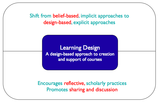
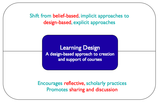
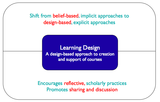
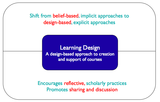
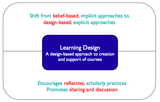
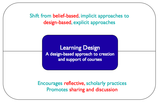
One of the things I will argue tomorrow will be about the benefits of adopting a Learning Design approach. In particular I will argue that it offers a design-based approach to the creation and delivery of courses, along with a set of resources, tools and activities to support this. It enables practitioners (and potentially learners) to shift from learning and teaching practices that are essentially ‘belief’ based (i.e. this is what I have always done, this is my experience of learning and teaching) and implicit to ones based on design principles derived from good pedagogy and mechanisms that enable the design to be made more explicit. Adopting a design-based approach promotes a reflective and scholarly approach and facilitates the sharing and discussion of learning and teaching ideas and designs.
In our Design-Practice project (with Cyprus and Greece) we are identifying what innovations from our Learning Design work we can transfer to be applied in their local contexts. This has enabled us to take stock of the range of tools, resources and activities we have produced and put them into a more logical and meaningful framework. Rebecca Galley, Paul Mundin and I had a great brainstorm about this earlier this week and I think we have come up with a nice way of capturing and representing what we have developed. The LD-wheel shown provides a higher level picture; i.e. that our Learning Design methodology is composed of three parts: theoretical perspectives, collaboration and visualisation. For each of these we have developed a set of tools, resources and activities. So for example the CBM Excel templates we have produced for the views are examples of visualisation resources. CompendiumLD is an example of a visualisation tool and Cloudworks an example of a collaboration tool.
At the end of this blog post the full Learning Design Taxonomy underneath this that we have developed is presented.
It is possible to take a number of guided pathways through the LD-wheel:
CBM awareness events (such as the workshop we are running tomorrow) - where the focus is on looking at and discussing the five CBM views.
An LD-lite workshop (for example ‘Using technology to support learning and teaching’) - where a selection of tools, resources and activities are used but there is no explicit mention of Learning Design. We are planning to run something like this with our Design-Practice colleagues.
Design challenges - using a range of the tools, resources and activities to support teams as they work through creating a course in a day. We have run a number of these both within the OU and externally with our partners on the JISC OULDI project.
A masters level unit - such as the one I authored for the H800 course.
A free format - where the user choose what they want to use and in what order.
I’m looking forward to the workshop tomorrow and getting feedback on aspects of this work and to seeing in the coming months how this work might be rolled out across the university.
e4Innovation
.
Blog
.
<span class='date ' tip=''><i class='icon-time'></i> Jul 23, 2015 12:45pm</span>
|
|
I have got a contract to write a book, current title ‘Designing for learning in an open world’. It’s really a chance for me to consolidate the learning design work that I have been involved in over the last eight years or so, to try and articulate my take on this, locate it to other learning design research and also related fields (such as pedagogical patterns work, instructional design and learning sciences). So far I have been working on it in the background, refining the focus, deciding on the structure and content, doing the necessary broader literature reading to locate the content alongside other work. However I think it’s now time to go a bit more ‘open’ - seems appropriate given the focus of the book! So I am planning to post thoughts, rough drafts, ideas etc. here as I go along. I’ve not done this so explicitly before with a piece of research, certainly not for a relatively large enterprise that is likely to go over a fairly extended amount of time. Sure I have put up ‘ideas in the making’ as blog posts and even drafts of papers, but it will be interesting to see how the articulation of a more substantive set of ideas pans out over time. Goodness only knows what I will make of early postings and drafts and/or even worse what if I end up abandoning the whole enterprise?
I’m not sure yet what format this will take, but my thinking at the moment is to post here reflective thoughts, ideas about structure and order, drafts of writing, emergent questions the work raises, pointers to interesting readings and how I am using them, plus maybe some more general reflections on the process. The reflective blog posts are being aggregated in a Cloudscape on Cloudworks, which will also be a space for discussion and aggregation of related relevant references.
Have others come across similar open approaches in our field and if so how effective are they? I know that some books have been produced and then ‘opened’ as wikis to invite broader contributions and of course that some commercial writings do keep reflective blogs, although I wonder to what extent these are marketing ploys rather than genuine invites to open up the process and invited broader comment? Of course, dare I say it, there is also the old chestnut about whether we should be publishing in traditional channels at all or simply going straight for completely open publishing routes, I know this is something my colleague Martin Weller feels passionate about.
So I post this first entry on this topic with some trepidation, feels like going into the unknown and a little out of my comfort zone… but hey if we don’t push the boat out occasionally life would be a lot less interesting
e4Innovation
.
Blog
.
<span class='date ' tip=''><i class='icon-time'></i> Jul 23, 2015 12:45pm</span>
|
|
This blog post is a draft of a chapter I am currently working on; would welcome thoughts on it. It explores how new open, social and participatory media can be used as cognitive learning tools to promote professional practice and critical reflection. It begins by referencing a recent review of web 2.0 tools and the ways in which they are being used to support new forms of dialogic engagement, social networking and collective aggregation of knowledge. It then focuses on the ways in which some of the existing web 2.0 tools are being used by practitioners, focussing in particular on blogs, Twitter and Facebook. It then introduces a new social networking tool, Cloudworks, which has been specifically developed to enable practitioners to share and discuss learning and teaching ideas. The structure and functionality of the site will be described, along with some examples of user behaviour that demonstrate how practitioners are using it to promote evidence-based approaches to practice. It will conclude by reflecting on the implications of such tools for learning and teaching and suggest ways in which open, participatory and social media might increasingly act as important social and cognitive tools for learners and teachers in the future.In a recent review of Web 2.0 tools and practice it was evident that new technologies are offering new ways for learners and teachers to engage in more open, social and participatory practices (Conole and Alevizou, 2010). These tools are fundamentally changing the way in which users are interacting, finding and using information, communicating and collaborating. The sheer scale and scope of the Internet enable networked effects to occur, facilitating collective intelligence on a scale not possible before. Users and tools co-evolve; so for example new tools become appropriated into a user’s personal digital environment; adapted and personalised as needed. These changes can be reflected by close scrutiny of a number of tools that are particularly popular; namely blogs, Twitter and facebook. Blogs have been taken up across disciplines as tools for sharing ideas and critical reflection. Blogs are used as both a means of dissemination and reflection. They offer new and immediate forms of communication and sit alongside more established means of communication, such as scholarly journals. Twitter, as a form of micro-blogging, has become important in recent years in a number of respects: firstly, as a means of sharing ideas, secondly as a mechanism for communication and dissemination and thirdly, as a way of asking questions. Through the notion of a hash tag, Twitter has become important as a back channel at conferences, and as a means of having selective conversations about particular topics. Facebook has become incredibly important as a social networking tool. It straddles both personal and professional spheres, offering a space for sharing and discussing. Through the notion of connecting to friends and updating status links, users can interact and communicate with their own personal network. Facebook is used for both personal and professional activities. Special interest groups on particular topics have developed and updates tend to be a mix of both personal and professional reflections.
These tools arguably are changing the way in which learners and teachers are communicating and even thinking. They act as cognitive tools, extending learner and teacher’s distributed cognition (Salomon, 1993). As Jenkins et al. (2006) argue new digital literacies are needed to be part of what they term this new participatory culture and they list the following as the digital literacies that are needed.
· Play - the capacity to experiment with one’s surroundings as a form of problem-solving
· Performance - the ability to adopt alternative identities for the purpose of improvisation and discovery
· Simulation - the ability to interpret and construct dynamic models of real-world processes
· Appropriation - the ability to meaningfully sample and remix media content
· Multitasking - the ability to scan one’s environment and shift focus as needed to salient details
· Distributed Cognition - the ability to interact meaningfully with tools that expand mental capacities
· Collective Intelligence - the ability to pool knowledge and compare notes with others toward a common goal
· Judgment - the ability to evaluate the reliability and credibility of different information sources
· Transmedia Navigation - the ability to follow the flow of stories and information across multiple modalities
· Networking - the ability to search for, synthesize, and disseminate information
· Negotiation - the ability to travel across diverse communities, discerning and respecting multiple perspectives, and grasping and following alternative norms
· Visualization - the ability to interpret and create data representations for the purposes of expressing ideas, finding patterns, and identifying trends.
Today’s teachers therefore not only have to master these new digital literacies, but also need to have a good understanding of new technologies and how they might be used in a learning and teaching context. When asked what they need to harness these technologies, overriding they say two things: ‘give me examples of how others in my discipline have used particular technologies’ and ‘provide me with a means of communicating with others who have similar interests’. At first face, Web 2.0 tools seem to provide the obvious mechanism for facilitating this, but in reality teachers are not using Web 2.0 tools extensively. As a result we decide to address this by creating a new social networking tool, Cloudworks, which was specifically designed as a space to support the sharing and discussing of learning and teaching ideas. The site was built from scratch, harnessing the best of web 2.0 functionality, but specifically aimed to support teachers. A number of papers describe how the site has been designed and evaluated (Conole and Culver, 2009; Conole and Culver, 2010). In addition we have developed a community indicatory framework, which can be used to analyse new patterns of user behaviour on the site (Galley et al., forthcoming). We have adopted a design-based research approach to the development and evaluation of the site Gibbons and Brewer (2005).
Cloudworks is a powerful new form of social networking tool: particularly suited for sharing, debating and co-creating of ideas (Conole and Culver, 2010). The site combines a mix of Web 2.0 functionality and enables new forms of communication and collaboration and cross-boundary interactions between different communities of users. The core object in the site is a ‘Cloud’, which can be aggregated into community spaces called ‘Cloudscapes’. In the Cloudworks site a Cloud can be anything to do with learning and teaching (a description of a learning and teaching practice, an outline about a particular tool or resource, a discussion point). Clouds combine a number of features of other Web 2.0 technologies. Firstly, they are like collective blogs, i.e. additional material can be added to the Cloud, which appears as series of sequential entries under the first contribution. Secondly, they are like discussion forums, there is a column under the main Cloud where users can post comments. Thirdly, they are like social bookmarking sites, i.e. links and academic references can be added. Finally they have a range of other functionalities common on Web 2.0 sites, such as ‘tagging’, ‘favouriting’, RSS feeds, the concept of following, and activity streams. Collectively these features provide a range of routes through the site and enable users to collectively improve clouds in a number of ways. The homepage of the site, in addition to providing standard navigation routes (such as browsing of Clouds, Cloudscapes and people and searching), lists currently active Clouds and five featured Cloudscapes. All recent activities on the site (newly created clouds and cloudscapes, comments, additions, etc) are listing in a site Cloudstream. Although the first use of the tool has been to support educators, it could be used to support any communities wanting a space to share and discuss issues and ideas. The site was launched in July 2009. The site represents a truly international community with 116, 374 visits from 177 countries. One of the most power features of the site is that it facilitates boundary crossings between communities, enabling different stakeholders (policy makers, researchers, teachers, learners, etc.) to interact in unanticipated ways.
One of the key distinctive features of Cloudworks and its advantage over other social networking sites is the way it enables and facilitates not only connections within communities but between them. It enables crossing of boundaries between communities. There is something distinctive about the general layout and functionality of Clouds - which in essence are a kind of mix of collective blog, discussion forum, social bookmarking, addition of links and embeds. This mixed functionality seems to be promoting new and interesting forms of social interaction. It has a genuine global reach with different kinds of stakeholders. For example in the current site researchers are interacting with teachers, policy makers, learners, etc. A core principle of the site is that it is totally open; anyone can see anything in the site. This means it has genuine global reach and ensures that it harnesses the best of Web 2.0 practices and affordances. Serendipity has been built into the site in a variety of ways, this enables individuals to cross community boundaries and make unexpected connections. The site offers powerful mechanisms for supporting social networks in a range of ways and at different levels. At the time of writing there are 3461 registered users, 3621 Clouds and 401 Cloudscapes. The site works well alongside other Web 2.0 technologies, such as blogs, Twitter and facebook, It is being used in a variety of ways; to support workshops and conferences, as a virtual reading space, open research reviews and spaces to discuss particular learning and teaching issues. An open source version of the site is now also available (http://bitbucket.org/cloudengine/cloudengine/wiki/Home).
The site already has a rich set of web 2.0 functionality; such as collective improvement of clouds via additional content, tagging, links and academic references, embedding of different types of content (such as blogs, video clips, voxpops etc), sequential discussion space, activity streams called Cloudstreams (for the whole site, individual cloudscapes, and individual users), functionality to ‘follow’ people - their activities on the site then appear in a personalised Cloudstream, voting and recommender tools, a personalised bookmarking feature ‘My Favourites’, and automatic embedding of Twitter streams on cloudscapes. There are multiple routes through and ways of connecting, so that individuals can personalise the use of the site to their own preferred ways of working. We now have a dynamic and self-sustaining community, with the emergence of individual champions and local colonisation of sections of the site. We have a lot of experience now as to how to foster and build this form of self-sustainability. One of the rich features of Cloudworks is the way in which there is a mixture of different types of activities occurring in the same space - events, reading groups, flash debates, online consultations, online research reviews.
This chapter has described a new social networking site, Cloudworks, which provides an example of a new form of cognitive tool designed to enable teachers to discuss and share learning and teaching ideas. The site combines different Web 2.0 technologies and enables teachers to share ideas, links and references and discuss learning and teaching topics. It will be interesting to see how the site continues to develop now that there is a sustained international community of users and in particular how new patterns of user behaviour emerge and how the site becomes part of users’ broader personal digital landscape.
References
Conole, G. and Culver, J. (2010) ‘The design of Cloudworks: applying social networking practice to foster the exchange of learning and teaching ideas and designs’ Computers and Education, 54(3): 679 - 692.
Conole and Culver (2009), Cloudworks: social networking for learning design, Australian Journal of Educational Technology, 25(5), pp. 763-782, http://www.ascilite.org.au/ajet/ajet25/conole.html.
Conole, G, and Alevizou, P. (2010), A literature review of the use of Web 2.0 tools in Higher Education, HE Academy commissioned report, http://www.heacademy.ac.uk/assets/EvidenceNet/Conole_Alevizou_2010.pdf.
Jenkins, H., with Clinton, K., Purushotma, R. Robinson, A. J., & Weigel, M. (2006). Confronting the challenges of participatory culture: Media education for the 21st century. Chicago, IL: MacArthur Foundation.
Galley, R., Conole, G. and Alevizou, P. (submitted), Community Indicators: A framework for building and evaluating community activity on Cloudworks, Interactive Learning Environments.
Gibbons, A.S. and Brewer, E.K. (2005), Elementary principles of design languages and design notation systems for instructional design, 111 - 129, in J.M. Spector, C. Ohrazda, A. Van Schaack and D.A. Wiley (Eds), Innovations in instructional technology, Lawrence Erlbaum Associates: Mahwah, NJ.
Salomon, G. (Ed.). (1993). Distributed cognitions - pyschological and educational considerations. Cambridge: Cambridge University Press.
e4Innovation
.
Blog
.
<span class='date ' tip=''><i class='icon-time'></i> Jul 23, 2015 12:45pm</span>
|
|
Handbook of research on educational communications and technology - 3rd Edition
Below are my notes on the handbook. Comments welcome!
Historical foundations, M. Molenda Pg 4 Educational technology as a field has developed through a series of phases as new technologies have emerged. Its origins are in the use of visual and audio-visual systems, then radio, television, teaching machines, the design of instructional systems, computers and ultimately the use of the internet for both storage/processing of information and communication.
Pg 9 Barriers cited for the lack of use for audio-visual tools in the 1940/50s were identical to those cited for lack of use of computers in the 1990s. accessibility, lack of training, unreliability of equipment, limited budgets and difficulty in integrating into the curriculum.
Paradigm shifts in the field due to new thinking around learning theories from behaviourism, through cognitivism and finally constructivism. These theories led to the development of particular uses of technology designed to support the underpinning principles of the theories.
Theoretical foundations, J.M. Spector
Pg 21 Foundations of educational technology: the psychology of learning, communications theory, human-computer interactions and instructional design and development
Pg 23 Dewey How we think argues that we need to understand the nature of thought to be able to devise appropriate means and methods to train thought.
Pg 24 All learning involves language Vygotsky
Philosophical perspectives, K.L. Schuh and S.A. Barab
Pg 74 Merrills principles of ID
· Task orientated approach
· Activation principle
· Demonstration principle
· Application principle
· Integration principle
Computer-mediated technologies, A.C. Graeser, P. Chipman and B.G. King
Pg 212 Most students do not know how to use advanced learning environments effectively, so modelling, scaffolding and feedback on their optimal use are necessary.
Technology-based knowledge systems, I. Douglas Pg 245 knowledge communities - ref for cloudworks
The learning objects literature D.A. Wiley
Pg 347 - 348 Wiley
Many different definitions of learning objects and a number of metaphors
Lego metaphor: small chunks of content which can be combined
Molecule metaphor: small chunks of content that according to their semantic and structural makeup have stronger affinities for binding with some learning objects, emphasises the role and importance of context
Bricks and mortar metaphor: small chunks of content which need some contextual glue to bind them together
Pf 351 the reusability paradox - the more reusable LOs are, the less instructionally effective they are and vice versa
Outcome-referenced, conditions-based theories and models, T.J. Ragan, P.L. Smith and L.K. Curda Pg 383 Outcome-reference, conditions-based theories and models Ragan Smith and Curda
Competencies for the new-age instructional designer, R.C. Sims and T.A. Koszalka Pg 574 term instructional design should be replaced with learner/learning design (Sims, 2006)
Cognitive task analysis R.E. Clark, D.F. Felden, J.J.G. van Merrienboer, K.A. Yates and S. Early Pg 579 Cognitive Task Analysis uses a variety of techniques and observations strategies to capture a description of knowledge that experts use to perform complex tasks.
Change agentry, B Beabout and A.A. Carr-Chellman Pg 620 despite the promise of technology, we are not seeing it revolutionise education, see also Cuban 1986 Cuban, L. (1986), Teachers and machines: the classroom use of technologies since 1920, New York: Teacher College Press.
Design languages, A.S. Gibbens, L. Botturi, E. Boot and J. Nelson, Pg 633 Design languages
Pg 634 Design languages and notation systems hold great practical and theoretical significance for instructional design. Instructional designeres use multiple design languages in the creation of designs. Notation systems make design languages visible and document those solutions. Design languages provide the building blocks of an evolving design.
Advantages:
1. Improved design team communications
2. Improved designer-producer communications
3. Improved designer-client communications
4. Promotion of design innovation
5. More direction from theory and more applicable theory
6. More nuanced theory integration with designs
7. Improved design sharing and comparisons of designs
8. Improved designer education
9. Design and production automation
A design language is a set of abstractions used to give structure, properties and texture to solutions of design problems.
Pg 640 Barton and Tusting noted that ‘ reification entails not only the negotiation of shared understanding but also enables particular forms of social relations to be shaped in the process of participation’. Barton, D and Tusting, R.M. (2005), Beyond communities of practice: language, power and social context. Cambridge, UK: Cambridge University Press.
Systems design for change in education and training, S.L. Watson, C.M. Reigeluth, W.R. Watson Pg 693 Nelson and Stolterman noted that fundamentally, design is a creative act, resulting in the creation of something that has not previously existed. It focuses on making choices to create the best design for a very specific system. Nelson, H.G. and Stolterman, E. (2003), The design way, Englewood Cliffs, NJ: Educational Technology Publications.
e4Innovation
.
Blog
.
<span class='date ' tip=''><i class='icon-time'></i> Jul 23, 2015 12:44pm</span>
|
|
This chapter will provide an overview of a number of related research areas that connect with learning design. In particular it will provide a description of a number of related research fields: pedagogical patterns, Open Educational Resources (OER), instructional design and learning sciences. It will attempt to show how these areas are related to but also distinct from learning design.
The context of modern education
Many are arguing that there is a need for a fundamental change in the way in which we design and support learning interventions. That traditional outcomes-based, assessment driven and standardised educational systems and processes do not meet the needs of today’s learners (Beetham & Sharpe, 2007; Borgeman, et al., 2008; Sharpe & Beetham, 2010). A number of triggers are evident. Firstly, there is the broader societal context within which educational sits. Giddens (Giddens, 1999), Castells (Castells, 2000) and others describe the networked and globalised nature of modern society, and the impact of the changing nature of society values (including the defragmentation of the family unit, polarised perspectives on secular vs. religion-based beliefs, changing roles for individuals and organisations).
Reigeluth (Reigeluth & Carr-chellman, 2009, p. 390) argues that we have seen a shift from the industrial to information age, where knowledge work has replaced manual labour as the predominant form of work. Within this context he argues that we need to place a greater emphasis on lifelong and self-directed learning. The greater complexity of modern society (both in terms of societal systems and technological tools) requires specific types of competences to make sense of and interact within this context, such as higher order thinking skills, problem solving, systems thinking and the ability to communicate, collaborate and interact effectively with others. Within this broader societal context there are a number of specific triggers influencing and shaping the context of modern education. Firstly, in terms of approaches to learning there has been a general shift away from individual, behaviourist approaches to those that are more authentic, contextual and social in nature. Constructivist and dialogic approaches have become more prevalent, with a rich set of empirically based case studies of applications of strategies such as problem-based learning, case-based scenarios and inquiry-based learning. Secondly, over the past thirty years or so technologies have had a steady, increasing impact on how learning is designed and supported, from the early days of programme instruction and computer-assisted learning packages through to the use of the Web and more recently Web 2.0 tools and services, online gaming environments, mobile devices and 3D environments such as SecondLife. As a consequence a body of research around the competences and skills needed to effective use and interact these new technologies has emerged. Terms such as digital literacies, information literacies, 21st Century literacies have been used, each with subtle nuances and different foci. However fundamentally the central issue is about the literacies needed to communicate with others and make sense of information (and more specifically how to do this in a digital context). Of particular note within this broader discourse, Jenkins et al. (Jenkins, 2009, p. 4) have identified twelve skills which they argue are necessary to interact in what they term this new participatory culture, namely - play, performance, simulation, appropriation, multitasking, distributed cognition, collective intelligence, judgment, transmedia navigation, networking and negotiation. The executive summary to the report states that ‘fostering such social skills and cultural competences requires a more systemic approach to media education’ (pg 4). This is at the heart of the learning design methodology approach outlined here. The aim is to present a more systematic approach to the educational design taking account of all the stakeholders involved in the process.
To sum up, because the context of modern education is rapidly changing, traditional approaches to the design and delivery of learning interventions are being challenged and may no longer be appropriate to meet the needs and expectations of modern learners. New pedagogies and innovative use of technologies seem to offer much promise in terms of providing new, exciting educational experiences for learners. However in reality there is little evidence of this happening. Educational innovations in both pedagogical approaches and innovative use of technologies remain the remit of educational innovators or early adopters, there is little evidence of mainstream adoption and indeed depressingly taken as a whole the majority of educational offerings are still based on fairly traditional approaches, with a primary focus on content and assessment of outcomes, delivered via traditional didactic approaches. See for example a recent review of the use of Web 2.0 tools in Higher Education (Grainne Conole & Alevizou, 2010).
The broader design perspective
The central argument of this book is that adopting a more principled, design-based approach to teaching and learning processes might offer a solution to enabling practitioners to make more informed choices about their creation of learning interventions and better use of good pedagogy and new technologies. Before outlining our learning design methodology, it is important first to consider the broader definition of what is meant by design practice and examples of how it is used in other disciplines.
Design theory refers to identifying methods (or models, techniques, strategies and heuristics) and when to use them. Reiguluth (Reigeluth & Carr-chellman, 2009, p. 7) argues that design theory is different from descriptive theory, in that it is goal oriented and normative. It identifies good methods for accomplishing goals, whereas descriptive theory describes cause-effect relationships. Arguably teachers need to develop both - design expertise through application of a design-based approach to the creation of learning interventions and descriptive expertise in terms of interpreting and understanding the learning that takes place. The learning design methodology described in this paper aims to facilitate the development of both approaches.
In this book I want to argue that we need a more formal design language for education, to make more explicit and sharable design intentions and to enable designers and users of designs to understand their context of use, their origins, and their intentions. This section provides a definition for the term design language and provides examples of how it is used in other professional domains.
Design is a key feature of many professions and in terms of specifically exploring the design aspects in an educational context. I would like to first consider design practices in related fields. I focus here in particular on three disciplines: Music, Architecture and Chemistry and describe how design approaches have been developed in each of these. I then summarise some of the key characteristics of design practice that emerge and explore the implications of these in terms of the application of design principles to an educational context.
It is worth beginning by comparing general language use with design language. Language is what people use for communicating information and ideas, design language is what designers use to communicate design plans, and intentions to each other. Cole, Engestrom and Vasques (Cole, Engeström, & Vasquez, 1997) argue that ‘the Languages used to a great extent shapes what can and cannot be thought and said’ (cited in (Gibbons & Brewer, 2005, p. 113)).
Design Languages can be used to both generate designs and as a mechanism for interpreting and discussing them. They are used in a range of professions, where there is a focus on developing a specific artefact of some kind. Examples include architecture, music composition, writing, choreography, mathematics and computer programming. With reference to the design of software systems, Winograd (Winograd, 1996) argues that design is not a static noun but about the activity of design. He identifies a number of important aspects: design as a conscious process, design as dialogue with materials, design as a creative process, design as a communicative process and design as social activity. He describes design languages as ‘visual and functional languages of communication with the people who use an artefact. A design language is like a natural language, both in its communicative function and in its structure as an evolving system of elements and relationships among those elements’ (Winograd, 1996, p. 64).
I now want to turn to some examples of how design languages are used in other professions. I will consider three examples - the development of musical notation, architectural designs and design in chemistry.
Musical notation captures abstract musical designs in the form of graphical, textual and symbolic representations. It is precise enough that a piece of music written by a composer from 300 or 400 hundred years ago can be accurately replayed. Early musical notations can be traced back to 2000 BC, but the standard notation used today is a relatively recent phenomenon, before its development, music had to be sung from memory. This severely limited the extent and reach of music, as well as resulting in a loss of fidelity of the original music as they changed from person to person memorising them. Musical notation went through a range of forms before settling on the notations we use today (Figure 1). The notation includes a complex set of instructions about not just the notes to be played and their sequence, but the timing, intonation and even some of the emotion embodied in the music.
Figure 1: Music notation[1]
Architectural notation helps articulate and share an Architect’s origin vision behind the development of a building and make that explicit and sharable with others involved in the design and development of the building. Buildings are complex and 3-dimensional. Design decisions have to cover a range of factors, such as the layout of the building, the relationship between the different components, the types of materials, the nature of the surrounding situation of the site. Different designs are therefore needed to relate certain elements of the design to each other while ignoring others, and these allow the designer to see their creation from different perspectives. 3-D visual representations are often annotated with text and supplemented by tables of data. In recent years design representations in Architecture have being computerised with the emergence of sophisticated Computer Assisted Design tools. Arguably use of these CAD tools has influenced the practice of design, in addition to facilitating more effective sharing of designs.
Chemists use a number of design representations, from chemical symbols for individual atoms, through various visual representations for displaying molecules and chemical equations for the design of chemical synthesis and for explanation of particular chemical properties. As with music and architecture the design representations that have been developed closely mapped to the discipline itself and the key focus of interest. So Chemistry is fundamentally concerned with the properties and chemical behaviours of individual atoms and how these can combine in different ways to create molecules with different properties. 2-D representations are common (for example chemical equations) but 3-D representations are also useful and particularly valuable when looking at large molecules with complex typologies. As in architecture a number of computer-based tools have now been developed to enable drawing and manipulation of molecules. These can in some instances be based on real data, such as individual atomic coordinates of individual atoms and so are also powerful modelling tools.
Figure 2: Chemistry notations[2]
Gibbons and Brewer (Gibbons & Brewer, 2005, p. 121) argue that once a notational system is established it can become i) a tool for remembering designs, ii) a structured problem-solving work space in which designs can take form and be shared, iii) a kind of laboratory tool for sharpening and multiplying abstract design language categories. Indeed in the examples cited above it is evident that there is a complex evolution of design languages and associated notations, and that this evolution is closely tied to the nature of the subject domain and what is of particular importance. So for music it is ensuring the accurate representations of the sounds in time, for architecture it is seeing the ways in which the different components connect and how they look overall and in chemistry it is about foregrounding the associated chemical properties and patterns of behaviour of the atoms and molecules.
Gibbons and Brewer (Gibbons & Brewer, 2005, p. 115) list a set of dimensions of design languages. The first is complexity, namely that design are merely partial representation of much more complex, and multifaceted ideas in our minds. The second is precision, there is a tension between the natural, fuzzy nature of real practice and tightly defined specification. This tension is very evident in an educational context as described later, in particular in the specification of formal technical learning designs that can be translated into machine-readable code and fuzzy, practice-based designs. The third is formality and standardisation, which refers to the importance of ensuring that terms used mean the same to all users. The fourth is the tension between personally created designs and those that are shared with others. Designs only become public or sharable through negotiation and interaction with others. Designs should never be seen as static artefacts and are always dynamic and co-constructed in context. The fifth is the tension between implicit, individual designs to those that are completely explicit with clearly defined terms and rules. Again this is a crucial issue in an educational context, where traditional teaching practice has been implicit and designs fuzzy. Shifting to more explicit and sharable designs requires a change of mindset and practice. Related to this are issues around standardisation vs. non-standardisation. In terms of these points, there is a tension with designs in terms of how much they focus on precise presentation, specification and how much on the more aesthetic, visionary aspects of the design. Derntl et al. (Derntl, Parish, & Botturi, 2008) consider this in an instructional design context, arguing that ‘On the one hand, solutions should be creative, effective and flexible; on the other hand, developers and instructors need precise guidance and details on what to do during development and implementation. Communication of and about designs is supported by design languages, some of which are conceptual and textual, and others more formal and visual.’ They present a case study where both a creative solution ("beauty") and clear-cut details ("precision") are sought. Finally there are issues around computability. Some languages are so formalised and precise that they can be converted into machine runnable code. Gibbons and Brewer (Gibbons & Brewer, 2005, p. 118) go on to argue that designs can be shared in two ways i) by a description that relies on natural language or ii) through a specialised notation system that uses figures, drawings, models or other standard symbolic representations to express the elements and relationship of the design.
Designs have a number of components. Firstly the context in which the design is created and used; i.e. a design carries with it a socio-cultural element - the background and context, both of the individual and the educational setting. Secondly the inherent beliefs of the designer; i.e. a design carries with it intentions, aspirations and beliefs. In a learning content this is the designer’s believes about what should be learnt and how it should be achieved. Donald and Blake (Donald, Blake, Girault, Datt, & Ramsay, 2009) see this inherent belief basis of teaching practice as a vital tool for unlocking and shifting practice. They have developed a learning design system, HEART (HEaring And Realising Teaching-voice), which aims to support teachers learning design practice by eliciting and depicting the pedagogical beliefs underpinning a learning design or a resource. In an educational context our implicit designs are based on a mix of theoretical concepts, prior examples, personal ideals and idiosyncratic opinions. Finally, designs should encourage reflection and should support iterative redesign and reuse.
Approaches to promoting good teaching practices
Having described design practice in a number of fields, this section looks explicitly at the ways in which learning and teaching innovations have been promoted and supported. It considers the strategies that have been used to scaffold teaching practice to ensure effective use of good pedagogy and to promote innovative use of new technologies. Whilst not intending to be exhaustive this section aims to give a flavour and overview of some of the approaches, before introducing learning design as an alternative approach. It is important to note that learning design as a methodology does not seek to replace these existing approaches, but instead intends to draw on them using a theoretical framework which focuses on the mediating artefacts used in learning and teaching. Learning design is intended to be a holistic approach, covering all stakeholders involved in the learning and teaching process.
The approaches discussed in this section are:
Instructional Design
Learning Sciences
Learning Objects and Open Educational Resources
Professional networks and support centres
Instructional Design
Instructional Design has a long history as an approach to systematically designing learning interventions. It has been defined as ‘The process by which instruction is improved through the analysis of learning needs and systematic development of learning materials. Instructional designers often use technology and multimedia as tools to enhance instruction’ (Design, n.d.). Reiser (Reiser, 2001aa) defines Instructional Design as encompassing ‘the analysis of learning and performance problems, and the design, development, implementation, evaluation and management of instructional and non-instructional processes and resources intended to improve learning and performance in a variety of settings’. He identifies two practices that form the core of the field, i) the use of media for instructional purposes, ii) the use of systematic instructional design processes (Reiser, 2001b).
Instructional designers design instruction to meet learning needs for a particular audience and setting. Learning design, in contrast, as described later, takes a much broader perspective and sees design as a dynamic process, which is ongoing and inclusive, taking account of all stakeholders involved the teaching-learning process. Instructional Design tends to focus more on the designer as producers and learners as consumer. A number of key features characterise or help define Instructional Design as an approach.
Van Merrienboard and Boot (Van Merrienboer & Boot, 2005, p. 46) describe Instructional Design as an analytical pedagogical approach. This includes the development and evaluation of learning objectives. A key milestone was Bloom’s Taxonomy of Educational Objectives (Anderson & Krathwohl, 2001; Bloom, 1956). In 1965 Gagné (Gagné, 1965) published his conditions of learning, describing five domains of learning outcomes (verbal information, intellectual skills, psychomotor skills, attitudes and cognitive strategies). He argued that each required a different set of conditions to promote learning. He also described nine events of instruction or teaching activities needed to support the attainment of the different learning outcomes. At the heart of the early instructional design work were three aspects: task analysis, objective specification and criterion-referenced testing. Since this early work, Instructional Design has developed in to a significant field and numerous instructional design models have been produced and evaluated. It is now a recognised professional discipline, with established masters-level courses providing a foundation on the fundamentals of the field. Instructional Design as an approach seeks to identify learning goals and through analysis of these goals deriving instructional methods to achieve them. This involves the development of a set of rules for employing instructional strategies to teach different content in different settings, with the rule set linking to conditions, instructional methods and learning outcomes. Instructional Design is also in essence a systems approach to instruction and instructional development, i.e. thinking systemically about instruction and seeing teachers, learners, content, etc. as components of a larger system.
Of particular note in the field is the work of David Merrill, who through a review and analysis of instructional design theories and methods devised a set of first principles for design (Merrill, 2009, p. 43), namely that learning is promoted where learners:
engage in a task-centred instructional strategy (Task-centred Principle)
activate relevant prior knowledge or experience (Activation Principle)
observe a demonstration (Demonstration Principle)
apply the new knowledge (Application Principle)
integrate their new knowledge into their everyday world (Integration Principle).
The principles were an attempt to identify the fundamental principles of good instructional design. The central focus is on the tasks that the learners do, through activation, demonstration, application and integration. The principles have been extensively quoted and many of the models that have been subsequently developed explicitly map to them. In recent years work in Instructional Design has shifted to attempt to take a more explicit account of constructivist and socially situated approaches to learning.
Learning Sciences
Learning Sciences is an interdisciplinary field that emerged in the mid-nineties (Sawyer, 2006). It developed in part as a backlash against traditional notions of education, focusing on instructionism (Papert, 1993 cited in Sawyer, 2006) as the principle paradigm, namely that learning is about acquiring knowledge which consists of a collection of facts and procedures. Sutcliffe (Sutcliffe, 2003, p. 242) defines instructionism as ‘learning by telling and emphasizes delivery of content; in contrast, constructionist approaches emphasize learning by doing’. New research on learning suggested that this narrow perspective of learning was incorrect and that there was a need to take account of a number of additional factors: the importance of deep conceptual understanding, a focus on learning rather than just teaching, the creation of appropriate learning environments to foster learning, the need to build on prior learning and the importance of reflection (Bransford, Brown, & Cocking, 2000). Sawyer lists five key influences that underpin learning sciences: constructivism, cognitive science, educational technology, socio-cultural studies and studies of disciplinary knowledge. Learning sciences as a field is concerned with developing a scientific understanding of learning. This includes the design and implementation of learning innovations, and an aspiration to improve instructional methodologies. The real value in much of the learning sciences work is the rich, rigorous empirical studies which have been carried out, which collectively give us a much deeper understanding of authentic, learning in real contexts.
Learning Objects and Open Educational Resources
Interest in learning objects emerged in the early nineties, with the promise of creating digital resources that could be shared and reused. The term is contested and has been used to describe everything from raw digital assets up to whole integrated curricula. Wiley provides a succinct definition: Learning objects are educationally useful, completely self-contained chunks of content (Wiley, 2005, p. 2). They usually consist of three parts: educational objectives, instructional materials and an assessment component. (Littlejohn, Falconer, & McGill, 2008) identify four levels of granularity: i) digital assets - a single file, raw media asset, ii) information objects - structured aggregation of digital assets, iii) learning activities - tasks involving interactions with information to attend a specific learning outcome, iv) learning design - structure sequences of information and activities. A considerable body of research has been done into the development of tools for the creation and storing of Learning Objects. However despite the vision in terms of their potential to development an educational exchange economy, the degree of actual reuse is relatively low.
More recently a related field has emerged, namely the Open Educational Resource (OER) movement. Supported by organisations such at the Hewlett foundation and UNESO, the vision behind OER is to create free educational resources that can be shared and reused. (Wiley & Gurrell, 2009, p. 362) argues that OER are ‘learning objects whose intellectual property status is clearly and intentionally labelled and licensed such that designers are free to adapt, modify and redistributed them without the need to seek permission or pay royalties’. He goes on to state that OER have unlocked a new set of issues for design, namely those around how to repurpose resources for different local context, taking account of linguistic and cultural issues. A number of centres for promoting and researching the use of Learning Objects and OER have arisen, as well as a host of online repositories. The Globe repository for example acts a gateway to other learning object repositories.(http://globe-info.org/) . The Reuseable Learning Objects centre (http://www.rlo-cetl.ac.uk/) aims to design, share and evaluate learning objects and has produced a tool, GLO Maker for creating Learning Objects (http://www.glomaker.org/). With the rise of the Open Educational Resources movement in recent years not surprisingly a number of support centres and community sites have emerged. OpenLearn, alongside its repository of OER, created Labspace and provided a range of tools for fostering community engagement, such as a free tool for video conferencing (Flashmeeting) and a tool for visualisation (Compendium) (http://openlearn.open.ac.uk). The aim was to provide an environment for sharing of good practice and promoting the reuse of OER. LeMill is a web-based community for finding, authoring and sharing open educational practices (http://lemill.net/). Similarly, Connexions provides a space for educators and learner to use and reuse OER (http://www.oercommons.org/community/rice-university-connexions). Carnegie Mellon, through its Open Learning Initiative (http://www.oercommons.org/community/rice-university-connexions), adopts a more evidence-based approach. Finally, Carnegie Mellon and the Open University in the UK are developing a global network of support for researchers and users of OER, through Olnet (http://olnet.org/ ). Conole and McAndrew provide a brief history of the OER movement (G. Conole & McAndrew, 2010). However despite the wealth of OER repositories that are now available, evaluation of their use indicates that they are not being used extensively in teaching and there is even less evidence of them being reused (Petrides & Jimes, 2006). As such some research has begun to explore the practices around the creation, use and management of OER, with the view that if we can better identify and understand these practices we will be able to developed approaches to improve the uptake and reuse of the OER. This is the central focus of the OPAL project (http://oer-quality.org/), work to date has included a review of 60 case studies of OER initiatives and from these abstracted eight dimensions of Open Educational Practice (http://cloudworks.ac.uk/cloudscape/view/2087).
Professional networks and support centres
Finally, it is worth mentioning that over the past ten years or so a range of professional networks and support centres have emerged which have as part of their remit a role in promoting good practice. Some have a specific focus on technologies (for example the Association for Learning Technology), others are either focused on educational practices or subject disciplines (for example the Higher Education Academy subject centres). In addition it is relatively common now for institutions to have some form of specialist unit concerned with promoting good approaches to teaching and learning practice and to helping practitioners think about how they can use technologies more effectively. In addition to these support centres there is also an international network of researchers and developers interested in exploring the use of technologies in education. Many of these have associated journals, conferences, workshops and seminar series, as well as a range of mechanisms for connecting members virtual via mailing lists, forums and social networking tools. These networks and support centres provide a range of mechanisms for supporting practice - facilitation of workshops and conferences, online events and discussions spaces, repositories of resources and case studies of good practice.
References
Anderson, L. W., & Krathwohl, D. R. (2001). A taxomony for learning, teaching and assessment: a revision of Bloom’s taxonomy of educational objectives. New York: Longman.
Beetham, H., & Sharpe, R. (2007). Rethinking Pedagogy for a Digital age: Designing and Delivering E-Learning: Routledge %@ 0415408741 %7 New edition.
Bloom, B. S. (1956). Taxonomy of educational objectives, the classification of educational goals: handbook 1 - cognitive domain. New York: McKay.
Borgeman, C., Abelson, H., Dirks, L., Johnson, R., Koedinger, K., Linn, M., et al. (2008). Fostering learning in the networked world: the cyberlearning opportunity and challenge, Report of the NSF task force on cyberlearning.
Bransford, J. D., Brown, A., & Cocking, R. R. (2000). How people learn: brain, mind, experience and school - expanded edition. Washington D.C.: National Academy Press.
Castells, M. (2000). The rise of the networked society, The information age: economy, society and culture, Vol, 1, Second Edition. Cambridge, MA; Oxford, UK: Blackwell.
Cole, M., Engeström, Y., & Vasquez, O. A. (1997). Mind, culture and activity: seminal papers from the laboratory of comparative human cognition. Cambridge, UK: Cambridge University Press.
Conole, G., & Alevizou, P. (2010). Review of the use(s) of Web 2.0 in Higher Education. Retrieved from http://cloudworks.ac.uk/cloudscape/view/1895
Conole, G., & McAndrew, P. (2010). A new approach to supporting the design and use of OER: Harnessing the power of web 2.0 In M. Edner and M. Schiefner (Eds) Looking toward the future of technology enhanced education: ubiquitous learning and the digital nature.
Derntl, M., Parish, P., & Botturi, L. (2008). Beauty and precision in instructional design. Paper presented at the Edmedia, Lugano, Italy.
Design, I. (n.d.). The instrucional design website. Retrieved 17/06, 2010, from http://www.instructionaldesign.org/,
Donald, C., Blake, A., Girault, I., Datt, A., & Ramsay, E. (2009). Approaches to learning design: past the head and the hands to the HEART - of the matter. Distance Education, 30(2), 179 %U http://www.informaworld.com/110.1080/01587910903023181.
Gagné, R. M. (1965). The conditions of learning. New York: Holt, Rinehart and Winston.
Gibbons, A. S., & Brewer, E. K. (2005). Elementary principles of design languages and design notation systems for instructional design. In J. M. Spector, C. Ohrazda, A. V. Schaack & D. A. Wiley (Eds.), Innovations in instructional technology. Mahway, NJ: Lawrence Erlbaum Associates.
Giddens, A. (1999). Runaway World: How Globalisation is Reshaping our lives. London: Profile.
Jenkins, H. (2009). Confronting the challenges of participatory culture: Media education for the 21st century: Mit Pr.
Littlejohn, A., Falconer, I., & McGill, L. (2008). Characterising effective eLearning resources. Computers & Education, 50(3), 757-771 %U http://www.academy.gcal.ac.uk/people/falconer.html.
Merrill, M. D. (2009). First principles of instrction. In C. M. Reigeluth & A. Carr-Chellman (Eds.), Instructional design theories and models III. NY: Lawrence Erlbaum Associates.
Papert, S. (1993). Mindstorms. New York: Basic Books.
Petrides, L., & Jimes, C. (2006). Open Educational Resources: towards a new educational paradigm iJournal, 14.
Reigeluth, C. M., & Carr-chellman, A. A. (2009). Instructional-Design Theories and Models, Volume III: Routledge %@ 0805864563 %7 1.
Reiser, R. A. (2001a). The history of instructional design and technology: part 1 a history of instructional media. ETR&D, 49(1), 53-64.
Reiser, R. A. (2001b). The history of instructional design and technology: part 2 a history of instructional design. ETR&D, 49(1), 53-64.
Sawyer, R. K. (2006). The Cambridge handbook of the learning sciences: Cambridge University Press %@ 0521845548, 9780521845540.
Sharpe, R., & Beetham, H. (2010). Rethinking learning for the digital age: how learnes shape their own experiences. London: Routledge.
Sutcliffe, A. (2003). Multimedia and virtual reality - designing multisensory user interfaces. Mahwah, NJ: Lawrence Erlbaum Associates.
Van Merrienboer, J. J. G., & Boot, E. (2005). A holistic pedagogical view of learning objectsL future directions for reuse. In J. M. Spector, C. Ohrazada, A. V. Shaack & D. A. Wiley (Eds.), Innovations in instructional technology. Mahah, NJ: Lawrenc Erlbaum Associated.
Wiley, D. (2005). Learning objects in public and Higher Education. In J. M. Spector, C. Ohrazda, A. V. Schaack & D. A. Wiley (Eds.), Innovations in instructional technology. Mahwah, NJ: Lawrenc Erlbaum Associates.
Wiley, D., & Gurrell, S. (2009). A decade of development…. Open Learning: The Journal of Open and Distance Learning, 24(1), 11 %U http://www.informaworld.com/10.1080/02680510802627746.
Winograd, T. (1996). Brigning design to software. New York: AddisonWliey.
[1] Source: http://www.flickr.com/photos/anyaka/21848267/
[2] Sources: http://www.flickr.com/photos/8272941@N07/498827420/ and http://www.flickr.com/photos/chemheritage/3984920162/
e4Innovation
.
Blog
.
<span class='date ' tip=''><i class='icon-time'></i> Jul 23, 2015 12:44pm</span>
|
|
Hohanson, B., Miller, C. and Hooper, S., pg. 1 -17 Commodity, firmness, and delight: four modes of instructional design practice
Pg. 6 Instructional design is guided by a range of theories and ideas, beliefs and assumptions, not the least of which is a perception of our own practice
Pg. 7 Vitruvius advocated that architecture design must satisfy three discrete requirements: firmitas (strength - construction and physical soundness of the building. How media is used and how technology is applied to a solution), utilitas (utility - functional use and appropriateness, application of instructional methods, use of sound instructional theories and the structuring of the interface design) and vernustas (beauty - aesthetic or beauty of the architecture, affective aspects and the complete learning experience).
Pg. 19 A design language is what designers use to communicate designs, plans and intentions to each other and to the produces of their artifacts Gibbons and Brewer, 2005: 113)
Understanding visual representations is a learned skill Rose, G. 2001 Visual methodologies: An introduction to the interpretation of visual materials, Thousand Oaks, CA: SAGE publications
Stubbs, S.T. and Gibbons, A.S. The power of design drawing in other design fields
Pg 35
In ID, visual representations serve two purposes. 1) used during design as part of the design process to represent some aspect of instruction before it had to be produced or represented. May be in the form of storyboards or flow charts 2) part of the content that is being produced.
Pg 37 Design drawing aids the designer by reducing cognitive load during the design process. Because design sketched are an external representation, they augment memory and support informational processing. Tversky, B (2002), What do sketches say about thinking? (AAAI technical report, SS-02-08), Stanford University
Pg 37 Another view of drawing is similar to Vygotsky’s description of the relationship of language to thought. Substituting drawing for words, Vygotky says: ‘Thought is not merely expressed in (drawings), it comes into existence through them.’
Pg 38 Languages in general provide advantages particularly useful in design. 1. They allow thought to be communicated so that good ideas don’t get lost, 2. They provide a focus of attention that permits higher-power processing and anchoring of thought and 3. They provide the ability to question and judge the value of the thought - to construct thoughts about thought. Jackendoff, R. (1996) The architecture of the language faculty, Cambridge, MA: MIT Press.
Stages of design
1. Sketches to try ideas out
2. As design progresses the drawings become more formal, more governed by rules and conventions
Pg 41 Design drawings can be categorised by their form and purpose. Massironi, 2002 taxonomy of graphic productions. Distinction between representional (physical reality) and non-representional (abstract concepts) drawings.
McKim types of abstract graphic languages: venn diagrams, organisation charts, flow charts, link-node diagrams, bar charts and graphs, schematic diagrams and pattern languages.
Laseau 1986: bubble diagrams, area diagrams, matrices and networks
Pg 56 Visual languages serve several purposes 1. Communicate a message through a visual or functional language, 2. Provide a synthetic idea, image or metaphor of complex ideas, 3. Create a grammar or produce meaning for its use.
Pg 112 Botturi, L. E2ML A tool for sketching instructional design
Two types of languages 1. Finalist communicative languages - serve the purpose of representing a complete instructional design for communicating it to others for implementation, reuse or simply archival 2. Representative - help designers think about the instruction they are designing and support its creation. Ability to express an idea, allows people to better analyse and understand it and to make better design decisions.
Pg 381 Agostinho, S., Harper, B., Oliver, R., Hedberg, J. and Wills, S. A visual learning deisgn representation to facilitate dissemination and reuse of innovative pedagogical strategies in university teaching
P381 Uptake of the use of high quality ICT-based learning designs in HE has been slow. Factors include low levels of dissemination of ICT-based learning projects, lack of ICT-based learning examples to model, barriers: lack of time, support and training.
Pg 382 Oliver and Herrington three elements that comprise an learning design
1. The tasks or activities learners are required to undertake
2. The content resources provided to help learners complete the tasks
3. The support mechanisms provided to assist learners to engage with the tasks and resources
Quality criteria
1. Engage learners by considering their prior knowledge and building on their experience
2. Acknowledge the learning context by considering how the learning experience is positioned in the broader program of study
3. Challenge learners through active participation
4. Encourage learners to practice or apply their learning through articulating and disseminating their understanding to themselves and their peers
e4Innovation
.
Blog
.
<span class='date ' tip=''><i class='icon-time'></i> Jul 23, 2015 12:44pm</span>
|
|
Agostinho, S. (2008), Learning design representations to document, model and share teaching practice
Pg. 1 Academics are presented with many choices in how they can design and deliver their courses.
Pg. 3 six learning design representations; E2ML, IMS LD, Learning Activity Management System (LAMS), Learning Design Visual Sequence (LDVS), LDLite and Patterns
Pg.4 Learning design as a process of designing learning experiences and as a product ie outcome or artefact of the design process
A learning design can represent different levels of granularity - from a whole course down to an individual learning activity
E2ML three aspects: 1. Goal definition, 2. Action diagram, 3. Overview diagram
IMS LD documents the learning design in computer readable format
LAMS software which allows teachers to design and implement online learning activities - sequence of activities as a flowchart
LDVS A learning design consists of 3 parts: tasks students do, content resources and support
LDLite 5 elements: tutor roles, student roles, content resources, service resources and assessment/feedback
Patterns a way of capturing knowledge from designers and sharing them with practitioners. Consists of pattern name, context for the pattern, description of the problem, solution, examples and links to related patterns
Pg. 13 Conole et al. 2007 explain that practitioners use f arrange of tools to support and guide their practice Conole, Oliver, M., Falconer, I., Littlejohn , A. and Harvey, J. (2007) designing for learning in Conole and Oliver ps 101-120 Oxon: Routledge
MoD4L http://www.academy.gcal.ac.uk/mod4l conducted focus groups concluded that no one single representation is adequate
Pg 14
1. Pedagogical models - academic literature
2. Generic learning designs - patterns and generic LDVS
3. Contextulaised learning design instantiations - LDVS, LDLite and E2ML
4. Executable runnable versions - IMS LD, LAMS
Falconer and Littlejohn 2008 Representing models of practice
Pg 20 Three challenges facing teachers: increasing size and diversity of student body, increasing requirement for quality assurance and rapid pace of technological change
Pg 21 little evidence that education has changed fundamentally
Pg 22 representations teachers use: module plan, case study, briefing document, pattern overview, contents table, concept map, learning design sequence, story board, lesson plan
Pg 23 Challenges of developing and using representations
Ownership of representations, different representations effective for different communities, number of different purposes a representation needs to fulfil
Issues from the focus groups: community and purpose, product vs. process, granularity and characterising representations
Pg 26 Purpose: be generic, detail sequence and orchestration and inspire teachers to implement them and hence change practice
Pg 29 Product vs. Purpose
Pg 30 most common level of granularity a lesson plan of 1-3 hrs
Pg 49 IMS LD Method - specifies the teaching-learning process, roles of learners and teachers, activities, environments - resources and services, conditions,
Garzotto, F. and retails, S. (2008), A critical perspective on design patterns for e-learning, pg 113
‘A design pattern describes a problem which occurs over and over again in our environment and then describes the core of the solution to that problem in such a way that you can use this solution a million times over, without ever doing it the same way twice, Alexander et al., 1977Alexander, C., Ishikawa, S. and Silverstein, M. (1977) Pattern languages: towns, buildings and construction, New York: Oxford University Press
pg 114 Eleaning design experience is often shared informally in the everyday language of teaching practice
pg 119 concept of design patterns also applied to software engineering
pg 120 Design patterns in e-learning Pointer project http://www.comp.lancs.as.uk/computing/research/cseg/projects/pointer/pointer,html
ELEN http://www2.tisip.no/E-LEN
TELL http://cosy.ted.unipi/gr/tell
Pg 121 A taxonomy for elearning design patterns: patterns about human actors, patterns about pedagogical strategies, patterns about learning resources and patterns about technological tools and services
Pg 144 Frizell, S.S. and Hubscher, R. Using design patterns to support e-learning design
Pg 147 three main benefits of design patterns 1. They serve as a design tool, 2. Provide concise and accurate communication among designers, 3. Disseminate expert knowledge to novices
Pg 156 design framework for elearning patterns: design for interactivity, provide problem-solving activities, encourage student participation, encourage student expression, provide multiple perspectives on content, provide multiple representations of data, include authentic content and activities, provide structure to the learning process, give feedback and guidance, provide support aides
Goodyear, P. and Yang, D.F. Patterns and pattern languages in educational design, pg 167
Pg 168 Educational design is the set of practices involved in constructing representations of how to support learning in particular cases
Pg 170 educational design takes time it rarely starts with a clear complete conception of what is desired. The process of iterative clarification of the nature of the problem and its solution involves complex thought.
Pg 173 Pedagogical Patterns Project (PPP) worked on 4 pattern languages: active learning, feedback, experiential learning and gaining different perspectives. http://www.pedagogicalpatterns.org/
Issue with patterns is that if they are too abstract they lack insight whereas if they are too specific they are not transferable
Pg 209 Masterman, E. Activity theory and the design of pedagogical planning tools
Pg 210 lack of uptake of technologies due to a number of factors: lack of awareness of the possibilities, technophobia, lack of time to explore the technology, aversion to the risks inherent in experimentation and fear of being supplanted by the computer.
Pg 211 Designing for learning - the process by which teachers - and others involved in the support of learning - arrive at a plan or structure or design for a learning situation (Beetham and Sharpe, 2007: 7).
Beetham and sharpe - learning can never be wholly designed, only designed for (ie planned in advance) with an awareness of the contingent nature of learning as it actually takes place (2007:
Activity theory 212 an activity to work on some sort of object and transform it into an outcome. In a learning session the object is the learning session being designed for and the outcome is the pedagogical plan
Activity system consists of the object and the outcome, the human subjects, mediated by two types of tools - technical tools which mediate physical actions and psychological tools which mediate cognitive actions. The learning designs are psychological tools for helping teachers to think about their practice in new ways. Social dimension of an activity means it is carried out in a community which has a set of rules and division of labour. Rules include curriculum, timetabling and procedures for booking IT facilities. Division of labour determines how the task is segmented among the subjects and the other members of the community. An activity is constantly changing and developing in expansive cycles.
Pg 223 Phoebe pedagogic planner was designed as a tool that could propagate the principles of effective practice to as wide an audience as possible by allowing them to develop new pedagogical approaches while still using the planning tools that they were familiar with.
Pg 228 Harper, B and Oliver, R. Developing a taxonomy for learning designs
Pg 230 there has been little work to provide a means to classify and categorise learning designs
Over 50 exemplar learning designs were gathered in the AUTC Learning Design project. These were evaluated using an adapted version of the framework developed by Boud and Prosser (2002) Appraising new technologies for learning: a framework for development, Educational Media Internationals, 39 (3/4).
1. Learner engagement
2. Acknowledgement of the learning context
3. Learner challenge
4. The provision of practice
Types of learning design
1. Rule focus - based on the application of rules
2. Incident focus - based on incidents and events
3. Strategy focus - that require strategic thinking, planning and activity
4. Role focus - where the learning outcomes are based on learners’ performance and personal experiences
Oliver and herrington (2001) describe three aspects of a design: content or resources the learners interact with, the tasks or activities that the learners are required to perform and the support mechanisms to provided to assist learners to engage with the tasks and resources.
Types of exemplars:
1. Collaborative focus
2. Concept/procedure development focus
3. Problem based learning focus
4. Project/case study focus
5. Role play focus
Kearney, M., Prescott, A. and Young, K. pg 263 Investigating prospective teachers as learning design authors
Pg 264 teachers often struggle to implement theory into practice Fang, 1996 A review of research on teacher beliefs and practices, Educational Research, 38(1), 47-65
e4Innovation
.
Blog
.
<span class='date ' tip=''><i class='icon-time'></i> Jul 23, 2015 12:44pm</span>
|