Blogs
|
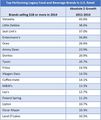
Power brands are not just cash cows. They are brands whose position in food culture and shrewd management have, together, allowed otherwise dated brands to remain contemporary and to continue to drive profit growth. Most leaders in the industry define power brands purely on the basis of scale, usually in excess of $1B in annual sales. We want to introduce to you a more future-leaning definition, one based on selecting for a proven track record of above-average market growth.
Specifically, we define power brands to mean brands that:
had greater than $1B in sales in the past year
had conventional channel distribution prior to 1980 (i.e., legacy brands)
have grown faster than inflation for the past ten years (i.e., > 21%)
AND have outperformed their respective sector growth rates during the past four years by at least one percent (i.e., 7.2% for packaged food, 6.4% for soft and hot beverages.
The reality is that, of roughly 213 legacy brands studied, only 8% can meet our strict power brand criteria. They are:
(Source: Euromonitor 2015, Hartman Analysis)
What is on the list:
Mostly snack brands, including a rising star in meat snacks
Brands sold on the fresh perimeter
Healthy alternative beverages
One tag-along brand (Coffee-mate) riding structural growth in a carrier category
Highly focused brands that operate in only 1.9 operating categories on average, the majority selling in the same operating category in which they began
What is not on the list:
Processed center-store convenience meal brands. As Americans liberate themselves from traditional notions of the meal and as snacking overtakes our eating day, many are finding that the most convenient thing to do is simply to snackify the meal. In this cultural environment, the better value proposition of fast casual restaurants is more appealing to today’s consumers’ appetites.
Very few beverage brands. The only two that meet our criteria are those that have a noticeable orientation to contemporary notions of health and wellness due to their categories.
Mega-brands that extended into multiple, culturally unrelated categories.
Standing back from this list, we see that long-term structural changes in:
1) how Americans eat
2) where they shop in the store (fresh perimeter $ growth)
3) dietary practices to achieve health and wellness goals, not just good marketing, are driving the results
Companies that are weighted toward products not on the list need to look beyond mere renovation strategies for their base brands. Serious consideration should be given to the overall structure of their portfolios to compensate for the long-term decline or neutralization of some of their legacy brands as growth drivers. Focusing too much investment on marketing mix, turnaround solutions alone puts them at risk of underperformance.
Yet the lessons for marketers and brand stewards are equally loud and clear. Legacy brands that have become so iconic as to weather the growing trends against processed food and beverage are ones that:
1) are highly focused on one product form, one food
2) have built an iconic brand reputation around that specific food form. Focus is not sufficient to guarantee long-term growth in a legacy brand, but it appears to be a requirement of true power brands in today’s market.
To read the full analysis, download a free copy of The Hartman Group’s "U.S. Packaged Foods at a Crossroads."
As CEO, Laurie Demeritt provides strategic and operational leadership for The Hartman Group’s analytics, consulting and research teams. She is a frequent keynote speaker at major industry conferences and client events. She is renowned for her adept ability to breakdown the complexities of culture and consumer behavior and translate them into meaningful solutions for clients. For more information about The Hartman Group, visit http://www.hartman-group.com/or contact Blaine Becker, senior director of marketing at: blaine@hartman-group.com
_________________________________________________
If you enjoyed this article, join SmartBrief’s email list for more stories about the food and beverage industry. We offer 14 newsletters covering the industry from restaurants to food manufacturing.
Related Posts:
The cultural transformation of the American breakfast
Reflections on food culture: The forces that shape consumer behavior
Greek food companies explore increasing exports amid economic crisis
Simple ingredients and sweet stories flavor the Fancy Food Show
What’s new on the cheese plates in restaurants?
Understanding the power brand phenomenon originally published by SmartBlogs
Julie Winkle Giulioni
.
Blog
.
<span class='date ' tip=''><i class='icon-time'></i> Aug 17, 2015 01:03pm</span>
|
|
Everything is awesome for Lego. With over 189 million engagements, including 184 million on its YouTube channel alone, Lego was the brand with which consumers were the most highly engaged throughout the second quarter of 2015, according to the ListenFirst Digital Engagement Ratings (DER).
For this analysis, we studied the owned, earned, or organic consumer behavior across Facebook, Google+, etc for the Redbooks 500 — a cohort of companies based on a weighting of variables, including brands’ revenue, advertising spend, and social media engagement.
This quarter, Lego’s social channels were very content-heavy, with Lego sharing more than 700 new pieces of content, with a special focus on YouTube content. The content that accumulated the most views and engagements on Lego’s official YouTube channel were a series of promotional videos for "Jurassic World" with the video "A Day in the Life at Jurassic World" standing as the top post across all channels for the quarter when it accumulated over 3.2 million interactions.
"Lego was able to find success in the second quarter by effectively leveraging their relationships with different film and television franchises, such as ‘Jurassic World’ and ‘Star Wars,’ as a way to make sure their product stays relevant with their target consumer and draft off the value of these pop culture icons," said Jason Klein, Co-CEO and co-founder of ListenFirst Media.
MTV, Hasbro, the NFL, and Coca-Cola rounded out rest of the top five brands for the second quarter. See graph below for the top 20 DER brands for the quarter:
Though brands in the Toys/Gaming industry were dominant in the top 10 (Lego, Hasbro, Nintendo), the Food and Beverage industry had the largest share of engagement overall among all sectors. See below for the top 5 industries:
The below breaks down the best performing content by platform:
YouTube — Not only was Gillette’s video promoting their Gillette Body razor the highest performing post on YouTube but it was also the highest performing post across all channels of Q2. However, even with strong support from video views, the brand did not make it into the top 20 DER brands this quarter.
Instagram — The top post in Instagram from the entire quarter came from Victoria’s Secret, and featured a model dressed in new loungewear as a way to announce the new variety of product.
Twitter — Denny’s tweet including a play on words of the current radio hit "Flick of the Wrist" came out as the most engaging tweet of the quarter. Denny’s, whose Twitter account often is full of pop culture puns, added their own little spin to the popular lyric "look at the flick of the wrist" by changing it to "look at the flick of the grits."
Facebook — Kleenex topped the Facebook leaderboard with a video featuring a man and his canine companion from their Messages of Care campaign, even though it was posted only a week before the quarter ended (June 24)
Wikipedia — Facebook as a brand had the highest Wikipedia search volume. Facebook search volume on Wikipedia peaked on June 18 when news circulated that regulators in Europe banned its new facial recognition app due to privacy concerns
One of the biggest movers in DER of the second quarter was Payless ShoeSource, as DER increased by 10,000% from Q1. The majority of Payless engagements came from YouTube, as the store utilized the channel over the quarter as a way to push sales and promotions. This promotional video for their sandal sale in early June garnered over 4.5 million engagements for the channel.
Jonathan Farb is the chief product officer at ListenFirst Media, a data and analytics company that helps brands make sense of the vast amount of data at their fingertips, predict outcomes, and optimize performance.
Related Posts:
10 predictions for marketers, the TV industry and the state of social in 2015
7 digital-marketing predictions for the rest of 2014
Instagram’s feat is a call to action for marketers
Is real-time marketing relevant in an on-demand world?
Smarsh CEO shares insights on social media compliance for advisers, broker-dealers
ListenFirst: Lego was most highly engaged brand in Q2, fueled by YouTube originally published by SmartBlogs
Julie Winkle Giulioni
.
Blog
.
<span class='date ' tip=''><i class='icon-time'></i> Aug 17, 2015 01:03pm</span>
|
|
This post is sponsored by Burris Logistics.
A recent survey by Boston Consulting Group and Grocery Manufacturers Association revealed that supply chain executives are facing rising costs and declining service levels in their transportation and logistics operations.
Freight costs increased by as much as 11% during the past year, the report found, while case-fill rates and on-time deliveries declined, with respondents reporting service levels falling 1% to 5%.
However, there is also evidence that companies that find the right supply chain partners to work with are seeing improvements in their metrics.
According to the 2015 19th Annual Third Party Logistics Study, shippers reported an average logistics cost reduction of 9%, an average inventory cost reduction of 5% and an average fixed logistics cost reduction of 15% when working with a 3PL partner. Shippers in the study also reported improvements in order fill rates and order accuracy when they partner with 3PL providers.
Those findings should be especially encouraging for retailers seeking to meet increasing consumer demand for a diverse, high-quality perishables offering, which requires a strong, dependable supply chain.
"The fresh supply chain is complex, given the unique requirements to ensure quality, safety and proper inventory controls to mitigate shrink," said Pat Walsh, vice president, supply chain, and chief business development officer, Food Marketing Institute. "Today’s consumer demands freshness, product availability and variety. An effective fresh supply chain meets all those needs and requires intense focus on forecasting and replenishment."
Michael Bargmann, a supply chain consultant and a former logistics executive at Wegmans Food Markets, said a productive collaboration between a retailer and a logistics provider can yield more than the sum of its parts, a result he calls "proactive innovation."
"If you get two great partners working together, they are going to have proactive, innovative ideas that each partner didn’t have on their own," he said. "The process should not be reactive, but focused on looking at the business, and saying, ‘What can we do together? What initiatives would create a win/win outcome?’"
For those shippers seeking to collaborate with a third-party logistics provider, trust is the perhaps the most important factor to consider, said Walsh of FMI.
"The best collaborative relationships begin with trust and transparency," he said. "Ongoing systemic communications are critical to ensure agreed-to goals and expectations are realized for both parties."
Reliability in terms of customer service is key, he said.
"Top perishables logistics providers have an intense focus on managing product availability and freshness, forecasting and on-time delivery. Logistics providers must be an extension of the companies they serve," he said. "In other words the retailer and 3PL work in harmony with common goals and common measures."
Bargmann, the former Wegmans executive, agreed that trust and a shared passion for superior customer service are the keys to success in collaborative logistics relationships. From a practical standpoint, it’s also important for the 3PL provider to have a knowledgeable, experienced and efficient workforce, along with best-of-breed information technology tools.
Working with a 3PL provider allows retailers to focus their time and resources on better serving their customers and building their brand.
"Today retailers are continuously being challenged with a growing number of competitors in multiple channels of trade, managing a heightened food safety focus and navigating an expanding complexity of government regulations," said Bargmann. "This is creating the need to seek out experienced logistics partners that offer a collaboratively transparent partnership that is flexible and agile in delivering."
"The right product at the right price, and at the right time."
Learn more about Burris Logistics.
__________________________________________________
If you enjoyed this article, join SmartBrief’s email list for more stories about the food and beverage industry. We offer 14 newsletters covering the industry from restaurants to food manufacturing.
Related Posts:
Q&A: FMI CEO Leslie Sarasin on the key takeaways from FMI Connect 2015
Food retailers find allies in social media followers
How to engage millennials through customization and curation
Infographics: The Food Waste Reduction Alliance releases analysis of food waste by industry
Prime real estate: The produce department expands beyond fruits and veggies
Collaboration keys supply chain efficiencies originally published by SmartBlogs
Julie Winkle Giulioni
.
Blog
.
<span class='date ' tip=''><i class='icon-time'></i> Aug 17, 2015 01:03pm</span>
|
|
The Young Entrepreneur Council is an invite-only organization comprised of the world’s most promising young entrepreneurs. YEC recently launched StartupCollective, a free virtual mentorship program that helps millions of entrepreneurs start and grow businesses. Read previous SmartBlogs posts by YEC.
If you enjoy this article, join SmartBrief’s e-mail list for our newsletters on small business and entrepreneurialism.
What is one question you ask every employee who has announced they’re leaving your company?
1. What can we do better?
There’s so many reasons for employees to move on: new relationships, new opportunities, difficulties with the job. One thing that I always want to know is what we can improve as a company. Once that employee has announced they are moving, they feel more comfortable being honest so they can really give us feedback. I ask for the good, the bad and the ugly — and then try to make improvements. — Marcela DeVivo, National Debt Relief
2. Why?
Firstly, I want to find out if it is something I can control. If it is something I cannot control, then I know there is nothing wrong with our company or culture; it is just what they wanted to do. For example, we have had two employees in the last month go on two different reality TV shows. In this instance, I knew this decision did not come from them having a negative experience with our company. — Jayna Cooke, EVENTup
3. Would you be willing to continue the relationship?
It’s a small world, and just because someone is leaving your employment now doesn’t mean you won’t have the opportunity to work with them again, either as an employee or in another capacity. I encourage all former employees to keep in touch so that they continue to be a beneficial part of our network. — Alexandra Levit, Inspiration at Work
4. Would you recommend a job here to others?
Their reaction and response to this question, with some careful reading between the lines, tends to get us much closer to an honest assessment for the reasons motivating an exit. Those genuinely seeking a career change or unique opportunity tend to be very positive. For those who may otherwise conceal deeper frustrations motivating an exit, it opens up the conversation by depersonalizing it a bit. — Jacob Goldman, 10up Inc.
5. Did you have what you needed?
When employees leave, I want to know if they felt they were given the appropriate tools and resources to do their jobs, and how often they felt that way. I want to eliminate any gaps between what I’m asking my team to do and how I’m helping them do it. — Simon Casuto, eLearning Mind
6. What are your next plans?
This allows the employee to give you information about why they are leaving without directly asking why they are leaving. It also gives them the option not to tell you if they aren’t comfortable. It’s a more personal approach then just thinking about the company and filling that position. — Phil Laboon, Eyeflow Internet Marketing
7. Have you shared your concerns prior to deciding to leave?
Thankfully, my company has experienced very little turnover throughout the years. However, when someone decides to leave, it is very important to find out if, at any point, they shared their concerns. Then, were these concerns addressed? I believe if your company promotes open communication, most concerns can be addressed prior to an employee making the decision to leave. — Matt Telmanik, CCS Construction Staffing
8. How can I help you?
I like to ask them how I can help them, because it’s a small world, and it’s amazing how many people you cross paths with over and over again. Awesome people will keep becoming more awesome with time. They could leave for a variety of reasons, and sometimes we just weren’t the right fit. — Kevin Henrikson, Acompli (now Outlook iOS/Android @ Microsoft)
9. What did you like and not like about working here?
I ask for feedback (both positive and negative) about their overall experience working for my company. I have learned not to take it personally when someone leaves, as the modern economy is all about rapid change. But I do want to know if there were aspects of working for me that the employee didn’t like. I also want to know what they did like. This is a good opportunity to get honest feedback. — Shawn Porat, Fortune Cookie Advertising
Related Posts:
How do you efficiently onboard new employees?
What unique perk does your company offer?
When do you let an underperforming employee go?
What resources can help entrepreneurs be better managers?
Common mistakes leaders make during periods of fast growth
What do you ask every employee before they leave your company? originally published by SmartBlogs
Julie Winkle Giulioni
.
Blog
.
<span class='date ' tip=''><i class='icon-time'></i> Aug 17, 2015 01:03pm</span>
|
|
This month, SmartBlog on Education is exploring classroom design and management — just in time for the new school year. In this blog post, educational leadership professor Maria Boeke Mongillo offers five ideas for "constructing a space that supports possibilities rather than perfection."
Film director James Cameron once said that young filmmakers should adopt the motto "Failure is an option. Fear is not." His point was that in order for new artistry to emerge in his field, filmmakers have to take risks and explore the potential of their medium without worrying about whether the product is successful or marketable.
This struck me as a good motto for classrooms as well. To provide an optimal learning environment for students, teachers must create an intellectually safe space, where risk-taking is celebrated as much as getting the right answer. This type of learning space needs to be deliberately set up at the beginning of the school year and reinforced throughout the year, just as much as classroom layout and other rules and routines. So in getting ready to go back to school, here are some ideas to consider for constructing a space that supports possibilities rather than perfection.
Celebrate process and progress over product. Students in general want to please their teachers and are looking for and will respond to feedback from their teachers. Feedback, particularly during the process, is what drives learning. Students need to know where and how their strategies are effective, and where they are not, not just be given a grade that says whether they were successful or not in the end. Provide opportunities for students to share their solutions to problems, or to allow struggling students to share their work in progress and permit the class to help figure out where the mistakes and misconceptions lie. Be sure students know that constant progress is the goal, and that you will allow, and even expect, revisions.
Remember students need challenge to change. Students cannot learn to overcome a struggle or failure if they are not being challenged appropriately. They also cannot learn to persevere if given assignments that have only one clear right answer. Take time at the beginning of the year to assess your students’ ability levels. You can look into the previous year’s scores or grades, but students may change over the summer. Also, think about ways to offer students open-ended problems to solve, particularly those that have multiple steps and require time and modification to come to resolution.
Teach who you are. Parker Palmer, in his book "Courage to Teach," states that we teach who we are. While we do have professional and personal lives and personas, they cannot be distinctly different from one another, especially if we are going to be successful and satisfied in our work. Relationships are at the heart of effective learning environments, particularly the teacher-student relationship. So participate in any getting-to-know-you or team building activities that you ask your students to do. Pay attention to their discussions about interests and experiences, and find ways to relate your own hobbies, sports and musical interests to theirs. Use stories from your own experiences to illustrate points or make connections to learning. By opening up, you show your students you trust them and you care. They will trust and care about you and your classroom space in return.
Model and mediate student interactions. Though we would like students to come to our classrooms knowing how to interact in socially appropriate ways, the reality is many do not. Children today spend more time interacting with screens than they do playing and socializing with each other. As a result, teachers need to clearly discuss how working in groups looks and sounds. Students need to see models and role play before they can get to the work of learning. They may also need specific strategies for conflict resolution. Students will feel safer and take risks if they know ridicule from others will not be allowed.
Include and engage. Teachers often include students in classroom rule writing, but how else could students be engaged in designing the learning environment? Consider letting students discuss and decide the classroom procedures for entering and leaving the classroom, turning in work, doing classroom jobs and other routines. Perhaps let students help in determining classroom layout and seating arrangements. Students feel safe in a place where they have ownership and a deep understanding of not only what to do and how to do it, but also the rationale for why they are doing it.
Thomas Edison said, "I have not failed. I’ve just found 10,000 ways that won’t work." Our goal should be to teach our students to view failure in a positive light and as a catalyst for future learning, through our conscious effort to offer opportunities and safe spaces to make mistakes and persevere. This will set our students up for future success both in school and in the world beyond.
Maria Boeke Mongillo is an assistant professor of educational leadership at Central Connecticut State University. She has taught in school-leader and teacher-preparation programs at multiple universities, and facilitates professional development in elementary schools. She began her career as a first- and second-grade teacher, and is passionate about supporting early childhood teachers and leaders through research and advocacy.
If you enjoyed this article, join SmartBrief’s email list for more stories about education. We offer newsletters covering educational leadership, special education and more.
Related Posts:
No Related Posts
"Failure is an option. Fear is not": Creating a safe intellectual space for learning originally published by SmartBlogs
Julie Winkle Giulioni
.
Blog
.
<span class='date ' tip=''><i class='icon-time'></i> Aug 17, 2015 01:03pm</span>
|
|
One of the most common challenges I see my clients coming up against in social media marketing is a lack of time and focus. Hootsuite can make the management of Twitter more efficient and more effective; here, I’ll explain how you can get more out of it through the use of streams and custom searches. Everything I’ll describe is in the free version of Hootsuite.
Set up streams for easier, more efficient Twitter monitoring
Hootsuite’s streams are your secret weapon for more effective Twitter monitoring. By setting up streams within your Hootsuite dashboard, you can filter through the mass of information on Twitter and get to what you need, quickly.
There are a selection of streams that should be standard, these being the home stream (pulls the Twitter home feed), mentions stream (every time someone mentions your Twitter handle), messages inbox stream (to show DMs) and the retweets stream (shows your tweets retweeted).
There are a number of custom streams I also recommend setting up to supercharge your Twitter monitoring. These streams will enable you to monitor what people are saying about your brand when not using your Twitter handle, to spot potential customers and engage in relevant conversations, and to use Twitter as a PR tool too.
Custom brand search stream. The first custom stream I recommend you set up is to show you every time someone mentions your brand name, without using your Twitter handle. So people might talk about Impression, but without writing @impressiontalk.
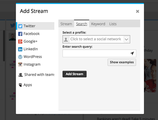
To set this up, select "add stream" and choose "search" in the tabs at the top:
Here, select the profile you want to set up the stream for, and enter your search query into the box.
Your search query can (and should) include search modifiers, which you may be familiar with from advanced searches on Google. These modifiers allow you to specify things such as when the search should display results which must include multiple phrases, or which could include a number of different phrases. For example, I’ve set up a custom brand search stream to show me instances of people mentioning Impression, and I’ve asked the stream to show me variations on our brand name. Here’s what I’ve entered into the search query box:
"Impression" OR "Impression Digital" OR "Impression Digital Limited" OR "Impression Digital Ltd" OR "Impression Agency" OR "Aaron Dicks"
You’ll notice here that I’ve included "Impression Agency," which was our URL when the agency first launched, and also the name of our MD Aaron. You too can set up a custom search for people mentioning your brand name and its variations, as well as key names within your team.
This stream lets me see what people are saying about us and about Aaron, all in one easy to access place. Now I can respond, retweet and follow those users straight from my Hootsuite dashboard.
Custom product or service search stream. You can use the same method to set up a stream which searches for people mentioning your products or services. This will enable you to identify people who are seeking to buy your product or service, sharing opinions about it, looking for advice on it and so on. Your job is then to respond to them in the most appropriate way, be it to answer their question or contact them with a view to quoting for their custom.
I work for a digital marketing agency, so I’ve set up a custom search which looks like this: "Digital marketing" OR "SEO" OR "PPC" OR "online marketing" OR "ecommerce" OR "content marketing" OR "digital PR"
You can see that I’ve included a number of our services in this search, but I could easily set up a different search for each service if I preferred.
Often, these searches will bring up a lot of results. If you’d like to refine it further, you might add a location caveat into the search - particularly useful if you only provide your services in a certain area. For example: "Plumber" OR "plumbing service" OR "plumbers" AND "Nottingham" OR "Notts"
In this example, I’ve used the modifier AND to specify that the results must include the terms "plumber," "plumbing service" or "plumbers" as well as either "Nottingham" or "Notts."
One example of this done really well was a coffee shop that set up a search for "coffee" and their local area. In one particularly successful PR stunt, they were able to identify a woman who had tweeted about her nightmare day and need for a good coffee, and respond to her offering her a reserved seat and a free coffee to help her relax. The story of their generosity generated far more in PR value than the free coffee cost them, and they exemplified great ‘social listening’ at the same time.
And that’s what these streams are all about — social listening. It’s about being really tuned in to what your target audience and customers are saying, so you can appeal to them in the most appropriate and valuable ways. It’s about generating new custom and revenue by working more efficiently on Twitter.
Hootsuite as a PR tool
Hootsuite isn’t only great for social listening. You can also use it as a PR tool, thanks to the array of hashtags used by PR professionals and the availability of their Twitter handles.
Finding new PR opportunities with a hashtag search. There are likely to be various hashtags used by journalists in your industry as they seek to identify commenters and contributors via this real-time, constantly updates platform. Have a look around and see if you can find any hashtags specific to you.
There are also more general hashtags used by journalists across all industries. Two common hashtags are:
#journorequest
#prrequest
If you conducted a search for these hashtags now, you’ll see lots of tweets coming through all through the day from journalists and PR professionals seeking stories and contributions.
Using the technique described above, you can set up a custom search stream to search for: #journorequest OR #prrequest
This will now deliver a stream of journalist requests straight to your dashboard. You can also modify this further to refine the stream some more. I have a client who rents out holiday cottages in the New Forest, so I have set up a hashtag search for them which looks like this:
#journorequest OR #prrequest AND "new forest" OR "holiday cottage" OR "holiday cottages" OR "travel"
This will deliver me opportunities to contribute to relevant journalist requests.
Follow local and industry specific journalists. You can also set up a stream where you search for journalists’ Twitter handles, if you know them. You’ll find that journalists are quite willing to share their Twitter details these days, so have a look on most newspaper sites where the journalists’ Twitter profiles are shown, or in Twitter lists.
You can then set up a stream to show you the tweets from those journalists, by setting up a search for their handles. This gives you the opportunity to see what they’re talking about, which can help you gauge the stories they’ll be interested in from you. You can also see when they request contributors or stories, and even tweet them directly if you have a story you think they’ll be interested in.
Scheduling
As well as streams, another huge benefit to using Hootsuite is the ability to schedule tweets to run throughout the day/week, so you don’t have to be there every time you want to tweet.
Hootsuite’s simple scheduling tool allows you to schedule a tweet for a specific day and time, or to use their "auto schedule" feature which learns over time when your audience is active and thus when the best times to tweet are. The scheduling tool is within the tweet area and looks like this:
Of course, scheduling should be done with caution.
The key to Twitter success lies in conversation, whereby you listen to what your audience are saying and respond accordingly. The danger with scheduling is that you become a broadcaster rather than a conversationalist, simply putting out messages about yourself without ever engaging with the people who follow you. For this reason, be sure to check in to Twitter a couple of times a day to respond to people when they contact you or mention something relevant to you. Your new streams will make this much easier.
In its most extreme, scheduling can even be detrimental to your brand. I had a client once who scheduled a tweet to say what a lovely day it was and encourage people to visit her tourist attraction; when it turned out to be a very rainy and wet day, the tweet was much less effective and inaccurate. That wasn’t the end of the world for the brand - in fact, my client realised her mistake and cancelled the tweet before it ever went out. But Google the phrase "tesco hit the hay" and you’ll see an example of a PR nightmare that came from a mis-timed scheduled tweet…
So there we have it; there are various ways to use Hootsuite to make Twitter management more efficient and more effective, the majority of which are available absolutely free. Give it a try, and if you’d like to ask me any questions or share your experiences, you can do so in the comments below or tweet me @lauralhampton or @impressiontalk.
Laura Hampton is the marketing manager at digital marketing agency Impression.
Related Posts:
Are third-party social media clients worth paying for?
With a little help from technology, you can harness the power of social media for customer service
How to choose the Twitter client that's right for you
ListenFirst: Lego was most highly engaged brand in Q2, fueled by YouTube
5 ways to use social media in lead generation
How to get the most out of Hootsuite originally published by SmartBlogs
Julie Winkle Giulioni
.
Blog
.
<span class='date ' tip=''><i class='icon-time'></i> Aug 17, 2015 01:03pm</span>
|
|
Eddie Young
This post is sponsored by AFS Technologies.
As senior vice president of sales at Sunny Delight Beverages, Eddie Young understands that to be effective with the management of trade spending, you need to implement scenario planning to create an annual calendar of trade promotions.
Young, who joined the Cincinnati-based beverage maker after it was spun off from Procter & Gamble in 2004, has learned the critical role that scenario planning plays in all aspects of a company’s operations, and its value in strengthening relationships with retail customers.
Young began his career in beverage sales at Nestlé, but it wasn’t until after he joined Minute Maid and began working as a regional sales manager in 2001 that he began to use scenario planning to refine the effectiveness of his company’s trade spending at the customer level.
"You had to be able to build an annual plan, understand what kind of funding that would lead to, and how you could deploy it for a maximum return for each customer," he said. "It had a big impact. If you start with a good plan, you have a much higher probability of success."
Scenario planning remains critical to the annual trade promotion planning process for Young at Sunny Delight, where he oversees the warehouse brands division, encompassing the Sunny D and Fruit2O brands.
Describe the situations in which scenario planning works well, and those in which it does not.
It works well — no surprise — when you have a customer that is interested in partnering, understands the value of the planning process and is committed to it. With good planning, you can make your promotions more efficient and you can take costs out of the system, ultimately giving the consumer a better value.
On the customer side, there has to be a commitment to running the plan, evaluating it and adjusting as necessary. You must continue to execute, not a month at a time, or six months at a time, but as a continual process.
We are all trying to satisfy the end-consumer with the right promotions and the right product and the right price. We are dependent on our retail customers, and those customers are dependent upon us to help them maximize what they are doing.
Are you analyzing price and/or promotion performance to make better decisions?
Absolutely. I don’t know how you can run your business without it. Our regional sales managers collaborate with their customers to conduct post-promotion analysis, and report the results back to our customers. It’s a "living plan" — so we can make adjustments as we do this analysis. We may decide we are running at the wrong price point, for example, or we are not displaying properly.
At the national level, we are always looking at our investments to make sure we are making the right promotions to meet the consumers’ needs. Sometimes you have the right intentions, but they don’t achieve the objectives, and you have to pull those back and examine other options that might drive sales. We are looking at price and promotion performance at multiple levels.
Are you overlaying shipping data/financial data with consumption data to do your scenario planning?
We build customer-level P&Ls. If you are just focusing on the trade budget, you are missing a whole lot of other pieces. For example, if you have a promotion that seems to do well from a sales lift standpoint, but it costs you three times as much because you had to run overtime in your plant, or you had to ship from multiple locations to meet the demand, you might find you didn’t do as well in the promotion as you thought.
You may still choose to do that, but at least you know the cost rather than having hidden costs in your value chain, where you think the promotion is doing really well, but you are not looking at the impact the promotion has on your company. If you have residual inventory, or leftover remnant materials, for example, those things have an impact on the effectiveness of your promotion.
We don’t do it on every single promotion, but with all of our big promotions with our largest customers, we do our best to evaluate what the actual impact was across the whole environment.
Where have you experienced the biggest benefits in using scenario planning?
The biggest benefits are trade efficiencies, and hopefully that ultimately leads to profitability. It’s as simple as a better understanding of what your business is doing. We might make decisions to invest or to run a promotion that doesn’t necessarily fit within our parameters, but because we understand the scenario on the front end, we know what to expect going into it. We don’t want to be surprised on the back end. It’s the difference between making a strategic decision and being surprised because you did not do your due diligence on the front end.
As a midsized company, we have little margin for error in terms of things such as production and procurement. Those have big impacts on our P&L. If we have bad forecasting, or bad planning, and we expect a promotion to come in light, and it comes in heavy, that could result in running plants on overtime, or doing last-minute procurement of raw materials, for example. That would become very inefficient for us, and it would hinder our ability to service our customers, and ultimately, the end-consumers.
In our annual planning process, we review each customer to see what worked, what didn’t work, what we need to accelerate, and what we need to cut back. We look at which customers are efficient and effective in how they run promotions with us, and that information is broadly communicated. We hold ourselves accountable for the forecasts. With a company our size, we just can’t afford big misses across our promotional calendar.
We’ll even share the results of our biggest promotions with our senior leadership team, including the CEO and CFO.
How has scenario planning helped you collaborate more effectively with retailers?
I personally have a lot of passion around this. I started my journey in scenario planning with Minute Maid, and they were very strong in this area.
When we become better at following through on our customers’ expectations, we become a better partner for them, and that gives us more credibility. Our customers have numbers to hit, they have customers they need to satisfy, and if we can predict how promotions will perform, and make them more effective, our retail customers are much more likely to cooperate and partner with us. They are looking for insights from us that can help them better serve their customers. Anything we can do that puts just the right amount of inventory on the floor, at the right time and at the right price, makes them better at what they do.
We rely on them to help us as well. We are running one branded set of promotions, and they are running thousands of them. So we rely on their expertise and their understanding of their shoppers, so we can be better at what we do.
It’s a cliché, but ultimately it comes down to collaboration. It’s a partnership, and when it is done correctly, it works really, really well.
In the consumer goods industry, manufacturers and their retail customers are working together on trade promotion planning to produce a win-win relationship and happy consumers. AFS Trade Promotion Management Retail (TPM Retail) is a powerful tool to aid in this collaboration. Based on deep consumer goods experience, TPM Retail supports the annual promotional planning process and a strategic approach to trade spend management, including the ability to plan, execute, settle and analyze retail programs.
Learn about AFS TPM Retail, visit: www.afsi.com/TPMRetail
Related Posts:
No Related Posts
Scenario Planning Provides Insight for CPG Industry originally published by SmartBlogs
Julie Winkle Giulioni
.
Blog
.
<span class='date ' tip=''><i class='icon-time'></i> Aug 17, 2015 01:03pm</span>
|
|
Storytelling — once the stuff of childhood nighttime rituals — has grown up and is quickly becoming a go-to tool in the very adult world of business. MBA programs, workshops, and coaches all offer strategies and support to help today’s leaders craft a better story.
And it makes sense. According to Pamela B Rutledge, Ph.D., in her post on Psychology Today, "The Psychological Power of Storytelling," "Stories are how we think. They are how we make meaning of life. … Stories are how we explain how things work, how we make decisions, how we justify our decisions, how we persuade others, how we understand our place in the world, create our identities, and define and teach social values."
The advantages of the story
Those who understand this dynamic can elevate the quality of their leadership — and their results — by leveraging the natural human propensity to make sense of the world around us through stories. These leaders create a narrative that contributes to greater connection, engagement and shared meaning.
Stories distinguish themselves from other communication vehicles in a variety of ways that contribute to their power in the workplace.
A well-told story appeals to a wider variety of learning, listening, and information-processing styles. You have a better chance of getting your point across to more people when it’s framed in terms of a story.
Stories have a way of tapping emotions and creating a visceral impact (that even the most well-crafted PowerPoint slides leave on the table).
They’re more memorable than other communication vehicles. According to Susan Weinschenk, Ph.D., in her Psychology Today post "Your Brain on Stories," "you are literally using more of your brain when you are listening to a story. And because you are having a richer brain event, you enjoy the experience more, you understand the information more deeply, and retain it longer."
They tend to be delivered through "human" means versus e-mail, texting, etc. This alone helps to cut through the noise of the thousands of disembodied messages we’re bombarded with daily.
Stories are efficient as they predigest and pack a potentially overwhelming volume of information for grateful inhabitants of a time-starved world.
When told live, stories create not just a shared experience but a shared space for dialogue as well — something craved by workers who are increasingly feeling disconnected in today’s virtual world.
Stories have the power to inform, instruct and inspire when crafted intentionally and delivered skillfully. And they’re remarkably flexible in terms of the context and content they can support. For example, stories can be used to:
Provide important information about who a leader really is, offering a window to his/her values, motives, and passions;
Frame the past and generate a shared foundational understanding upon which to build;
Position threats and opportunities, bringing the need for change into sharp focus;
Personalize strategy and breathe life into it (as opposed to issuing another missive or creating another poster for the lunchroom);
Preview the future, creating an appetizing vision that motivates and inspires; and
Package lessons and insights in a quick and memorable fashion.
Plotting out your stories
Leadership stories that accomplish all of this don’t occur spontaneously. While they may appear to be off the cuff, there’s nothing impromptu or unscripted about them. They are intentional, thought through in great detail and frequently rehearsed to ensure they hit the mark.
The most effective stories tend to share a few common characteristics. They are authentic and personal to the leader. They use appropriate humor. They tend to have a narrow or specific focus, which helps with one more characteristic: brevity. Unlike Grandpa’s long, winding stories on the porch, some of the best leadership stories are relatively short.
Additionally, the best and most memorable ones feel honest and candid. They reveal vulnerability and even mistakes. As a result, they evoke emotion. In fact, research suggests that people learn more from stories of struggles overcome than stories of perfection. When leaders let their defenses down and share errors, missteps and mess-ups, they not only gain greater credibility; they also teach more.
And, because they are at their very core classical literary devices, stories also contribute to a more effective outcome:
The classic three-part structure of set-up, confrontation and resolution lends itself to a variety of story types.
Metaphors and analogies offer descriptive imagery, framing concepts in more understandable and/memorable terms.
Sharing dialogue and repeating what was spoken between or among individuals creates an immersive experience that engages and triggers a different type of understanding.
Surprises and unexpected twists keep the listener on the edge of his or her seat.
Intentional repetition of key words or phrases can also drive home the important points being made, make the message more memorable, and sometimes yield those signature leadership expressions that go viral in an organization.
"Stories are the single most powerful tool in a leader’s toolkit." ~ Howard Gardner
With all of the tools available to leaders today, many are returning to a low-tech, old-fashioned, tried-and-true strategy that likely traces back to some of their earliest childhood memories. Want to lead? Start with a story.
So, tell us your story. What do you do that makes storytelling effective?
Julie Winkle Giulioni is the author of "Help Them Grow or Watch Them Go: Career Conversations Employees Want," with Bev Kaye. Giulioni has spent the past 25 years improving performance through learning. She consults with organizations to develop and deploy innovative instructional designs and training worldwide. You can learn more about her consulting, speaking and blog at JulieWinkleGiulioni.com.
If you enjoyed this article, join SmartBrief’s e-mail list for our daily e-mail on being a better leader and communicator.
Related Posts:
Subtle sabotage: The invisible impediment to change
How to increase your team’s productivity in minutes each month
12 principles of inspiring leadership
Finding the "motive" in motivation
4 actions that can make you a wellspring of confidence
What’s your story? Leadership and storytelling originally published by SmartBlogs
Julie Winkle Giulioni
.
Blog
.
<span class='date ' tip=''><i class='icon-time'></i> Aug 17, 2015 01:03pm</span>
|
|
Recently we asked if the term "learning management system" was due for a makeover. We think it is. And we’re teaming with the Software & Information Industry Association (SIIA) and C. Blohm & Associates for a session to discuss that idea at the 2016 SXSWedu conference called "LMS: Extreme Makeover."
We would love to hear your thoughts on redefining LMS, but first we need your help. Vote for our session between now and Sept. 4 to help guarantee that it will be added to the official SXSWedu program. Every vote counts and we would appreciate yours!
LMS evokes strong feelings among educators, administrators and even the companies that create them. Some view it as a useful tool for teaching and learning and others view it as a necessary evil. Whether you’re for or against LMS, it plays a significant role in today’s schools. Over the years the terminology has morphed and changed — remember "computer-assisted instruction"? — and it continues to do so. But if not LMS, what should we call it? To determine that, we must first discuss LMS challenges, including how curriculum and technology leaders can work together to achieve the same goals. Our session at SXSWedu will seek to build consensus around oft-ambiguous terminology and the advantages and challenges of these evolving digital learning platforms.
Share your thoughts in the comments section below or on Twitter with the hashtag #LMSMakeover. And please take a minute to give our session a thumbs up for SXSWedu 2016.
Jared Stearns is the marketing manager for SmartBrief Education. He can reached at jstearns@smartbrief.com.
Related Posts:
#SXSWEdu: You go (far), girl! Inspiring girls in STEM
Entrepreneurship in higher education: Lessons from abroad
#SXSWedu Summit: What higher education does right, what it needs to do better
Is the purpose of college to get an education or a job?
Educational technology for a better classroom experience
Vote for our session at SXSWedu 2016: "LMS: Extreme Makeover" originally published by SmartBlogs
Julie Winkle Giulioni
.
Blog
.
<span class='date ' tip=''><i class='icon-time'></i> Aug 17, 2015 01:03pm</span>
|
|
As a leader, it’s your job to ensure you’re always pushing your employees to form positive workplace habits. But like any ingrained routine, it takes more than motivation for it to truly sink in. Even the most promising change can fizz out if it’s not repeated on a daily basis.
According to international business speaker and author Michael Kerr, successful people tend to thrive on routine and consistent habits. Of course, you can’t force your employees to adopt a habit, but by finding the right work pattern and reinforcing it daily, you’ll build a culture that’s driven by consistency. And as a result, you’ll foster a more productive workplace.
Habit formation is a team effort
In his book "The Power of Habit," Charles Duhigg attributes the formation of a habit with a psychological pattern called the "habit loop." This routine consists of three key steps: the trigger, the routine, and the reward.
According to Duhigg, once a habit is formed, the brain starts working less and less while engaged in that task, and eventually, it can virtually shut down. As a result, mental capacity is cleared up for tackling other duties or forming other habits.
Still, knowing the science behind habit formation and putting those ideas into practice are two distinct concepts. Here’s how you can help your team form lasting, positive habits:
1. Motivate. Gumption is what separates the desire to change from the will to change. As the leader, your teammates must share the same goals as you. You have to motivate them to care about the new habit you’re promoting.
Consider having an entire meeting based solely around the new habit you want your employees to perfect to stress how important this process is. By getting your teammates on the same page and placing a degree of urgency on the habit-forming process, they’ll begin to understand why these habits are such an integral part of their success and will draw motivation from you and from within.
2. Craft a plan. Once you’ve got the troops motivated, you need to capitalize on their gumption and help them create a plan to solidify their new habits. After that first meeting, you need to follow up with your teammates with snippets of advice on how to keep up the progress. Forming a new habit isn’t easy, but with a strong leader behind them every step of the way, your teammates will adjust more quickly than expected.
I recommend setting up a 12-week plan for your employees with ample opportunities for check-ins, one-on-ones, and constructive feedback.
3. Coach them. There are numerous ways you can coach your teammates — it all depends on how they respond. One technique I’ve found helpful is identifying an employee who is really taking the lead on forming a new habit and making him or her an example for others. For instance, if John in accounting was able to adopt a new piece of software, you might have him talk about how he was able to do so in your next meeting.
This is not only a great way for employees to grow into their new habits together, but it’s also a great way to boost morale. The key is coaching people until they find a way to do it themselves.
Small habit changes may seem granular, but minor improvements can add up to big results. By empowering your employees to make positive changes, you can reap the benefits of a more productive workplace. You just have to attack this process with the mindset of a stonemason: one brick at a time.
Chris Cutter is the founder and CEO of LifeDojo. LifeDojo’s evidence-based 12-week wellness programs lead employees through a journey of motivation, daily action, and support, resulting in permanent health behavior change.
Related Posts:
Unleashing the improvement potential of front-line employees
Let your stars shine: Why your team needs a coach, not a manager
Learning from fiction: An insight into coaching
Can a manager be a coach?
A 4-step guide to coaching your employees
The 3-step process for creating better habits across your team originally published by SmartBlogs
Julie Winkle Giulioni
.
Blog
.
<span class='date ' tip=''><i class='icon-time'></i> Aug 17, 2015 01:02pm</span>
|