Blogs
|
Hi! We are Sara Vaca (EvalQuality.com) and Pablo Vidueira (professor at the Universidad Politécnica de Madrid). Today we are going to talk about the benefits of using the latest advances in data visualization to improve ST tools.
Systems Thinking (ST) is the new paradigm in Evaluation which represents a significant mind-set shift and a powerful tool to tackle complex environments. It refers to the adoption of concepts, methodologies and tools coming from the systems field.
Lesson Learned: ST already use data visualization
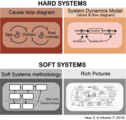
Among the wealth of tools, concepts and approaches within the systems field there are hard and soft systems approaches. Among soft systems, rich pictures and the soft systems methodology are widely used. In the hard systems side, system dynamics (SD) is one of the most famous systems approaches.
And all these tools already use data visualization: they depict ideas, relationships and concepts relying in shapes and figures more than a textual explanation.
Rad Resource: Knowing how graphical perception works
For many years vision researchers have been investigating how the human visual system analyses images. An important initial result was the discovery of a limited set of visual properties that are detected very rapidly and accurately by the low-level visual system.
An important discovery of early studies investigating how the human visual system analyzes images was the identification of a limited set of visual features that are detected very rapidly by low-level, fast-acting visual processes. These properties were initially called preattentive, since their detection seemed to precede focused attention, occurring within the brief period of a single fixation. Attention plays a critical role in what we see, even at this early stage of vision. The most relevant pre-attentive visual features are: orientation, length, width, closure, size, curvature, density, contrast, number, estimation and color.
Cool Trick: Using graphical perception principles to improve the ST tools
We are studying ST tools conventions of symbols and are working on variations to broaden its variety using simple features. For example: in the typical standard scheme for a Stock and Flow diagram, we are playing with the width of the arrows to represent the relevance of each variable. Thicker arrows (flow variable 2 and auxiliary A) would indicate bigger influence than thinner arrows (flow variable 3 and auxiliary B)
Another example would be replacing +/- symbols in causal loop diagrams by colors (green=positive, red=negative), to make the causal relationships between variables easier to interpret.
We think these improvements would make these tools more informative for those using them and more attractive for those new to them.
We welcome your reactions and hope to share an upcoming paper on this topic with you in Chicago!
The American Evaluation Association is celebrating Research on Evaluation (ROE) Topical Interest Group Week. The contributions all this week to aea365 come from our ROE TIG members. Do you have questions, concerns, kudos, or content to extend this aea365 contribution? Please add them in the comments section for this post on the aea365 webpage so that we may enrich our community of practice. Would you like to submit an aea365 Tip? Please send a note of interest to aea365@eval.org. aea365 is sponsored by the American Evaluation Association and provides a Tip-a-Day by and for evaluators.
AEA365
.
Blog
.
<span class='date ' tip=''><i class='icon-time'></i> Aug 17, 2015 01:36pm</span>
|
|
Hey there! Liz Zadnik here, Outreach Coordinator for the tip-a-day blog and sometimes Saturday poster. As you may know from some of my previous posts, my primary job is not as an evaluator. I like to consider myself an Evaluation Enthusiast - bringing my love of evaluation to others in the anti-sexual violence movement.
Now for some (not us, of course), "evaluation" and "fun" are not words often used in the same sentence. I’ve made it my mission over the past few years to infuse all my trainings with fun activities that explore the variety of ways evaluation can enrich practice and capture meaningful work.
Rad Resource: I can’t say enough about Hallie Preskill and Darlene Russ-Eft’s book Building Evaluation Capacity: 72 Activities for Teaching and Training. I’m also a big fan of "thinking with things" and encouraging adult learners to play as a way of getting to creative problem-solving. These approaches have also helped training participants associate a fun atmosphere with learning about evaluation, data, and research.
Part of being an Evaluation Enthusiast also means connecting with researchers and professional evaluators to fill in gaps and stay informed. I know there is much to be learned and not enough time in the day to learn it all!
Rad Resource: The National Sexual Violence Resource Center recently hosted an xCHANGE forum with two brilliant evaluators. Discussion threads included topics on alternatives to the pre/post-test approach, evaluating prevention with young children, and assessing community-level prevention efforts. The forum was an opportunity for practitioners to connect with one another and hear from practice-minded evaluators. Bridging that gap is incredibly important as we strive to inform practice with research and infuse practice into research.
The xCHANGE forum got me thinking about other ways evaluators and organizations can engage practitioners in a more widespread way using social media. What about hosting a twitter talk or town hall for to provide introductory technical assistance? Using themes and hashtags like #writinggoodsurveys or #evalbasics could help share best practices while also connecting practitioners and evaluators.
So, dear AEA365 readers, how do you bring fun and enthusiasm to your work?
Do you have questions, concerns, kudos, or content to extend this aea365 contribution? Please add them in the comments section for this post on the aea365 webpage so that we may enrich our community of practice. Would you like to submit an aea365 Tip? Please send a note of interest to aea365@eval.org . aea365 is sponsored by the American Evaluation Association and provides a Tip-a-Day by and for evaluators.
AEA365
.
Blog
.
<span class='date ' tip=''><i class='icon-time'></i> Aug 17, 2015 01:36pm</span>
|
|
Hello there! Saville Kushner, Professor of Public Evaluation at the University of Auckland. I am here to share some reflections on fear and formulas.
I was in a seminar recently, listening to a woman talk about her fear of entering into evaluation. I remembered fears of mine from when I was new to evaluation and vulnerable to its consequences - well, to unemployment.
But what she said brought to mind a change in me.
As I have lapsed into an age of wisdom, I slide into a seasoned confidence. I walk into an evaluation as a veteran actor breezes onto a stage, blasé about the risks which I have minimised with my formulaics. I am even desperate for a moment of chaos that will take me back to my youthful spontaneity. I guess this is what Csikszentmihalyi called ‘flow’ - with no hint of irony.
But as I listened to her I realised that I, too, am afraid when I enter evaluation - genuinely, tangibly. But not for myself, nor because of authority. I fear my failure to respectfully represent those whose lives are under scrutiny. I do feel the burden of that responsibility. At my age of supposed sagacity I am the formula maestro. I can see a person motivated by an inner psychological need and distinguish them from another motivated by belief or by a rational principle….or by habit. I can see when the evaluand is making a complaint about something irrelevant because they cannot articulate their real grievance. I can feel the evaluand’s discomfort, persuaded into talking of things of which they actually have no interest. And I can empathise with someone who speaks of their values, but who needs to promote their interests.
Lesson Learned: These things make me a good evaluation manager. But as much as they might excite Csikszentmihalyi, they do not make me a good evaluator. Because I certainly and casually fall at the first hurdle. I make too easy assumptions about my respondents in their practices to be able to do what I advise in my writing and my supervision: to represent them in their own terms. To listen to the case. To defy my presumption of telescopic insight.
Lesson Learned: Theory of Change evaluators, impact assessors, realist evaluators, those focused on ‘intended users’ - I have reproached them in my writing for placing methodology over lived experience, for elevating theory over what we should be helping our evaluand to do which is theorising. They are unethical in that particular sense. But how different is what I do which is to smother the evaluand with my seasoning? I, too, elevate a methodological principle. All formulas fail people.
Do you have questions, concerns, kudos, or content to extend this aea365 contribution? Please add them in the comments section for this post on the aea365 webpage so that we may enrich our community of practice. Would you like to submit an aea365 Tip? Please send a note of interest to aea365@eval.org . aea365 is sponsored by the American Evaluation Association and provides a Tip-a-Day by and for evaluators.
AEA365
.
Blog
.
<span class='date ' tip=''><i class='icon-time'></i> Aug 17, 2015 01:36pm</span>
|
|
I’m Mary Kane, President of Concept Systems, Inc. and a specialist in stakeholder engagement. I’ve served as a community organization leader and strategic facilitator for groups of all kinds, and then as the lead resource for Group Concept Mapping. I’m lucky that my work connects the face to face aspects of facilitation consulting with a reliable way to organize those voices.
When we establish expectations and priorities for meaningful planning and evaluation, isn’t it obvious that we would seek information from affected stakeholders?
Well, yes and no. Different environments have different definitions of "stakeholder". In an authority hierarchy, authority holders define the stakeholders, and so define the kind of input to be used in decision making. The concept of Community-Based Participatory Research (CBPR) started in the corporate world, and then gained use in areas like community-building, public health, and social support systems. CBPR evolved to community-centered PR, community-authored PR, and the mantra of disenfranchised communities: "Nothing about us without us".
"Valuing Voice" comes out of this tradition. We say that Valuing Voice recognizes and recruits the perspectives of the communities of interest, and also assertively seeks the often unheard voice of the person, family or system most affected or in need.
We use Group Concept Mapping to ask the challenging question, and then listen! The trick is to make sure that we drill for the "right people" to answer the question, and support their participation however necessary. This means using unconventional means to find and encourage people, meeting them where they are, and respecting their words and values.
Hot Tip: Use simple rules to identify, engage and respect those who are most affected by an issue. We ask people what they think, know or feel using an incomplete sentence that the person can complete. We then ask them how they think and value the issues that come from the question.
Rad Resource: We used Group Concept Mapping to uncover what adults who have severe mental illness think "recovery" looks and feels like for them. We went to the members of recovery communities, and asked: A specific thing that makes this community effective in supporting a person’s recovery is… They offered over 1000 ideas, like spirituality, resources for learning, and "citizens are people, not a diagnosis".
Here is the map of their results, authored completely by the participants:
Lesson Learned: When we ask those who experience the need we are trying to address, the richness of the results far outweighs the burden of seeking, finding and respecting the voices of the community.
Evaluation 2015 Workshop: To learn more about using Group Concept Mapping to Value Voice, please sign up for our workshop on Tuesday November 10th.
Do you have questions, concerns, kudos, or content to extend this aea365 contribution? Please add them in the comments section for this post on the aea365 webpage so that we may enrich our community of practice. Would you like to submit an aea365 Tip? Please send a note of interest to aea365@eval.org . aea365 is sponsored by the American Evaluation Association and provides a Tip-a-Day by and for evaluators.
AEA365
.
Blog
.
<span class='date ' tip=''><i class='icon-time'></i> Aug 17, 2015 01:36pm</span>
|
|
American Authors are enjoying the rage of this current song. Go Big or Go Home is a worthy entry in the Urban Dictionary and epitomizes for me the spark and enthusiasm I witnessed last week. For the fourth summer, I was graced to serve with a number of fabulous faculty as we delivered a Business Management Institute, sponsored by the Western Association of College and University Business Officers. The UC-Santa Barbara campus is always a beautiful backdrop to a great week of learning. I think, this was one of the best sessions. The students, aspiring leaders across the business...
SHRM
.
Blog
.
<span class='date ' tip=''><i class='icon-time'></i> Aug 17, 2015 01:36pm</span>
|
|
On August 12, @shrmnextchat chatted with Jennifer McClure (@JenniferMcClure) and Lori Kleiman (@LoriKleiman) about Emerging HR Leaders. In case you missed this excellent chat on personal branding and career development for HR, you can read all the tweets here: [View the story "#Nextchat RECAP: Emerging HR Leaders " on...
SHRM
.
Blog
.
<span class='date ' tip=''><i class='icon-time'></i> Aug 17, 2015 01:36pm</span>
|
|
A couple of months ago, the Society for Human Resource Management published Repurposing HR: From a Cost Center to a Business Accelerator by Carol E. M. Anderson, SHRM-SCP. She is the founder and principal of Anderson Perfomance Partners in St. Augustine, Fla. Repurposing HR explains how and why eliminating organizational silos and fostering collective thinking can lead HR to improve the performance and productivity of the workforce. The book, according to Dr. Sandra J. Guerra, SHRM-SCP, past president of the Greater Orlando Society for Human Resource Management, "provides an insightful and thought-provoking road map" to guide...
SHRM
.
Blog
.
<span class='date ' tip=''><i class='icon-time'></i> Aug 17, 2015 01:36pm</span>
|
|
As the congressional recess began last week, Members of Congress made a mad dash out of DC. For members of the Congressional Black Caucus, their destination was Tunica, Mississippi. Every August, Congressman Bennie Thompson (D-MS) hosts his Annual Congressional Black Caucus Political Education and Leadership Institute’s (CBC Institute) Public Policy Conference in his home district. The conference brings together stakeholders from local municipalities, state governments, the U.S. Congress and federal agencies to discuss current public policy challenges and potential solutions. ...
SHRM
.
Blog
.
<span class='date ' tip=''><i class='icon-time'></i> Aug 17, 2015 01:35pm</span>
|
|
The Philadelphia area’s economy has long relied on its sizable health care and higher education sectors. Much of its future success, however, may depend on easier access to jobs in manufacturing, retail and other industries that are expanding in the region. "In too many cases, if you’re living in some parts of the city, it takes upwards of two hours of connections on buses and trains to get to a job. That needs to change," said Steve Wray, executive director of the Economy League of Greater Philadelphia,...
SHRM
.
Blog
.
<span class='date ' tip=''><i class='icon-time'></i> Aug 17, 2015 01:35pm</span>
|
|
7 Quick Sales Tips for a Strong 2015 Close
The year has once again flown by and, for calendar-year companies, the fourth quarter looms ahead. For sales professionals, this means pedal to the metal to close out the year on a strong note. For sales managers, it means coaching and guiding teams to reach the finish line in good shape.
Here are some quick sales tips that may prove helpful in bringing 2015 to a strong close.
Personalize your dialogues — Too many sales professionals send impersonal e-mails and leave "canned" voice mails- I know, because I’m on the receiving end. There’s a tool called the Internet, with the World Wide Web and social media sites, offering a wealth of information regarding the contacts you’re trying to reach. Prior to any dialogue, phone or e-mail, take the time to check LinkedIn and Twitter to find out who they are, their interests, and what they’re tweeting about. Then, use this personal information in your dialogues. I know how great marketing automation systems can be, but they tend to generate generic responses. When you make dialogues personal, you can expect to see a change in response rates.
Read, read, read, and read — In our great age of content-based marketing, organizations are producing an abundance of relevant articles, white papers, research studies, briefs, and blogs on key subjects. Search for topics related to your industry, and sign up for alerts and blog subscriptions from people and organizations that can help build your knowledge base. These sources can give you the information to develop and provide insights to prospects.
Provide real insights — The more you read, the better the insights you can provide. Don’t just automatically share content with "read this article, it’s a great piece." Take the time to aggregate data and provide meaning. Offer real insights and value to your connections. Develop an opinion and communicate your points of view. It’s a great way to become an expert and build both credibility and your personal brand.
Don’t get complacent — If you are close to making goal with a few months of the year left, it’s easy to get complacent. I say keep the pedal down and make it to the finish line as quickly as possible. Remember, the calendar resets itself each year. Don’t just think about completing the current year; push for continued, sustainable success to lay the foundation for 2016.
Fill out your CRM — Data capturing and sharing is critical in today’s business world. I understand that sales professionals typically don’t get up in the morning eager to fill out their CRM, but make a commitment to do so. Tracking won and lost deals is critical for companies, with analysis helping to improve products, positioning, and messaging.
Get social — If you are not leveraging social selling tools, do so before it’s too late. You don’t have to become an expert in Twitter or make hundreds of connections on LinkedIn. At the very least, set up accounts on these two social platforms and follow your clients and prospects so you can learn more about how they think and what is important to them. Follow the posts of investor relations departments to get a better understanding of your target companies’ business performance. Finally, follow your competitors, too, so you can stay current on what they are doing.
Nurture leads — Prospecting can be difficult. That’s why if someone downloads content from your website, you should make the commitment to follow up and nurture that lead. They may not have an immediate need, but they are searching for elements of your solution. Basically, they’re kicking the tires. If they fit your lead criteria, make sure to touch base and nurture those leads. Don’t just give up after two e-mails; make sure the prospect knows who you are for when the need arises.
Whether you are working effortlessly to make up ground to reach quota or, let’s hope, having a stellar sales year that’s closing in on making President’s Club, it’s wise to plan ahead to create momentum into the next year. That’s how you provide ongoing value for your clients and differentiate yourself from the rest of the pack. What else would you add to this list?
Learn more about Richardson’s Consultative Selling Sales Training Solutions.
The post 7 Quick Sales Tips for a Strong 2015 Close appeared first on Richardson Sales Enablement Blog.
Richardson Sales Enablement
.
Blog
.
<span class='date ' tip=''><i class='icon-time'></i> Aug 17, 2015 01:35pm</span>
|