Blogs
|
Choconancy1 posted a photo:
Nancy White
.
Blog
.
<span class='date ' tip=''><i class='icon-time'></i> Aug 18, 2015 11:18pm</span>
|
|
Choconancy1 posted a photo:
Nancy White
.
Blog
.
<span class='date ' tip=''><i class='icon-time'></i> Aug 18, 2015 11:18pm</span>
|
|
Choconancy1 posted a photo:
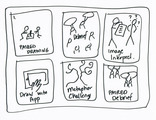
Storyboard planning a UdG Studio on Visuals for Teaching and Learning
Nancy White
.
Blog
.
<span class='date ' tip=''><i class='icon-time'></i> Aug 18, 2015 11:17pm</span>
|
|
Many years ago at a KM4Dev community meeting, Carl Jackson coined the word "confusiasm," a combination of confusion and enthusiasm. This has become a way of being for me. It represents, quite simply, learning in action.We used this concept at the University of Guadalajara Diplomate program on mobile tech for engagement the last two weeks in Guadalajara with the Agora project. There is much more I want to write, but at the minimum, I want to start curating and sharing the artifacts. Here is the first one, a Storify of the Confusiasm Twitter thread.Many years ago at a #KM4Dev community meeting, Carl Jackson coined the word "confusiasm," a combination of confusion and enthusiasm. This has become a way of being for me. We used this concept at the University of Guadalajara Diplomate program on mobile tech for engagement.Many years ago at a #KM4Dev community meeting, Carl Jackson coined the word "confusiasm," a combination of confusion and enthusiasm. This has become a way of being for me. We used this concept at the University of Guadalajara Diplomate program on mobile tech for engagement.View the story "Confusiasm/Confusiasmo at the UdGAgora" on Storify
Nancy White
.
Blog
.
<span class='date ' tip=''><i class='icon-time'></i> Aug 18, 2015 11:17pm</span>
|
|
Johnnie Moore pointed to an interesting article on why checklists don’t always produce the kind of positive results expected in hospital operating rooms.I remember a few years back when I had major surgery. I had been rolled into the operating room. I was looking around and I commented on the team’s use of a checklist. They looked at me, surprised that I noticed. I said I’m interested in group process. With that, they gave me my anesthesia. I think one of the things on the list was to shut up talkative patients. But I wondered, did the checklist make a difference for that team? It seemed like they were comfortable and well-practiced…Outside of hospital operating rooms, where I have no expertise other than as patient, I’m fascinated by what sort of invitation gets people to engage with tools that can increase their individual and collective performance. It seems to me the invitation is as important as the checklist. Here is a related snippet from the article:Dixon-Woods did identify one exemplary ICU, in which a high infection rate fell to zero after Matching Michigan began. The unit was led by a charismatic physician who championed the checklist and rallied others around it. "He formed coalitions with his colleagues so everyone was singing the same tune, and they just committed as a whole unit to getting this problem under control," says Dixon-Woods.I don’t think the intention here is blind lock-step and I cringed a bit at "singing the same tune." What I do think matters is that people understand the value of something they are asked to do, and that leadership walks the talk. That starts with an informed, intelligent invitation to participate. Not blind obedience. Not "because you have to." And the ability to critically question an invitation, checklist or whatever, because in complex settings, not everything is predictable.I’m currently reflecting on the last two weeks where a team of us co-facilitated 2 rounds of a week long learning experience for professors at the University of Guadalajara system in Mexico. (More to come on that.) I suspect where we created warm, intelligent INVITATIONS to experiment with mobile technologies for engaged teaching and learning, we had more professors "accept," dive in and learn. Where we focused too much on content, we started to lose people. Interesting, eh?Source: Hospital checklists are meant to save lives — so why do they often fail? : Nature News & Comment
Nancy White
.
Blog
.
<span class='date ' tip=''><i class='icon-time'></i> Aug 18, 2015 11:17pm</span>
|
|
Well, this seems to be a fitting follow up to my last blog post.Amabile: I believe it’s important for leaders to understand the power of ordinary practices. Seemingly ordinary, trivial, mundane, day-by-day things that leaders do and say can have an enormous impact. My guess is that a lot of leaders have very little sense of the impact that they have. That’s particularly true of the negative behaviors. I don’t think that the ineffective team leaders we studied meant to anger or deflate the people who were working for them. They were trying to do a good job of leading their teams, but lacked an effective model for how to behave.So, I would say sweat the small stuff, not only when you’re dealing with your business strategy, but with the people whom you’re trying to lead. I would encourage leaders, when they’re about to have an interaction with somebody, to ask themselves: Might this thing I’m about to do or say become this person’s "event of the day"? Will it have a positive or a negative effect on their feelings and on their performance today?Amabile also calls out the rich, internal emotional lives that we all have, and how that influences our working together and collaboration.One, people have incredibly rich, intense, daily inner work lives; emotions, motivations, and perceptions about their work environment permeate their daily experience at work. Second, these feelings powerfully affect people’s day-to-day performance. And third, those feelings, which are so important for performance, are powerfully influenced by particular daily events.This again has resonance with last week’s #UdGAgora work where we explored the role of empathy in course design. The red threads are really showing up today. Maybe this will help me start pulling together a full post about The Agora. Alan has already started the "reflective ball" rolling. Source: The Power of Ordinary Practices — HBS Working Knowledge
Nancy White
.
Blog
.
<span class='date ' tip=''><i class='icon-time'></i> Aug 18, 2015 11:17pm</span>
|
|
Last week I blogged a little piece on the power of inviting a human being into a learning or doing experience. The human side of it. Today I finally read the post from Ryan Tracey that a number of folks have mentioned, Collateral damage | E-Learning Provocateur.Ryan, after acknowledging the lack of evidence that supports the theory or learning styles (yay!), brings some nuance into the conversation and tackles the contextual issues around learner preferences.If someone is in a classroom or a job-mandated training session, they will take what you give them. They may not be happy, but the in-room environment creates more pressure to conform.In independent, self-driven learning, we hew more to our own personal preferences. Like Ryan, I cringe when I have to learn through videos, not just because so many are bad, but I’m a fast reader and can pinpoint what I want more efficiently. I certainly CAN learn with videos, I just prefer NOT to.Creating a space for choice seems a pretty humane thing to do. I am more likely to follow through, to say YES, if you give me the respect as an adult learner and, where practical, some choice. I’ve observed this increases engagement over time (mine and others’). I wonder if there is any data to support this?I think back to the JIBC/UdG Guadalajara group last month and even the conversations around Adroid vs. IOS, even without their religious zeal, reflect that driving impulse to have some level of choice, both as instructors/teachers/trainers and as learners.P.S. I enjoyed the images in Ryan’s post as well!P.S.S. The network and Ryan have circled back and now we know the image is the work of Allie Brosh at Hyperbole and a Half: http://hyperboleandahalf.blogspot.com - Allie, your work rocks!
Nancy White
.
Blog
.
<span class='date ' tip=''><i class='icon-time'></i> Aug 18, 2015 11:17pm</span>
|
|
Skilled classroom facilitators always make an extra effort to effectively practice both their verbal and non-verbal communication skills. Verbally, it’s important that we use proper grammar, minimize speech fillers, and clearly articulate our words and syllables. Non-verbally, it’s critical that we incorporate gestures, facial expressions, and movement to help convey our message.
There’s another aspect of non-verbal communication that we, as facilitators, need to be mindful of; it’s an aspect called proxemics.
Proxemics is the theory of using measurable distance and space to make people feel comfortable or more relaxed while interacting with them. The term was coined by the late anthropologist, Edward T. Hall, Jr. during the late 1950s/early 1960s. Proxemics is usually categorized by personal territory and physical territory.
Personal territory proxemics is that safe distance of space that we keep between us and the person we’re standing behind while waiting in line at a ticket counter. Another example of personal territory proxemics is the space or area that we comfortably settle into when we enter an elevator with other people.
Proxemics as it relates to physical territory involves the use of furniture and seating arrangements. Think about how the seats in movie theaters and on public transit usually consist of individual chairs, often with an arm rest or divider, as opposed to a long, singular bench. Designers of these public spaces often consider proxemics.
As classroom facilitators the awareness and practice of proxemics can be used to our advantage. Let’s first explore personal territory proxemics.
Dr. Hall separated personal territory proxemics into four distinct zones: intimate, personal, social, and public. There have been countless studies conducted to determine what is considered a comfortable distance in each zone.
In North America, the "comfort zones" between individuals are usually as follows:
Intimate - Ranges from one foot or less of space, and usually involves some sort or touching, such as whispering or embracing.
Personal - Ranges from 2-4 feet of space, and is usually practiced among friends and family members.
Social - Ranges from 4-10 feet of space and is typically exercised when business associates and strangers communicate with each other.
Public - Ranges from 12-25 feet of space and is often the distance between a public speaker and his/her audience.
In the classroom, practicing social distance or proximity is usually most advantageous when interacting with your learners. It’s not necessary to actually consult a tape measure to determine the suggested 4-10 feet of space; however, I feel it’s important to be mindful of a learner’s personal space. I try to practice this habit when I’m conversing with a learner and giving feedback.
I often have flashbacks of a time where I was made to feel very uncomfortable by an instructor who didn’t practice this proximity guideline. I was being trained for a job in a call center which required heavy usage of a desktop computer. During training, if I had difficulty using my computer or entering data, the trainer would assist by hovering over me and invading my personal space. I’m not even sure she realized how uneasy I felt as we were both virtually cheek to cheek while looking at the computer screen. I never want to make my learners feel uncomfortable like this in any of my training classes.
Public distance or proximity should be considered as you set up your classroom. The 12-25-foot range gives you a safe distance from your learners when you present in front of your audience. It also creates an ample and unobstructed area, which is good for movement during your presentation.
You may have noticed I made specific reference to North America when explaining the "comfort zone" proximities. Not all cultures practice the same protocol as it relates to personal space. I have read that certain Middle Eastern, Latin American, and African cultures are considered "high contact" cultures because close proximity is the cultural norm for them.
I experienced this first hand on a trip to South Africa. While waiting in line at a South African fast food chain, the person standing behind me was so close, I actually felt him breathing on my neck. Feeling uncomfortable, I immediately got out of line and went to the restroom. As I waited "in queue" (as they say in South Africa) for a second time, I realized the next person who came behind me stood just as close. I remember looking around to see if a large crowd of people had suddenly arrived at the restaurant. Because the restaurant was not crowded, I was left to assume that standing in such close proximity was simply a cultural difference; however, as an American, it made me feel a bit uneasy.
In regard to training, if your audience is comprised mostly of North Americans or other members of "low contact" cultures, it’s probably best to practice personal territory proxemics and keep what’s considered a safe or appropriate distance.
I also recommend practicing physical territory proxemics in the corporate classroom. As mentioned earlier, physical territory proxemics involves the use of furniture and seating arrangements.
As you arrange your classroom tables and chairs, be mindful of the learners’ personal space. Typically they will be seated for extended periods of time next to other individuals during a course. At Langevin, we recommend 30-35 square feet of space per person while seated. If your learners are required to write, we recommend providing tables with 4-6 square feet of table space per person so they have adequate "elbow room."
On the flip side, research shows that too much distance between learners can actually reduce interaction and participation. Still keeping the "elbow room" concept in mind, I recommend using seating arrangements such as the "Bistro" style at round tables. Or, you might consider using the "U" or "Horseshoe" style set-up. These seating arrangements have a tendency to promote comfortable interaction and participation, rather than limit it.
Perhaps proxemics are already part of your presentation skills toolkit; if not, I encourage you to incorporate this powerful tool to help you better connect with your learners by making them feel comfortable and relaxed in your classroom.
How else might you incorporate proxemics in the classroom?
Jeff
Langevin Blog
.
Blog
.
<span class='date ' tip=''><i class='icon-time'></i> Aug 18, 2015 11:16pm</span>
|
|
About ten years ago, I read an article that said this would be the decade for customer service. Well, I think the author was partially right; it was the decade for customer service to be a clever mask for sales. I was reminded of this the other day when I clicked on a link to what I thought was a helpful article regarding a product I had purchased. It turned out to be nothing more than a sales attempt for other products I had not yet purchased. It was then that I realized that all I really need to know about good customer service I learned while trick-or-treating. I have three suggestions that will safeguard your training department from participating in this misleading masquerade.
Separate Your Candy
By separating sales from support, your department can be focused on…well…support. The goal becomes solving a problem rather than selling a product (e.g. a new course). When you have happy participants, your department is viewed in a much more positive light. While it is true that your participants look to your department for post-course support, it is actually the job of an employee’s manager to support their performance back on the job. We can still provide support in the way of job aids, online references, and maybe an occasional call or email to answer a question. The key is to keep those support activities separate from your communications about new course offerings.
Be Easily Visible
Have you ever had to search a web page for contact info, just to get a little support, only to end up completely frustrated? How visible is the post-training support that you offer to your participants?
How about providing one post-course training support number, and maybe an email address, and putting it where it can be easily found? For example, you could put this information on your company’s internal web page, on posters in your training rooms, in your manuals, or even on business cards.
Stick Together
Keep in touch with former participants, and be available when you say you will be available. This approach gives your participants an opportunity to ask questions and receive follow-up information when necessary.
When I conduct workshops, I always let the participants know they can call or email me any time with questions about training or the training industry; however, I also manage those expectations. If they need help right away, I encourage them to call because I return phone calls within 24 hours. I then explain that for less urgent issues, they can email me, and I’ll reply within a week. That may seem like a long time, but it is an attainable target considering the crazy schedules of most trainers.
Applying these lessons learned while trick-or-treating can increase your opportunities for success. By separating sales from support, providing post-course support contact information, and making an effort to keep in touch with former participants, maybe this will be the decade when your training department defines support. No tricks, just the treat of getting the support your participants expect without the sales call they don’t.
Jim
Langevin Blog
.
Blog
.
<span class='date ' tip=''><i class='icon-time'></i> Aug 18, 2015 11:16pm</span>
|
|
Practice makes perfect, right? How many times have you heard that cliché associated with self-improvement? I heard it often from my parents, teachers, and sports coaches while growing up. Well, what would you say if I said this famous cliché is incomplete and inaccurate?
We instructors might be tempted to use this cliché, too, when teaching employees, but I think we need to add two key words to make the phrase more complete and accurate: Practice, with feedback, makes perfect! Someone can practice something all they want but unless they get timely and constructive feedback, they will not reach their full potential.
Oftentimes we focus so much on our presentation skills and the design of our courses that we sometimes forget about doing the little things that help us connect with our learners in meaningful ways; providing effective feedback is one of those often overlooked little things.
Feedback Tips
With that in mind, I’d like to suggest the following five tips to help you deliver meaningful learner feedback:
Ask learners if they would like some feedback. This shows them respect.
Always let them know what they are doing well (so they keep doing it), and deliver this feedback with a smile and enthusiasm!
Deliver the positive feedback first followed by suggestions for improvement. Try substituting the word "but" in between positive and negative feedback with the word "and." For example, "Jim, your essay was well written and I have some ideas on how to improve it. Would you like to hear them?"
Deliver your suggestions for improvement with a confident but compassionate tone of voice. When people are learning something new and practicing skills for the first time, they are nervous and more sensitive than normal so keep this in mind.
Give them feedback only on things they can control and make the comments very specific so it is clear to them what they need to do to improve instead of just saying, "You’re great!"
So the next time you teach a course, be sure to tell your employees that you are going to give them a lot of practice, with feedback, so they can become as perfect as they can be!
What other tips do you have about giving feedback?
Lynne
Langevin Blog
.
Blog
.
<span class='date ' tip=''><i class='icon-time'></i> Aug 18, 2015 11:16pm</span>
|