Blogs
|
The title of this entry was inspired by a passage from Craig Wortmann’s terrific book, "What’s Your Story?" It speaks to both how communication has shifted in recent years and the ineffective nature of the way we often attempt to teach.Just as lengthy memos were replaced by brief emails, which were, in turn, overtaken by IMing and SMS (thanks to increasingly powerful mobile phones/devices), the way we converse and communicate is becoming more and more staccato’d . Increasingly, we are speaking to each other in fragmented facts and bullets instead of descriptive and nuanced narratives. In pursuit of speed, we have traded away "rich/engaging/compelling" for "fast/efficient/familiar". In many ways, this is a fool’s bargain, and it’s beginning to show.Q: What is the longest standing, most tried-and-true, and instinctually natural way of passing knowledge from expert to novice?A: Leave your laptops, Powerpoints, and Blackberries behind… Forget about books, manuals, and job aids… It’s the ancient art of storytelling.I’m planning to post a series of entries about the power of Story in Instructional Design in the coming weeks/months, but I figured this observation regarding bullet points was a good place to begin the journey. It speaks to the importance of context and the way we process, store, and recall information.When you tell someone a set of facts and figures, it can make a temporary impact, but it’s usually quickly forgotten as decontextualized white noise. What’s lacking is meaning and relevance to the listener - in order for something to be understood at a deep level and retained for more than a few days (hours?... minutes!?...), there has to be a personal connection made. Something that relates the new information to old, personal, previously understood information. Something that refines, extends, contradicts, augments, or otherwise changes the existing set of cases and rules that exist in the learner’s mind. Without this comparative review and adjustment, any ‘learning’ that may occur will ultimately be fleeting.So, we need to move away from the expedient habit of disseminating data in meaningless bullets and rediscover the importance of context, which can be created in the form of stories.Here's a short and simple example to illustrate the difference.Consider the following bulleted fact:
"Corporate earnings were 3.2 billion (dollars/yen/euros/pounds/rupees) in 2006."
What
does this data point tell you? What image do you have in your head
about this company’s standing? What do you understand now that you
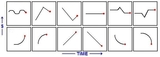
didn’t understand before? What meaning has this information given you?OK - now review the following 12 charts (with the red "dot" marking 3.2 billion):
Instantly,
and without conscious effort, you probably told yourself a "mini story"
to process and comprehend the data represented in each chart. You
couldn’t help yourself. Is 3.2 billion a good thing? A bad thing?
Status quo? For each chart above, you easily created a plausible tale
of "what’s going on" that is grounded in your previous experiences
(firsthand and vicarious). This instinctual tendency is part of who we
are, at a fundamental level. It provides a compelling insight into how
our brains work, and suggests ideas for leveraging this cognitive habit
to our instructional advantage.Imagine
the final step in this example chain - instead of being given a
bulleted fact, or even a graphical chart, you are provided a compelling
narrative of the events that influenced a company's fiscal performance
Maybe a story
of how a small oil and gas company played a role in one of the largest
bankruptcies in US history? How recognizible and well-understood are
terms like "securities fraud"
in the post Enron/Worldcom era? Why? Because stories were told -
stories of greed, arrogance, fraud, trust, loss, and ruin - that
brought obscure accounting terms and practices out of the textbooks and
into the personally relevant world of everyday people.Stories
help to add meaning to new data. Meaning is a critical element in
increasing retention. Without retention, there's no hope for
application.
(Jon Revelos is Director - Story Based Learning at TATA Interactive Systems)
Tata Interactive Systems
.
Blog
.
<span class='date ' tip=''><i class='icon-time'></i> Aug 23, 2015 04:47pm</span>
|
|
I've noticed a slowly growing trend in the marketplace, and I think it's time it's questioned.
It has become quite in vogue to bad-mouth and shun the use of Powerpoint in presentations.
I was first exposed to this stance in a presentation by Edward Tufte (author of several fantastic books on information visualization and communication). He made a mark for himself by declaring that "Powerpoint is Evil", both in a WIRED article and in a longer whitepaper.
More recently, Elliot Masie dubbed his newly minted "Learning 200X" conferences to be "PPT-free Zones", instructing presenters to leave their slides at home in hopes that it would foster greater discussion and interaction amongst attendees (and this underlying objective may have been accomplished, as the sessions *did* move from being lectures to conversations).
Just last week I spent a terrific day in Washington DC talking about Stories and Conversations at an event hosted by the Smithsonian Associates. One of the great speakers that presented was Larry Prusak of IBM KM fame. I really enjoyed his talk, which was PPT-free, but instead of simply quietly adopting that presentation stance and moving ahead, he made a pointed announcement of his disdain of Powerpoint. He even went so far as to say that he uninstalled the app from the MS Office Suite on his computer.
Finally (and completely serendipitously), this month's 'Big Question' on the Learning Curcuits Blog is precisely on this topic - the What/When/Why of PPT. The BQ seems to have been prompted by an Austrailian press article that uses Dr. John Sweller's Cognitive Load Theory to explain why most PPTs are so head-droppingly awful (and the link makes terrific sense to me).
In all of these cases (and the dozens I haven't mentioned, some of which are here), I can't help but think that the primary flag-wavers of the Anti-Powerpoint movement are projecting their disgust and anger in the wrong direction. Powerpoint is simply a tool, like a hammer, or a lawnmower. In and of itself, it's not really something that can be deemed "evil". It is the way the tool is leveraged that gives it "value" (good or bad).
Don't get me wrong - I've been the victim (and... umm... the perpetrator) of more than a few AWFUL powerpoint presentations. You know the ones - where the audience is given a live (often monotone) narration of (text-laden) slides that are linearly displayed. I am in no way defending this embarrassment of communication - I'm simply pointing out that the fault sits with the *presenter*, not the tool (despite the fact that the tool may make it easy for the lazy to use it in bone-headed ways).
Just because a hammer can be used to both frame a house for the victims of a natural disaster and murder someone, that doesn't make it inherently "evil" or "good". Those value-laden terms can only be reasonably used to describe the users of the tool based on what they chose to do with it. When Larry said he had removed Powerpoint from his computer, for its nature of promoting one-way communication, I wanted to ask him if he had also removed Word? According to the logic of his argument for uninstalling Powerpoint, any word processor should also be shunned - after all, documents are monologues, not dialogs, right?I'm reminded of a email exchange I recently had with Geetha Krishnan, a colleague at TIS. In our exchange, I was reminded of an old argument Socrates made against the adoption of books:Socrates:
….If men learn this, it will implant forgetfulness in their souls; they
will cease to exercise memory because they rely on that which is
written, calling things to remembrance no longer from within
themselves, but by means of external marks. What you have discovered is
a recipe not for memory, but for reminder. And it is not true wisdom
that you offer your disciples, but only its semblance, for by telling
them of many things without teaching them you will make them seem to
know much, while for the most part they know nothing, and as men
filled, not with wisdom, but with the conceit of wisdom, they will be a
burden to their fellows."
Phaedrus: . . . I agree that the man of Thebes is right in what he said about writing.
Socrates: Then anyone who leaves behind him a written manual,
and likewise anyone who takes it over from him, on the supposition that
such writing will provide something reliable and permanent, must be
exceedingly simple-minded; he must really be ignorant of Ammon's
utterance, if he imagines that written words can do anything more than
remind one who knows that which the writing is concerned with.
Phaedrus: Very true.
Socrates: You know, Phaedrus, that's the strange thing about
writing, which makes it truly analogous to painting. The painter's
products stand before us as though they were alive, but if you question
them, they maintain a most majestic silence. It is the same with
written words; they seem to talk to you as though they were
intelligent, but if you ask them anything about what they say, from a
desire to be instructed, they go on telling you just the same thing
forever. And once a thing is put in writing, the composition, whatever
it may be, drifts all over the place, getting into the hands not only
of those who understand it, but equally of those who have no business
with it; it doesn't know how to address the right people, and not
address the wrong. And when it is ill-treated and unfairly abused it
always needs its parent to come to its help, being unable to defend or
help itself.
Phaedrus: Once again you are perfectly right.
(from
The Collected Dialogues of Plato. Eds. Edith Hamilton and H. Cairns.
Princeton: Princeton UP, 1963. pp. 520-21. 274D-276B.)A
presentation can be given effectively or ineffectively using the same
tool (or without a tool at all). It's time to focus on the actual
source of the problem and stop making simple-minded arguments against
red herring causes.
Those who create and deliver Powerpoint presentations with packed
paragraphs of 10-point text, meaningless clip-art, and irritating
spinning and flashing animations should be sent to a class on effective presentations.
Simply taking the (abused) tools away leaves these culprits
none-the-wiser to the error of their ways, and discounts the
communicative power that Powerpoint can render when placed in the right hands.
Just as Socrates threw the baby out with the bathwater regarding the
power and benefit of the written word, I think those who argue that
Powerpoint should be nuked are making a similar error. This suggestion
is analogous to saying that duiring your next presentation, you should
require the audience to close their eyes as you speak - to turn off one
of the primary means of informational reception.
Visuals play a powerful role in communications, so why would anyone
make a broad-brush suggestion that there's benefit in prohibiting
them? Can you imagine speaking about Art without visuals? How about
good User Interface Design? How about long-horizon trends in any one
of a variety of domains? Images often instantly 'say' more than is
able to be easily enunciated in words or text.
"A picture is worth a thousand words" isn't just a meaningless phrase, you know...
(Jon Revelos is Director - Story Based Learning at TATA Interactive Systems)
Tata Interactive Systems
.
Blog
.
<span class='date ' tip=''><i class='icon-time'></i> Aug 23, 2015 04:46pm</span>
|
|
Happy Planet is an animated short film about the beauty of life on earth. The film eliminates dialogue and speaks with its visuals and music. Much like life with its unexpected surprises, the flow of visuals in the film is organic. The interplay among the creatures or between the creatures and the environment in each shot creates the visual room and space for the next interplay. These visuals and the movement within them blend seamlessly alludes to the connected life that all we share. The film ends on a poignant note - a child’s hand appears on screen, requesting us humans to take responsibility for protecting and conserving our environment.
Happy Planet was the outcome of an animation workshop conducted by Dhimant Vyas for our animators, for many of whom it was their first foray into claymation. The concept and storyboard was done by the entire team, under Dhimant’s guidance and direction.
The setting and characters were created by the whole team working together, they are intentionally kept realistic or semi-realistic because the movement of the characters could not be made too exaggerated and cartoonish - considering they were made out of a rigid material. The characters are made out of clay - and are mostly relief work on glass. It was a challenge to give them a three-dimensional look on the screen. The team studied wild life videos for reference in character design, and to get a sense of timing for the character movement.
Each sequence was animated by a different animator. It was a challenge to link different animators’ ideas effectively and make smooth transitions between the sequences.
We hope you enjoy watching Happy Planet. Even more so, we hope the message in it impresses you enough to make you contribute your bit to make our planet happier.
(Happy Planet is a claymation (stop motion) film directed by Dhimant Vyas, Deputy Head - Animation at Tata Interactive Systems.)
Tata Interactive Systems
.
Blog
.
<span class='date ' tip=''><i class='icon-time'></i> Aug 23, 2015 04:46pm</span>
|
|
I have never written a story or an experience of this sort. I have visited Japan once in the past and worked with a lot of Japanese companies like NEC, Fujitsu, and Toshiba, to name a few. I had faint memories (none, to be honest) of my last visit. During this visit to Japan, what touched me was the hospitality and the kindness of the people. I have often heard about the Japanese being tough, difficult negotiators but what I saw of them during this visit was completely contrary. They are professionals in their field, they ask the right questions, and more so, are extremely hard working.
I always thought that Indians work hard, stay late in office, speak to clients at odd hours, etc. And don’t we complain that we spend so much time in the office and hence have less time to spend with our family? The Japanese professionals are out to work when we were having a morning walk at 6 a.m. They were still in office when we were packing our bags to go back to our hotel. Most of the senior guys are in office until midnight and this is their daily routine. Wonder how they can work so hard, every day. During our consulting assignment we asked what is a normal day for a 4th grade kid is like. This was their response.
Wake up at 7 a.m.
Public/private school from 8 a.m. to 4 p.m.
Extra-curricular activities like football, baseball, karate, etc up to 6 p.m.
Special schools for another 3 hours (Now you know why I qualified the second point). While the public schools are in the same locality where they stay, the kid has to travel to go to a good special school. Sometimes this travel takes about an hour by train one way. By the time the kid gets home it is well past 11 p.m.
Once they are back home, they would like to play games.
So much pressure on kids from such an early age and we talk about how school education in India puts so much pressure on kids and how there is too much competition.
Another interesting characteristic of the Japanese is the punctuality. Be it trains, be it for dinner, or be it for meetings. You would rarely see anyone walk. They are always running, to catch a train, to go for a meeting.
An interesting statistic to note is the average delay of a Shinkansen (Bullet train) in a year is 0.4 minutes. This includes delays caused by typhoon, rains, earthquakes, snowfall, etc. Punctuality is not by accident but by design and it is taught and ingrained in children right from an early age.
After having visited and stayed in Japan for 2 weeks I think there is a lot to learn from the Japanese. Arigatou Gozaimasu means "thank you very much" in Japanese.
(Anand Subramanian is Head - Systems Design with Tata Interactive Systems)
Tata Interactive Systems
.
Blog
.
<span class='date ' tip=''><i class='icon-time'></i> Aug 23, 2015 04:46pm</span>
|
|
We are living in exciting times. We are smack-dab in the middle of a r/evolution of such magnitude that its impact will (likely) only be evident in retrospect.
Three data points have converged recently to evoke this feeling of excitement, amazement, and minor vertigo about what the future holds.
1) Information Management Technologies
In the video above (one of several fantastic presentations shared by TED), Blaise Aguera y Arcas demos some jaw-dropping technology (Photosynth) coming out of Microsoft Live Labs (based on Blaise's previous efforts with Seadragon, which was acquired by MS in '06). This image/info manipulation and organization tool is tough to describe in words, but the wide array of potential applications/uses immediately become apparent via the demo shown in the video.
Suddenly, we see the ability to enable the emergence of information that has never been explicitly defined by someone, but rather is dynamically created based on the novel analysis of large groupings of small pieces. (see the segment about Notre Dame modeled off of Flicker images)
We begin to see novel ways to leverage technology to do truly unique things, rather than using them to recreate old things in new skins. (see the embedding of micro images/print into digital versions of 'traditional' media - it reminds me of the corporations who are inserting long, detailed product information and extended stories in a momentary burst at the tailend of TV ads, viewable only by 'stepping' through them frame-by-frame using a Tivo/DVR remote, as a means to (re)capture eyeballs in the age of 'ad skipping'. For an example, view GE's One Second Theater.)
I recall reading somewhere (can't remember now) that UI beauty is born from spare MIPs - that it was only when processing/computing speeds became sufficiently fast that any substantial attention was directed towards the look & feel of applications. Thus, we had text-based OS's and app's (think DOS as a later example) well before any GUI's were an option. It seems we are experiencing another step along this path, as the power of even average PCs today far outstrip the stress the average user places on them - they (effectively) sit idle, waiting for the next command from the user 95% of the time (I made that figure up, but it's probably an underestimation, if anything). Thus, you see 'grid computing' efforts popping up to take advantage of these spare cycles (one of the older examples is the SETI@home initiative). The power of 'gamer' video cards and video gaming systems (XBox, PSP, etc.) is extraordinary by measures set only a few years ago. This fact enables people like Blaise to begin to imagine new capabilities (thanks to Moore's Law... although I think that he came up with some very innovative ideas about how graphics are handled that amplified the pure computing power curve!)2) Direct Manipulation Interfaces
In video above (again, from TED), Jeff Han
demonstrates an amazing and intuitive way of manipulating information
directly, rather than the long-in-the-tooth mouse/keyboard method.
Again, seeing the demo in video takes the place of pages of
(inadequate) descriptive text.
This is very similar (perhaps related deeply?) to the newest Microsoft announcement, Surface.
Even if they aren't related efforts, it may be an example of simulateous convergence of an idea whose time has come (like Newton and Leibniz related to Calculus).
This concept of direct manipulation, coupled with widely networked and
'aware' devices (see the three videos on the Surface home page) will
open up an entirely new horizon of creating/storing/sharing digital
information.
3) New Paradigms of Information Organization
David Weinberger recently published a fascinating book, Everything is Miscellaneous.
At its core, it's a book about classification/categorization and how
things change when the items being cataloged are bits rather than atoms
(digital rather than physical). It's about the power of metadata,
tagging, and in/formal taxonomies.
This basic premise (that we are now afforded the option of
describing a single thing in multiple ways, all of which are valid and
useful, depending on your objectives) is the fuel behind what makes
Blaise's work possible (in part). The ability to search, sort, and
shuffle large storehouses of otherwise miscellaneous/random data to
reveal new patterns and meaning rests in the 'information about the
information'.
These three spikes in the blogosphere converged in my head today and
(re)ignited my imagination of what awaits us (and our children) in the
not-so-distant future.
How will these samples (along with the hundreds of other gadgets,
gizmos, and tools that are popping up daily on the web) influence and
impact the way we conceptualize and manage "information", "learning",
and "knowledge" in the academic (K-12/16/20+) and corporate domains?
Only time will tell, but it seems clear that the possibilities are
limited much more severely by our own imaginations and mental models
than by the enabling technologies.
(Jon Revelos is Director - Story Based Learning at TATA Interactive
Systems)
Tata Interactive Systems
.
Blog
.
<span class='date ' tip=''><i class='icon-time'></i> Aug 23, 2015 04:46pm</span>
|
|
Michael Moore's latest movie, Sicko, is a powerful example of how Stories trump Facts when attempting to teach material that is intended to invoke change (mental and/or active).
Although the film won't be in wide release in the US until later this month (June 29th), Moore has been on the promotional circuit non-stop since his latest work debuted at Cannes' annual film festival (where he won top prize of Best Picture three years ago for Fahrenheit 9/11'). This time around, Moore set his sites on the flawed American health care system.
This blog isn't the proper place to comment upon the in/validity of the content within Sicko. Nor is it the right forum for arguing the pros and/or cons of socialized medicine. Besides, a quick search on the 'net will turn up more than enough 'discussion' on these topics.
I'm mentioning this movie here not because of WHAT material is contained in the film, but rather because of HOW that material is presented.Here, in the US, the shortcomings of the healthcare system aren't
something newly uncovered, freshly emerging, or previously
unrecognized. The issues associated with this topic have been
discussed and analyzed in great depth, for several years, by both
political parties and a myriad of independent agencies (see this, that, and the other for a short, random sampling) . And yet, little has occurred in the way of substantive change on this hot topic.
Why?
While it would be wrong to simplistically distill this complex
issue's solution into a blog entry, for the purposes of education,
learning, and change (arguably the focus of this blog), there may be
something interesting and illuminating that we can learn here.
Consider the following statistics:
"Rates of potentially preventable hospital admissions ranged
from more than 10,000 per 100,000 Medicare enrollees in the worst
performing states to 5,000 per 100,000 enrollees in the five best...
The researchers estimated that if all states could reach low levels of
preventable hospital admissions and readmissions for Medicare
recipients, hospitalization rates for senior citizens alone could be
reduced by 30% to 47% and save Medicare $2 to $5 billion a year." (source)
"Between 2000 and 2005, 7.2 million Americans lost their health
coverage according to the US Census Bureau.... At the end of 2005, the
number of Americans without health insurance reached 47 million." (source)
"...the U.S. is an outlier in terms of financial burdens placed on
patients. One-half of adults with health problems in the U.S. said they
did not see a doctor when sick, did not get recommended treatment, or
did not fill a prescription because of cost... Despite these high rates
of forgone care, one-third of U.S. patients spent more than $1,000
out-of-pocket in the past year. In contrast, just 13 percent of U.K.
adults reported not getting needed care because of costs, and
two-thirds had no out-of-pocket costs." (source)
OK... Now consider these profiles from Sicko (as summarized by Robert Weissman):
Dawnelle, whose 18-month-old daughter Michelle died because her
health plan, Kaiser, insisted Michelle not be treated at the hospital
to which an ambulance had taken her, but instead be transferred to a
Kaiser hospital. Fifteen minutes after arriving at the next hospital,
Michelle died, probably from a bacterial infection that could have been
treated with antibiotics.
Julie, who works at a hospital, explains how her insurance plan
refused to authorize a bone marrow transplant recommended for her
cancer-riven husband. He died quickly.
Larry and Donna, a late-middle-age couple, find that co-payments
and deductibles for treatment after Donna has cancer add up to such a
burden that they have to sell their house and move into a small room in
their adult daughter's house. The day they move into their daughter's
house, her husband leaves to work as a contractor in Iraq.
Which list better captured your attention? Which list made the
(claimed) crisis more real/tangible to you? Which list created more
outrage... sadness... anger... disappointment... amazement?
From an Instructional Design perspective, which list (or approach: fact vs. stories) is more likely to improve your ability to understand the situation at hand, recall relevant examples of the claims, and invoke behavioral change
with your local government representative? (Comprehension, Retention,
and Application are three primary legs upon which the fundamental goals
of Instructional Design rest).
The questions are effectively rhetorical. In matters of Change
Management at nearly any level (personal, corporate, organizational,
political), the analytical and quantitative approach of providing
stacks of facts and figures in hopes to evoke a shift in behavior is
inefficient (at best) and ineffective (at worst). Most change doesn't
occur based on evidence - it most often happens based on emotion.
Al Gore's award-winning documentary on global warming, An Inconvenient Truth,
was chucked full of statistics and report findings that had been around
for years, but those numbers weren't what made the film a catalyst of
attention and action - it was the stories and photos (in part) that caused audiences worldwide to speak up and take action.
The dangers of Methamphetamine are well documented, but the factual presentation
of definitions and known side effects were largely ineffective against
the powerful lure of the drug. Solution: move away from the dry
figures and highlight the stories of real people (individuals, as well as their families, children, neighbors, and communities).
The next time you are tempted to force a change in your organization
(or at home) by overwhelming your audience with facts, figures, charts,
graphs, reports, or (gasp) orders from authority figures ("Why should
you do this? Because I/your boss/the CEO said so, that's why!"), take
a moment and resist the urge. After all, you know in your heart that
sort of an approach is rarely effective beyond the short-term.
Instead, come up with a tangible example (story) that illustrates
why action is necessary, what sorts of positive (or negative) results
may blossom from the change (or lack thereof), or how the success of
the change is intimately tied to the actions of individuals. The
difference, not only reception, but in deep understanding and
internally-motivated behavioral change/action will be amazing.
In the end, it's easy for data to be questioned and argued to the
point that your larger message is lost; to bury your call to action
beneath an appeal to facts; to mistakenly assume that your audience is
logically-driven rather than emotionally-driven.
When we tell (focus on the quantitative), we force our audience to accept a viewpoint that isn't theirs. When we share
(focus on the qualitative), we allow our audience to draw a conclusion
for themselves - to decide, for their own reasons, that change is
necessary.
All long-term, meaningful change is grounded in belief, and belief
ultimately comes only from within. Stories provide a uniquely
effective path to the threshold of internally-motivated change.
(Jon Revelos is the Director of Story-based Learning at Tata Interactive Systems)
Tata Interactive Systems
.
Blog
.
<span class='date ' tip=''><i class='icon-time'></i> Aug 23, 2015 04:45pm</span>
|
|
For the past year, I have been working at TIS as its first American employee based in India. It has been a thrilling experience; living in India has not always been easy, but it’s always been interesting. I’ve learned so much at TIS that it’s hard to know where to start, so I thought I’d start with my first day.
On my first day, still jet-lagged and overwhelmed, I was pleased to find that I at least had no problem understanding people’s accents…until lunchtime. At lunch, my new friends took me into the cafeteria, where their work accents, good for conference calls and in-laws, gave way to a fast talking, and, to my ears, nearly incomprehensible banter. It turns out this is a common phenomenon; people unconsciously talk and write one way for business and another way in their personal lives. But at that point I could hardly keep track. People kept weaving in and out of Hindi and using English words in ways I just couldn’t understand.
Indian English is a great language; brash and breezy. It varies enormously from one person to the next, depending on their education and where their parents are from. Some people switch v and w, others pronounce both like Americans pronounce w. Some people pronounce th like Americans do, others just stress the t a little more (give it a little spit at the end…you can do it.) Less educated people speak a functional, pidgin English that lets them communicate across India’s innumerable local languages. Indian English incorporates innumerable Hindi words, such as "wallah," which basically means a guy. A rickshaw driver is therefore a rickshaw-wallah, a vegetable seller is a subzi-wallah, a newspaper delivery guy is a paper-wallah, and so forth. Hindi speakers also unconsciously use plenty of English. People who
don’t speak a word of English talk about "pest-control-wallahs," known
in the US as exterminators. Similarly, I asked several friends whether
they knew how to say "left" and "right" in Hindi; all did, but none
remembered which was which.
Some people despair of the quality of English the kids these days are
speaking, but I think it’s great. I’m sure that 12th century Norman
aristocrats were horrified by the Saxon inflected French their kids
were speaking. After all, what’s English if not German + French + time?
I think that this new English reflects Indians’ comfort with both
Indian traditions and Western culture; Indians now engage with and
contribute to English and the West, rather than simply observe them.
Over the last year, my comprehension problems have dissipated and my
language has met Bombay half way. I luckily found that I really like
the people I had lunch with my first day, even after I started
understanding what they were saying; they were less lucky to discover
that once I know what’s going on, I’m not actually so quiet or
pleasant. While I’ll be happy to return to my friends and family back
home, I will also miss TIS, Bombay, and Indian English enormously.
(Daniel Goff spent a year in India, working with Tata Interactive Systems as lead content developer.)
Tata Interactive Systems
.
Blog
.
<span class='date ' tip=''><i class='icon-time'></i> Aug 23, 2015 04:45pm</span>
|
|
A couple of months ago, WIRED Magazine made a subtle offer to their subscribers (I've been a loyal subscriber since the first issue showed up in my mailbox for free back in the early 90's):
The first 500(?) people to email a digital photo of themselves to their site would get a personalized cover (using that picture) on the July '07 issue, courtesy of Xerox and their "Custom Xerox" offering.
Well... my personalized issue arrived the other day (see the image on left), and even though it is just a marketing stunt, I have to say that it was pretty neat to have my photo on the cover of my favorite magazine (my son got a kick out of it, too)!
This fun experiment got me to thinking about the implications for learning....
Being primarily focused on technology-based learning, I usually see things through those sorts of glasses, but I am in full agreement with the claim that eLearning is no more a silver bullet solution to education/training woes than the television was when it was introduced. Rarely are there full, single-source solutions to issues, and education is no exception - a careful analysis of goals and objectives, tied to a review of the available tools and techniques is always a critical first step in any learning effort.
With that in mind, I was reflecting on how, even in this age of websites, blogs, and wikis, most people are still much more comfortable and happy with physical documents. For anything over the length of a short email message, most people still prefer to have a hard copy for reading and 'personalizing' (marking up with notes and comments). This is easy enough on a one-off basis for shorter length items using traditional PC printers and blank paper, but what about longer articles or collections of essays that are related?
What would it be like to be able to self-assemble 'personalized learning packets' of related articles from the web that could be bound into a magazine-like format? It's not a rocket science idea (in fact, I don't think there is anything that's been preventing it to date), but just how much more convenient, usable, and useful would such an animal be, compared to stacks of individual articles (usually stapled in a corner, printed with questionable quality on a single side of paper)?
Would YOU value the ability to have a "magazine" of the articles that you wanted/valued? How much would you be willing to pay for it? Would your organization see value in producing customized, high quality collections of articles for its employees (as an internal communication vehicle, performance support tool, or as a blended-learning artifact)? What sorts of avenues of opportunity begin to emerge and open as the ability for greater personalization becomes feasible (both technologically and economically)?
Hmmm.....
(Heck... forget about personalized magazines! What about personalized objects? Where do these trend-lines begin to take us, as learning and performance improvement experts?)
(Jon Revelos is the Director of Instructional Design and Story-based Learning at Tata Interactive Systems)
Tata Interactive Systems
.
Blog
.
<span class='date ' tip=''><i class='icon-time'></i> Aug 23, 2015 04:45pm</span>
|
|
Alan Kay, a true pioneer/legend in the Computer Science world, once said:
"People who are really serious about software should make their own hardware."
Apple CEO Steve Jobs has referenced this quote several times when challenged with the idea of making Apple more profitable by taking a page from Microsoft's strategic play book and concentrating efforts primarily on software.
Without speaking for Mr. Kay and what it was that he intended with this famous phrase, one potential interpretation is that living in operational silos makes for less than stellar results. The more you have isolated groups who have little/no understanding or appreciation of what goes on in other operational divisions, the less likely you should expect anything groundbreaking or revolutionary to emerge. The best one can expect in such a circumstance is a more finely polished version of what has been seen before, due to a lack of understanding of what is possible and reasonable.
Relating this interpretation to the world of online learning and instructional design, I have gone back and forth over the years regarding if the best (eLearning) IDs also have a more-than-passing familiarity with the basics of computer science, programming, and some of the more popular/powerful authoring tools.
Reflect, for a moment, on the following:
Are the IDs you admire/respect the most tech literate?
In recruiting, do you explicitly look for tech abilities/understanding as one of the characteristics that are required?
Are tech skills something your organization supports developing (in the form of ongoing training) in its ID team members?
Why? Why not?
I'm still not fully convinced one way or another, but I have a heavy leaning...
In my 16+ years in the field, I've seen far too many examples of designs thrown over the wall to developers that detail either mind-numbingly simple interactions (for lack of knowledge that anything better was possible) or amazingly complex pipe-dreams that would require a form of A.I. to actually implement (for lack of understanding of what sorts of logic would necessary). In such cases, I can't help but believe that having a moderate understanding of how development work is done would make for better designs (and ultimately, courseware).
Just as a good architect can't simply design based on what 'looks good', but actually needs to have a basic understanding of the strength of various materials and how they may (not) interact with each other, perhaps the best IDs should know be conversant with Programming Concepts 101 (maybe 201? maybe more?).
Of course, there will always be the counter argument that such a background should be regarded as a 'nice to have', not a 'must have'. After all, didn't Frank Lloyd Wright design beautiful homes that had notoriously leaky flat roofs? (it is said that FLW once told a client to "Move the chair" in response to a complaint of rain leaking through the roof of their house onto the dining table.) But should we build the rule based on the exception?
How would the ID profession change (both positively and negatively) if we suddenly began to require more of a tech-bent? Would we end up cutting our noses off to spite our face? Or would we see a sudden surge in the quality, sophistication, and ingenuity of the instructional solutions that are thrust upon the world?
I'd like to hear YOUR thoughts, regardless of what they are, or how fully fleshed out they might be!
Weigh in!
(Jon Revelos is the Director of Instructional Design and Story-based Learning at Tata Interactive Systems)
Tata Interactive Systems
.
Blog
.
<span class='date ' tip=''><i class='icon-time'></i> Aug 23, 2015 04:44pm</span>
|
|
I've posted several entries related to Story and Narrative since TIS decided to open this blog (and I intend to continue), but sometimes the abbreviated format of a blog isn't the optimal way to communicate an idea (or to understand it, to take a learner-centric perspective).
Just as a 'blend' is more often than not the best overall delivery strategy for instruction, I wanted to share an opportunity for those who want to see/hear the 'long version' of why I'm such a fan and advocate of Story as an instructional strategy.
Late next week (Aug 16-17), I'll be presenting as part of a 'virtual conference' (read: you can attend from the comfort of your office/home) hosted by the eLearning Guild.
I'll be taking the cyberwaves at 1:15p ET on Thursday 8/16. If you are interested in 'attending', you can visit the event's website to learn more.
I know the talk will be recorded, but I'm not sure if the archived versions will only be available to registered participants, eLG members, or if they will be made open to the general public, so why take a chance? It's quite affordable and you'll have access (either live or archived) to several terrific presenters on a variety of "Advanced e-Learning Instructional Design" topics.
I hope to 'see' you there!
(Jon Revelos is the Director of Instructional Design and Story-based Learning at TATA Interactive Systems)
Tata Interactive Systems
.
Blog
.
<span class='date ' tip=''><i class='icon-time'></i> Aug 23, 2015 04:44pm</span>
|