Blogs
|
Student of the Month and Community Service scholarship award winner, Sara Schumann
Globe University-Appleton‘s August Student of the Month has sure been busy. Upcoming graduate Sara Schumann is currently juggling six classes, a family of four, volunteering, and working… all while maintaining a 4.0 GPA. Graduating this quarter with a diploma in massage therapy, Sara is ready to take the next step in her life.
Sara admitted she was hesitant about coming back to school; she started working and raising a family right after high school. However, she stated that "I have a wonderful and supportive family. My husband and two children have been keeping me motivated and on track with school."
When Sara was contemplating going back to school for massage, she was deciding between Globe and a competing massage school. However, she immediately got a good feeling when she came to the Appleton campus during her first meeting with admissions.
Sara said, "I felt like they really did care, as the motto is ‘We Care’. Since starting school in October, Globe staff have made me feel like a person and not just a number, face or name."
As part of her volunteering, Sara’s family hosted the Girl Scout Troop 2576 to "camp out" in their backyard to earn their outdoor patch.
In addition to school and her family, she currently volunteers at her children’s school, her church and for her daughter’s Girl Scout troop. As a result, she also won one of the Community Service Scholarships this past spring quarter. The Community Service Scholarship is awarded to two students each quarter who volunteer within their community. The students receive $2,000 and can reapply each year.
In addition to the Community Service Scholarship, Sara was also selected as the August student of the month on campus. She was chosen because she is constantly helping others despite her busy schedule. Massage Therapy Program Chair Kathryn Tollefson said Sara has been a great student in class and she thinks of others before herself.
"Sara is a great addition to the massage therapy program and will be an awesome addition to our profession," Tollefson added. "Her work ethic is outstanding and she always displays a positive attitude. She treats those around her with kindness and respect and is always willing to help out however needed."
Sara is currently doing her externship at Agea Spa in Appleton.
The post Globe University-Appleton’s Student of the Month Shows You Can Do It All appeared first on Globe University Blog.
Globe University & Minnesota School of Business
.
Blog
.
<span class='date ' tip=''><i class='icon-time'></i> Aug 24, 2015 04:13am</span>
|
|
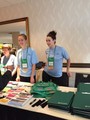
Rebecca Rice (left) and Jasmine Parmeter (right) at the 2015 Educational Conference.
Globe University-Woodbury massage therapy students Rebecca Rice and Jasmine Parmeter volunteered at the 2015 Educational Congress hosted by the Alliance for Massage Therapy Education (AFMTE) and the Commission on Massage Therapy Accreditation.
"This was such a great opportunity for these students to network with industry professionals and to learn more about the state of the massage therapy indtustry," said Sharon Pollock, massage therapy program chair. "This educational congress focused on many crucial topics that students, instructors and industry professionals should be aware of."
The mission of the educational congress was to foster dialogue, inquiry, and creative problem-solving between and among organizations and individuals involved in massage therapy and bodywork education.
According to AFMTE, the idea of having an educational congress was inspired by the voices within the massage therapy education community. The journey began with a discussion at the 2013 Florida State Massage Therapy Association with the Commission on Massage Therapy Accreditation and the Alliance for Massage Therapy Education. It has now grown into an event with nine organizations collaborating and continuing to expand daily.
About AFMTE:
The AFMTE serves as an independent voice, advocate and resource for the massage therapy and bodywork education community. Their mission is to support, strengthen, and elevate educational practices and standards in massage therapy and bodywork.
Why Choose Globe Massage Therapy?
Globe University offers hands-on, quality training giving students the skills they need to be successful in the classroom and most importantly, in their future careers. The program offers both networking opportunities, like Rebecca and Jasmine experienced, as well as real world experience via volunteer opportunities throughout the local community. Click here for some examples.
Not only is massage therapy a rewarding career, but it also is growing 23 percent faster than the national average of other occupations through the year 2022, according to the U.S. Bureau of Labor Statistics.
The post Massage Therapy Students Volunteer at Educational Congress appeared first on Globe University Blog.
Globe University & Minnesota School of Business
.
Blog
.
<span class='date ' tip=''><i class='icon-time'></i> Aug 24, 2015 04:12am</span>
|
|
Written by Brandon Ryans, Health Care Management Program Chair
According to the Bureau of Labor Statistics (2012), employment of medical and health service managers is projected to grow by 23 percent from 2012 to 2013. These numbers are based on the projection of the baby-boom population, as older adults remain active later in life the healthcare industry as a whole will experience a demand for medical services. With a health care management (HCM) degree, healthcare managers (also referred to as health care administrators or executives) can be responsible for planning, directing, or coordinating medical and health services (Bureau of Labor Statistics, 2012).
Career choices with a HCM degree are diverse, which includes working in organizations (but not limited to) such as: clinics, consulting firms, health insurance organizations, hospitals, nursing homes, private practices, mental health organization , public health departments, or universities and research institutions (American College of Healthcare Executives, 2014). Health management positions are readily available at different levels, from entry-level to chief executive officers, for an individual to employ their HCM degree. A HCM degree will supply an elevated opportunity to work in healthcare related departments such as finance, government relations, information systems, marketing, medical/nursing staff administration, planning/development, or patient care services.
Potential employment opportunities at the entry level with a HCM degree would be similar to titles such as provider relations specialist, account representative, or an operations coordinator. With more experience, individuals with a HCM degree will be prepared to work at the senior associate or manager level. Potential employment opportunities at these levels would be similar to titles such as compliance analyst, senior auditor, or an activities coordinator. Supplied by World Wide Learn Online (2015), below are other common titles/positions for a HCM degree:
Ambulatory care center manager
Assistant administrator
Clinical director/manager
Facility manager
Health and social service manager
Health care consultant
Health care financial manager
Hospital administrator
Managed care manager
Medical device/pharmaceutical sales representative
Medical records coordinator/manager
Nursing home administrator
Nutrition service manager
Office manager
Practice manager
Program coordinator
Program manager
As with any professional career, joining a professional association can assist in getting a head start in the HCM field and provide you with resources to help you throughout your career. In a professional organization you will be praised for taking the initiative to learn more about your field while networking with professionals. Beyond networking opportunities and learning, as a member of a professional organization you have connections to internships/job opportunities, field related conferences, information on industry standards, and current HCM policies (Scholnik, 2013).
Career choices in the health care management field are limitless. As the industry continues to grow, your HCM career choices will become more diverse and rewarding. You are the Health Care Managers of tomorrow.
The post Endless Career Possibilities in the Health Care Management Field appeared first on Globe University Blog.
Globe University & Minnesota School of Business
.
Blog
.
<span class='date ' tip=''><i class='icon-time'></i> Aug 24, 2015 04:12am</span>
|
|
Congratulations to Leslie Giffin for winning Globe University & Minnesota School of Business-Online Division’s Research Award! Giffin’s research paper was written for the Applied Ethics class taught by Jon Stambaugh. Giffin is getting her bachelor’s degree in health care management-online. We interviewed Giffin to learn more about her research process and tips for successful researching and writing.
Research Award Winner Leslie Giffin
What is your favorite library resource for doing research?
I like to use the search engine Discovery, it is located on the library’s home page. I like Discovery because I get empirical literature, not necessarily a Wikipedia page. Google gives you opinions and not necessarily academic sources.
What is your best advice for other students who are doing research?
It’s best to start early if you know you have a research paper coming up try to compile as much as you can ahead of time. Sometimes you’ll find an article with a good title and it’s not necessarily what you thought it would be. Start early so you have time to find the right articles. And also - use resources to make sure they are academic sources versus opinion.
How do you know if an article is an academic source?
I look for an academic journal - you can tell from the journal name or the author if it’s academic. I will take the title of the article and Google it to see if it’s locked down. If it’s academic, you won’t get free access. If it’s from EBSCO, you won’t find it free online.
Were there any tips you learned while writing this paper that you’re going to use next time you write a paper?
One part I struggled with is that I’m not used to writing papers with personal pronouns. Usually I’m writing a paper with research on how to do a process properly. It was new for me to write a piece that had my opinion in it. I always use the Purdue OWL for my citations. I went into that to look for how to handle it when there are opinion sections in your paper.
Walk us through your research process:
Most importantly whenever I am writing a paper I have to make sure I know my topic and what my thesis is going to be. From there I start compiling my research by using the resource [Discovery] that the library website has. After I have about 5-7 resources, I start reading through them.
After my thesis is decided, I move onto my main points. Then I look through the research I compiled to back up my main points. I create a skeleton for my paper before I put my content in. It’s like a rough draft so I know where my research will be. After I have my skeleton complete, I start building in the research that I found from my resources. Once that’s complete, one of my favorite resources is the instructor of the class. If they have said you can send them a rough draft, I always do it. They know what they’re looking for so they‘re the best resource when it comes to guidance. Then I submit and cross my fingers for an A!
If you are interested in submitting a research paper for the Research Award check out the details here.
The post Research Award Winner Shares Secrets of a Successful Research Paper appeared first on Globe University Blog.
Globe University & Minnesota School of Business
.
Blog
.
<span class='date ' tip=''><i class='icon-time'></i> Aug 24, 2015 04:11am</span>
|
|
Accolades are in order to the 232 Globe University & Minnesota School of Business Online students who have had exceptional academic performance to meet the recognition of Honors or Highest Honors for the Spring 2015 quarter.
In order to receive Honors recognition a student must achieve a quarterly grade point average of 3.5 or above. To achieve Highest Honors a student must have a quarterly grade point average of 4.0.
Congratulations to the students who have dedicated themselves to their class work to achieve Honors and Highest Honors!
Spring Quarter 2015 Highest Honors
Spring Quarter 2015 Honors
The post Honors and Highest Honors Announced for Spring Quarter 2015 appeared first on Globe University Blog.
Globe University & Minnesota School of Business
.
Blog
.
<span class='date ' tip=''><i class='icon-time'></i> Aug 24, 2015 04:11am</span>
|
|
There is a fashion trend sweeping the internet right now. Yes, I said fashion trend. Don’t worry, this is still the Everything eLearning Blog. We have not changed it to the Everything Stephanie and Christie Wear Blog. Yet.
Fashion bloggers, business professionals, stay-at-home moms, and more are all embracing the Capsule Wardrobe Movement. I embraced it for all of three days, and then decided I loved my clothes more than I loved minimalism. Essentially, you pare down your wardrobe to anywhere from 30-50 pieces—depending on your lifestyle and work requirements—for each three-month season. The idea is that it helps you define your personal style and gives you more time to focus on the more important things happening in other aspects of your life, because you’re not spending 25 minutes every morning trying to decide what to wear.
So, what if you created a capsule wardrobe for your eLearning content?
What if you limited yourself to three fonts and four colors per project? What if you said "I will only use photo-realistic graphics from now on?"
The result: cleaner, simpler eLearning design with more time to focus on creating engaging interactions and dynamic quizzes.
Take it from art director Matilda Kahl in New York, who actually wears the exact same outfit to work every day and says having a uniform keeps her from having creative fatigue when she’s working during the week. Or talk to Courtney Carver, one of the frontrunners of the capsule wardrobe trend. "All creatives like to express themselves through what they wear, but they’re finding they are better able to focus their creative energies when they’re not thinking about how to create the perfect look."
Here are a few tips and suggestions for starting your capsule font collection:
1. Pair typefaces that are in the same superfamily—like Batman and Robin. Just kidding! A superfamily (or type system) is a family of fonts that contains a large set of weights and widths. Check out this example from Google Fonts.
2. Play with similarity and contrast. Using two typefaces that are similar to each other—in things like x-height, ascenders, descenders, terminal shape, etc.—can create a consistent tone for your content. Be careful though—if you choose two fonts that are too similar, you might as well just use the same font. Using radically different fonts brings a balance and visual hierarchy to your page. An easy way to bring in contrast is to pair a serif typeface and a sans serif typeface.
3. Scope out Pinterest. You can find tons of font combinations and design ideas on Pinterest. For example, Pinterest led me to this graphic from blogger SFGirlByBay:
Keep in mind—many of the fonts recommended on Pinterest aren’t free, or aren’t standard system fonts. But if you find a font pair you just have to use, this guest blog by Sergey Snegirev walks you through how to use custom fonts in Lectora® eLearning software.
Can’t get enough of fonts and eLearning design? Here are a few more design resources from the Everything eLearning Blog:
e-Learning What Not to Do… BuzzFeed Style!
Tips from a Graphic Designer
Want a Head Start? Course Starters Are the Way to Go!
As always, don’t forget to subscribe, so you get all our great posts. And let me know if you decide to try out a capsule font collection—or a capsule wardrobe!
The post Define Your eLearning Style with Capsule Fonts appeared first on .
Trivantis
.
Blog
.
<span class='date ' tip=''><i class='icon-time'></i> Aug 24, 2015 04:09am</span>
|
|
Need an engaging way to introduce new content to your learners? One that will get their brains thinking… and not snoozing? Instead of presenting introductory information (text, a graph, or photo) on a plain course slide, try this idea in the Trivantis Community.
Add these drag and drop puzzle interactions to your Lectora® eLearning course, and turn new content into an engaging puzzle! Wendy Miller on the Trivantis team got creative and used an ungraded Drag and Drop Question object to create both a single-drop puzzle (where learners can drop the puzzle pieces on only one drop target) and a multi-drop puzzle (where learners can drop the puzzle pieces on any drop target).
Download the Photoshop template files in the Trivantis Community to create single-drop and multi-drop puzzles with your own images in your eLearning course today!
Download Single-drop Interaction
Download Multi-drop Interaction
The Trivantis Community is your place to connect with Lectora and CourseMill® users across the globe, share and showcase the content you’ve built in Lectora and Lectora® Online, or browse the Knowledge Base for resources like webinars, articles, and video tutorials. Join the community today!
Subscribe to the Everything eLearning Blog for all the latest eLearning posts.
The post Free Download: Lectora Puzzle Interaction appeared first on .
Trivantis
.
Blog
.
<span class='date ' tip=''><i class='icon-time'></i> Aug 24, 2015 04:09am</span>
|
|
The translation process can make your head spin. From finding someone who can translate content to making sure your training material is ready for deployment, there are a dizzying number of steps that can slow down the process. Add in the inability to read or edit incoming content, and you have a logistical nightmare. But it doesn’t have to be that way. Here are 7 tips to streamline the process.
1. Get management buy in and secure talent early.
Securing management support and getting an appropriate team size before starting the translation process ensures that you have willing participants in the process. If possible start by hiring contractors or freelancers, but be sure to find someone who can successfully communicate in your native language as well as the language being asked for and who can assign a contact point in your region to avoid time zone hassles and delays. If your company is trying to use internal resources or reduce the overall cost, then the person completing the translation would probably be an employee. This employee should be made aware of the extra task and how it helps the company from his or her employer before the process takes place. Include information like total number of documents, expected hours per week contribution, and due dates.
2. Be concise.
Edit down the (English or other source language) version, so it includes concise wording. This ensures the translation is more likely to come back clean and that the project scope is narrowed. Outsource translation firms often charge by the word, so you’ll be saving money too! Check for clauses or phrases to see if they can be reduced to a simpler construction. Then quickly scan your script for possible edits—look for unnecessary:
• Adverbs,
• Pleonasms,
• Metaphors,
• Inappropriate culture gestures or references,
• Clichés or colloquialisms, and
• Euphemisms.
3. Do a red flag check.
Review the material for potential issues. Check for text on images to see if they need to be translated or recreated. Be sure the content is generalized when needed and refined to localized content when necessary. During a rather large project, we had a standard course translated into multiple languages. Because the red flag check wasn’t done, no one realized (of course until it was too late) that the content was instructing European countries about electrical safety using American standards (220 versus 110 and pictures of the wrong type of plugs).
4. Vary your images.
As a good general practice, include images that are not biased when it comes to gender and race. This can be especially important when working with clients across the globe. On one project I worked on, I was called out for using "too many females" even though the mix throughout the course was 50/50. Do what you can to prepare and have additional images on hand if needed.
5. Leave room for text to breathe.
Be sure to leave enough room for text and respect the languages nuances. In some languages, punctuation is different (Thai uses none) while accents may be used in other languages (Spanish). Brush up on your linguistic investigation skills and be prepared to scan the document accordingly. While the facts and figures I’m going to throw out are hotly debated in the translation community, here are some basic "guidelines" to follow regarding the space of a language compared to English:
• Hebrew text tends to be 1/3 shorter
• French languages tend to be ¼ longer
• Scandinavian is almost word for word with the expectation of Swedish which tends to be longer
• German includes compound words which makes for longer line spacing
• Thai is longer and also includes no punctuation so only spacing is used to separate sentences
• Double byte characters such as Chinese and Korean are shorter
• Russian is debatable, but most agree it’s a little longer
6. Provide guidelines.
When possible, provide a document with general guidelines. This can include:
• Common words to be used
• The difference between abbreviations—which should be kept and which ones should be replaced
• "Slang" that’s appropriate to use
• Instructions on using informal versus formal
You can also include best handling tips for the RTF like:
• Using Arial Unicode MS (it’s able to accommodate almost every language)
• Opening the document in Notepad or WordPad (Word sometimes transfers unseen characters which can cause spacing and phantom objects on the page)
• Checking the document for white text (that one took a while to figure out)
• Not removing or editing the "do not edit" lines
Most importantly, provide instructions on how to access the English version (or other source text version) for reference. A lot of questions a translator may have can easily be resolved using reference to the native piece and contextual clues.
7. Ask for help!
Unless you’re required to know the language you’re translating material into, there’s no harm in asking for help. For especially complicated courses with transitions or content that’s presented in complex manners like charts, create a key and ask the translator to fill in the blanks. If needed, have your developer and translator meet to ensure the course is built correctly.
Editor’s note: Special thanks to our guest author, Jennifer Valley!
Jennifer Valley is an Instructional Designer with five years of experience in learning. She loves sharing and conversing on social media, blogging, and spending time with her family. You can read her blog here, as well as follow her on Facebook and Twitter.
Subscribe to the Everything eLearning Blog for more guest posts from industry insiders, free resources, and eLearning tips.
The post 7 Tips to Streamline Translations appeared first on .
Trivantis
.
Blog
.
<span class='date ' tip=''><i class='icon-time'></i> Aug 24, 2015 04:08am</span>
|
|
The Experience API (xAPI) is an updated standard for tracking eLearning; it shows a more complete picture of your learners’ activity than SCORM does. xAPI was created by Rustici Software to replace SCORM (an earlier set of technical standards for eLearning software products).
Let’s talk about the background of SCORM and xAPI for a minute.
The ADL—or Advanced Distributed Learning—recognized the need for a set of standards to ensure that programmers write code that can play well with other eLearning software. First, they created SCORM—Sharable Content Object Reference Model. Years later, when SCORM couldn’t do everything needed, the ADL asked Rustici Software to create an updated standard: The Experience API or xAPI.
Rustici Software says they called xAPI the Tin Can API at first because "it was meant to be a two-way conversation between us and the e-learning industry. It’s only fitting that the solution be named the Tin Can API - an elegant solution for letting us communicate with one another." The ADL now calls the Tin Can API by the name Experience API because it fits the eLearning community better; xAPI’s purpose is to store and provide access to learning experiences.
With xAPI, you can track experiences like:
• Mobile learning
• Serious games
• Simulations
• Informal learning
• Real world performance
By tracking all kinds of learning experiences, xAPI can help you measure the ROI from your online training.
With xAPI, you can find out which training methods are successful and which aren’t worth continuing. Data is based on completed eLearning modules, completed simulations, and results of an assessment on the topic.
Instructional designer Jared Schaalje uses xAPI to measure training success. In an interview with Rick Zanotti, he says, "It’s great. With xAPI, with things I’ve built and that I’m going to continue to build, we can capture so much data on the learner… We can data mine, and we can display just the minimum that the executives and that the learner themself needs to see—but then going back, we can go and do data mining, and it’s almost like a dream come true."
You can watch the full video of his interview with Rick Zanotti here:
For more eLearning articles and tips, subscribe to the Everything eLearning Blog.
The post Why the Experience API (xAPI) Is Crucial to Your eLearning Success appeared first on .
Trivantis
.
Blog
.
<span class='date ' tip=''><i class='icon-time'></i> Aug 24, 2015 04:08am</span>
|
|
Trivantis recently added another Lectora® training option for our users: video training. You can now purchase on-demand video training courses for Lectora Fundamentals and Lectora Intermediate in the Trivantis shop. That means you can access training videos from our Lectora eLearning experts anywhere, anytime!
Why video training?
With Lectora video training courses, you can learn Lectora authoring software at your own pace, right in your office or home. The videos have interactive instructions, quick tips, and engaging simulations right from the Lectora experts.
The courses are hosted online, and you can access them anywhere, anytime for up to thirty days from when you purchase them. For example, let’s say you want to review a specific section, or you’re working late one night and want to reference a technique. With these video courses, you can do that.
To give you a better idea of what video training courses are like, I asked one of our fantastic trainers, Gina White, a few questions:
What is one of the most common topics that new users need help with and is addressed in Lectora training?
Variables. Lectora Intermediate training will introduce you to variables and reinforce the logic.
What are a few examples of topics covered in Lectora Fundamentals?
The Fundamentals class will teach you the basics of Lectora® Inspire, including an introduction to many of the menus within the application and the various object properties. In this class, you’ll build an eLearning course from scratch consisting of: chapters, sections, pages, and a graded test. You’ll include a variety of media within your title to engage learners and learn how to create basic actions (such as rollovers), navigation, customized buttons, and various question types. You will also learn how to publish a title to ReviewLink™ and to HTML for access via the Web.
What are a few examples of topics covered in Lectora Intermediate?
The Intermediate course will focus primarily on using variables and conditional actions within a title. In this course, you’ll learn how to take your Lectora knowledge to the next level. You’ll use variables to track user interactivity, display both generic and user information, and conditionally branch within a title. Finally, you’ll learn how to publish a title to AICC/SCORM, for use within a learning management system.
What if I’m not totally new to using Lectora? Can I jump ahead to Lectora Intermediate?
Yes, you are able to skip through to the Intermediate course. The Intermediate class goes above and beyond the basic uses of Lectora. Prior to taking this course, you should be comfortable with creating a course structure, adding content to a title, creating buttons, and have an overall understanding of Lectora’s book metaphor, inheritance, and modes. These concepts are covered in the Lectora Fundamentals Training.
Thanks, Gina, for the info!
Interested in taking a course? Sign up for video training today!
For eLearning articles and tips every week, subscribe to the Everything eLearning Blog.
The post Why You Need to Sign Up for Video Training Courses appeared first on .
Trivantis
.
Blog
.
<span class='date ' tip=''><i class='icon-time'></i> Aug 24, 2015 04:08am</span>
|