Blogs
|
If we were a supermarket, we’d have just dropped balloons and streamers on our good friends over at Tandem Learning. But, since we’re 798 miles away from them, we just had cake and ice cream at the office instead.
Why the hoopla? Well Tandem is our 100th paying SCORM Cloud customer and we think that’s something worth celebrating.
We’re not a very metrics-oriented company. We believe that if we focus on serving our customers well, the numbers will take care of themselves.
With SCORM Cloud though, we took a bit of a gamble. We made a significant investment in an innovative product that, frankly, we weren’t sure if people would understand or want.
To ensure that we didn’t throw good money after bad, we set up a scoreboard to monitor adoption. At every turn, the scoreboard has been ahead of our projections and as it adds its third digit, we’re sure we’ve hit on something good.
It’s been amazing to watch the variety of ways people are using SCORM Cloud to distribute learning.
Tandem Learning is using SCORM Cloud to deliver "The Change Game". "The Change Game is an avatar based serious game that will help increase a player’s agility in a changing environment by strengthening their personal resilience" and, in my opinion, is a stellar example of what online training should be like.
Tandem needs to deliver "The Change Game" to small groups that don’t always need the overhead of an LMS. They were already using the SCORM Cloud Sandbox as a testing platform and simply started sending out invitations to use it as a delivery platform.
So, thank you Tandem and the rest of our SCORM Cloud customers. We’re excited to see what comes next for the Cloud.
Rustici Software
.
Blog
.
<span class='date ' tip=''><i class='icon-time'></i> Aug 24, 2015 06:22am</span>
|
|
"we made this chart and it just looked dumb so we changed it"
-Mike Rustici
We recently decided to change the way we represent the different account options on the SCORM Cloud sign up page. We made a nice looking table that would allow users to do side-by-side comparisons of the different account levels. It looked great except for this one place in the middle where there was just too much text.
"The Big" plan wasn’t as straightforward as the others. Instead of just one price for all overage registrations, the price was discounted after a certain threshold was met. Evidently the additional code to handle the pricing complexity wasn’t enough to make us want to simplify. Likewise, explaining the pricing to users didn’t clue us in, either. But such a glaring blemish on an otherwise streamlined table just wouldn’t do.
The solution? Remove the extra text by simplifying the price structure.
Now The Big plan has one price for each overage registration. At 33 cents per overage, The Big plan is cheaper for all "The Big" plan users.
We like the way the new pricing table looks, and apparently our vanity can save you some money.
Rustici Software
.
Blog
.
<span class='date ' tip=''><i class='icon-time'></i> Aug 24, 2015 06:19am</span>
|
|
If you’ve been paying close attention, you may have noticed a prerelease of our latest SCORM Cloud feature, support for IMS BLTI plus Simple Outcomes.
BLTI provides a simple way for LMS users to incorporate remote tools into their system. Think of it as a super-simple plugin architecture.
Used mostly by academically-oriented LMS’s, BLTI provides a way to authenticate users from an LMS into a tool offered by another vendor. Simple Outcomes is an informal extension to BLTI that allows for very basic results reporting from the tool back to the LMS.
People love SCORM Cloud for it’s ease of integration, but we’re constantly looking for ways to make integration even simpler. BLTI is step along that path.
SCORM is underutilized in the education market. This is partly because academically-oriented LMSs have historically had weak SCORM support and partly because the tracking that SCORM provides hasn’t always been valued in academic circles the way it is in corporate circles.
With greater emphasis on assessment and measurement in education, we believe that detailed tracking will be increasingly important. We hope SCORM Cloud’s BLTI integration will help bring the power of SCORM and the vast quantity of SCORM conformant content to this important segment.
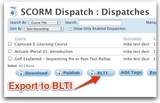
The BLTI export can be found in the SCORM Dispatch section of Cloud. To expose a SCORM course as a BLTI tool, simply create a Dispatch, click on the BLTI button and then copy the provided credentials into your BLTI LMS. That’s it. Your LMS will now be able to launch the SCORM Course. SCORM Cloud will maintain all of the detailed tracking data on the course and report back a score to the host LMS.
Special thanks to Dr. Chuck for helping us put this together. To see a list of other products that support BLTI, check out the LTI list on eLearning Atlas.
Rustici Software
.
Blog
.
<span class='date ' tip=''><i class='icon-time'></i> Aug 24, 2015 06:19am</span>
|
|
A car salesman’s credibility is quickly lost when he guesses what size engine is under the hood or what the gas mileage could be. Claiming a car has "good" gas mileage is not the same thing as knowing it’s 40 mpg. A 6-cylinder engine can come in a variety of flavors… in-line or V, turbocharged or naturally-aspirated, these details create some machines that are much faster than others. With cars, more is not always better, sweating the details creates vehicles that keep "car guys" debating for hours. People who care nothing for cars will make generalizations that make me cringe, but nobody wants a guessing salesman to help choose the perfect vehicle.
How do car specs relate to eLearning standards? SCORM 2004 comes in three flavors, 2nd edition, 3rd edition and 4th edition… it can be confusing. Nearly 75% of the products in our eLearning Atlas that support SCORM 2004, don’t specify which edition is implemented. While I’m sure the development team behind these companies understands the differences in the standard, the customer-facing side generally has no clue. Most don’t even bother to guess or publish it on their website. SCORM 2004 is powerful, but all editions are not created equal, most editions do not play nicely with one another.
The generalization of SCORM 2004 sometimes creates compatibility issues that can be a source of frustration for customers. In order to truly understand if a piece of content and a LMS will easily work together, it’s crucial to know that they speak the same language, er, SCORM edition. I’ll quietly challenge those that generalize to express the details they support, even it’s not presented prominently. The eLearning Atlas provides an easy way to find the companies that know exactly which edition of SCORM 2004 they support. However, if a generalization of the standard is all that a user really needs, the eLearning Atlas has that covered as well.
Rustici Software
.
Blog
.
<span class='date ' tip=''><i class='icon-time'></i> Aug 24, 2015 06:19am</span>
|
|
Ever since we came up with the idea of the eLearning Atlas, we’ve been thinking about ways to make it better for our users.
What we realized was, as great as we are, we can only do so much. So we started thinking about what to bring to the Atlas next. We are proud to say that Craig Weiss of eLearning 24/7 has graciously agreed to share his professional insight on some products listed on the Atlas. How’s that for exciting! What we love so much about Craig’s product reviews is he takes a non-biased, no BS approach. Craig will be adding comments in the Atlas to the products he has reviewed and providing links to his full reviews.
"I am absolutely thrilled to work with eLearning Atlas and being able to provide an independent assessment of each product. As a reader you can expect the same approach I use on my blog - right to the point without any fluff. Plus you will be able to gain additional insight with direct links to an extensive product review."
- Craig Weiss
We can’t thank Craig enough for the great addition to the eLearning Atlas. We built the Atlas to bring the eLearning community together and form a community. We hope that Craig is just the start, join the discussion by adding your own comments on the products and companies you love!
Rustici Software
.
Blog
.
<span class='date ' tip=''><i class='icon-time'></i> Aug 24, 2015 06:18am</span>
|
|
We created the eLearning Atlas to be an ideal tool to easily find the proper solutions. Jena and I have tried to speak to every company in the Atlas, and we continue to seek those that we’ve missed. This process provides a valuable pool of data. Rather than hoard this information, I thought it would be nice to share.
Let’s take a graphical look at some of the interesting conclusions I’ve drawn. The following graphs only include traditional products that can implement standards (Authoring Tools, LMSs, LCMSs and Content Libraries). Here we can see the haves and the have-nots:
eLearning Atlas Products That Support At Least One Standard:
A look at the Haves:
So, what does this all mean? For the majority of the industry, SCORM works, but there are lots of eLearning products out there that don’t play nicely with one another. The creation and delivery of content is a hard problem to solve, without a common standard or model… it’s really hard to solve. When developers try to fit a unique course into a unique learning system… things get complicated. When eLearning gets complicated, things get expensive.
The eLearning Atlas proves that there are thousands of possible companies who can create, manage and deliver eLearning, some doing it without any claimed support for standardization. For some companies, the expense of stepping outside their branded box of solutions, locks a customer in for life. We think SCORM frees people to choose the best fit. The eLearning Atlas can help users easily filter out the noise of companies who are not interested in playing nicely with one another, and make connections with products that want to work together.
To look at it another way, we’ve currently found 219 Authoring Tools, some being used by 360 Custom Content Creators to make training that will be delivered using 655 LMS/LCMSs… that’s 51,640,200 possible combinations. Trying to fit all those pieces together, each time, is a daunting task and the exact pain ADL created SCORM to solve. SCORM (and other standards) help eLearning providers play nicely with one another; the eLearning Atlas can help users find the products and services that will play nicely with the systems they already use.
Rustici Software
.
Blog
.
<span class='date ' tip=''><i class='icon-time'></i> Aug 24, 2015 06:18am</span>
|
|
Brought to you by SCORM.com, the e-learning standards experts.I answer a lot of SCORM questions ranging from the basic to the extravagant, and I actually like it. A huge part of what I do is teaching about SCORM.
Sometimes, though, I get questions that make me laugh. Today, I feel like I need to share this one because it isn’t the first time I’ve gotten a question like this one.
What is Scorm Compliance?
OK, good question. I get this one a lot, so I have a sense of where it’s headed. My answer:
Is this what you’re looking for? The distinction between compliance and conformance? Or something more like this, a basic description of SCORM?
The response (slightly rephrased):
Yes both are good. There is a training specialist job interview question? "Which of the following best describes your experience with Scorm Compliance?" (Then # years and months choice) So what does experience with Scorm Compliance mean in this context?
Let’s cut to the chase. The answer is none. You have no experience if you don’t know what it is.
Funny, yes. Uncommon? Not entirely. People think, or more accurately hope, that their products are SCORM conformant. Let me put it simply… if you haven’t tried, or worked at it, your product simply is not SCORM conformant, or IMS BLTI compliant, or AICC conformant. These things take effort. And so does acquiring SCORM experience as an individual.
Brought to you by SCORM.com, the e-learning standards experts.
Rustici Software
.
Blog
.
<span class='date ' tip=''><i class='icon-time'></i> Aug 24, 2015 06:17am</span>
|
|
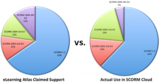
Brought to you by SCORM.com, the e-learning standards experts.When looking through the eLearning Atlas, I wondered if the versions of SCORM that companies claim to support are closely matched to what we see being used in reality, via SCORM Cloud. Let’s check it out:
Versions of Claimed SCORM Support in the eLearning Atlas vs. Use in SCORM Cloud:
When I last reviewed our SCORM Cloud stats, I noticed just how closely the actual use of different standards mapped to the claimed support. Obviously SCORM 1.2 is the most popular and has nearly identical use in our SCORM Cloud. However, many may claim to support SCORM 2004 4th edition, but few actually generate courses using it. I realize SCORM 2004 isn’t always easy and it can create some confusion, could this be the reason for the difference? Maybe the 3rd edition was widely implemented and some became weary of another upgrade. It’s also possible that some of the 4th edition experts out there have no need to test content on SCORM Cloud. I’ll continue to pick at this, but the exact answer is unknown to me.
Whatever the reason for 4th’s variance, it’s comforting to know that the standards we mapped in the eLearning Atlas closely match the real-world behavior in the SCORM Cloud. As we continue to develop both tools, what other correlations or discrepancies do you expect to find?
Brought to you by SCORM.com, the e-learning standards experts.
Rustici Software
.
Blog
.
<span class='date ' tip=''><i class='icon-time'></i> Aug 24, 2015 06:17am</span>
|
|
Brought to you by SCORM.com, the e-learning standards experts.Most people think buzzwords are annoying, trendy and overused words that pop up everywhere. Buzzwords serve one purpose: to drum up excitement around an idea, product, or event. That’s why people use them.
While Chris and I worked through the Atlas, we kept an eye on words that came up to see if we could find any trends in the industry. I’m not one for graphs and charts, that’s more Chris’s speed. What I’m into are trends and patterns. (If you were wondering, I have an affinity for plaid, houndstooth and ikat patterns).
After months of observation, one of the trends we saw was a move in the industry towards social learning.
Everyone has different meanings for what "social learning" is and what it does. For some, it means collaborating with others while creating or viewing content. For others, social learning means simply the integration of social media, like blogs, wikis, Twitter or Facebook into traditional eLearning. For me, social learning is both of these things.
A few months ago, I added Cookie Intern to my resume here at Rustici Software. A match made in heaven, as I love to bake and the Rusticians love to eat.
All of the sudden, every batch of cookies started tasting like soap. I couldn’t figure it out. I changed pans, mixing bowls, spatulas, everything. I took my questions to Facebook and Twitter, begging my friends to provide suggestions, hints, anything that would vanquish this soapy situation. They posted helpful links and speculations, and finally I got my answer. Baking soda.
Old, old baking soda that began its journey with me as a high school senior, watched me matriculate at Alabama, witnessed the glory of our 2009 National Championship (Roll Tide), smiled at my graduation, and travelled with me to my new home in Nashville. Who knew that old baking soda made cookies taste like soap, right?
Anyways, my point is that I could have Googled the answer myself but I used my community, where my friends and family could brainstorm with me and the group came to the final conclusion, together. This is what social learning is all about: making connections to people and what they know.
Chris and I have been fortunate enough, through working with the Atlas, to discover companies who are integrating different forms of social learning into their solutions. Take a look at all of the different companies in the eLearning Atlas that are making the move towards social learning.
So keep your eyes open, eLearning world. We’ve only scratched the surface of what social learning is capable of.
Brought to you by SCORM.com, the e-learning standards experts.
Rustici Software
.
Blog
.
<span class='date ' tip=''><i class='icon-time'></i> Aug 24, 2015 06:16am</span>
|
|
Brought to you by SCORM.com, the e-learning standards experts.I’m that kid. When you talk about the new kid around the office, the one with a phone practically glued to her hand, constantly texting (I sent over 1,650 last month alone!), the aptly named "digital native", you are talking about me.
When it comes to mobile technology, when you aren’t talking about kids like me, you’re talking about mobile learning. But the weird thing is, you all mean different things when you talk about mobile.
Mobile means different things to different people. Instead of spouting out my thoughts about what mobile is and what it does, I will stay neutral and point you to the eLearning Atlas instead. We’ve uncovered a lot of really great companies making waves with mobile learning, so take a look and see what they mean when they say mobile. If you are looking for a mobile solution, this is definitely the place to start. We’ve got over 100 platform providers, authoring tools and content creators working with mobile learning in a variety of ways.
Whether you are creating stellar mobile content or new ways to access it, if you aren’t a part of the Atlas, pretty please let me know. I’m running low on text messages for the month, so get in touch via smoke signal or email me at jena.lawing@scorm.com this time around. Thanks!
Brought to you by SCORM.com, the e-learning standards experts.
Rustici Software
.
Blog
.
<span class='date ' tip=''><i class='icon-time'></i> Aug 24, 2015 06:16am</span>
|