Blogs
|
I'm very excited to share a new class project which is about to start. It's going to be a collaboration Brazil + Argentina. After contacting my PLN friends from our neighbour-country, Argentina, Jennifer Verschoor accepted the challenge.We both have teenage students who are going to be in contact during 4 weeks.What's the project about?PROJECT: Hello, there!TYPE OF LEARNING: Language GOAL: participants will be able to develop communication skills in the English Language. TARGET AUDIENCE: a group of teenage students (14-16) from Brazil and Argentina. TECHNOLOGY EXPECTED: students will be using their own devices (cell phones, tablets or computers) to communicate in Edmodo. STAKEHOLDERS: teachers, parents, directors. DEADLINE: project will be developed during four weeks. PROJECT DESCRIPTION:18 students from Brazil will be paired up with 18 students from Argentina to communicate during 4 weeks. Objective: to learn as much as they can about the other student and the place where he/she lives during this period of time. At the end of the 4 weeks, each student will write a report to the teacher expressing what they have learned.Platform: students from both countries will join an Edmodo group. Both teachers, from Brazil and Argentina, will be the managers of the group. Students will be divided in small groups in Edmodo (pairs) where they can develop a conversation. Their communication can be via text, audio files, videos, photos using any kind of file they wish to attach to their messages. Teachers will have access to their communication the whole time.Teachers' role: to get students in contact, divide them into pairs and manage their conversation. Students' messages don't need to be corrected by the teacher beforehand as the objective is not accuracy but the development of a conversation. However, the teacher can prepare activities to be carried out in class with some common mistakes observed (without identifying students).Final Task: by the end of 4 weeks, each student should publish a report to their teacher, explaining how the communication took place and what he/she learned about the other student. The final report should contain at least 200 words and images/ videos to illustrate it. The reports will be posted on a common wiki: http://projecthellothere.pbworks.com/ which will then be shared with parents.Our students are joining the Edmodo group this week, so let's see how it goes.
Ana Maria Menezes
.
Blog
.
<span class='date ' tip=''><i class='icon-time'></i> Aug 26, 2015 09:17pm</span>
|
|
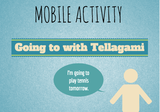
Language focus: describing appearance and going to.Device: Cell phones or tablets (one per person)App: TellagamiInteraction: student - student, student - deviceTime frame: 15 mins.Connection: offlineSome weeks ago, I presented a workshop at Cultura Inglesa Uberlândia on OFFLINE MOBILE ACTIVITIES. We focussed on some apps which allow students to work offline once the app has already been downloaded to the device.We had great fun and brainstormed several activities we could develop with the apps TELLAGAMI and SIMPLE MIND. Both apps are available for IOS and androids.A few days later, a very creative colleague of mine, Ana Cláudia, tagged me on a facebook post where she shared pictures of her students using Tellagami in class.Then, I asked her to describe the steps she had followed.1. Students created their avatars using the app. They could customize the hair, eyes and clothes.2. Students interacted showing their avatars to other students and asked and answered questions about their appearance.3. Students recorded the avatar saying what they would be doing the following day. Ex: I'm going to play tennis tomorrow.4. Students exchanged devices, listened to the avatar speaking and repeated what they heard.Another variation for step 4 would be for students to listen and write the sentence they hear, then they could keep exchanging devices and write other sentences they hear.
Ana Maria Menezes
.
Blog
.
<span class='date ' tip=''><i class='icon-time'></i> Aug 26, 2015 09:17pm</span>
|
|
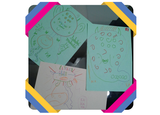
I love simple activities! A very creative colleague of mine, Luiza Helena, shared two activities she has tried with her junior students recently.Luiza explains:"Well, here is a photo of a very simple activity. The students were organized in a circle. The teacher gives a piece of paper and they have to start drawing a monster. When the teacher makes a sound students change papers and continue the previous monster and go on. The teacher continues making sounds so students change the position of the monsters until get their own. The fun is that students don't make only one monster but it is a collaborative work. At the end, students laugh a lot and say: This is not mine. What have you done with mine?... They create a name and then others vote for the best one."Then, Luiza shares a second one:"Today I did an activity and I also took a picture of it. It is a sleep diary. You give each student a sheet of paper (A4). They fold and cut it and then staple it in a format of a diary. Inside they write one information in each side, for example: I go to bed at...; I wake up at...so on... Students can tell if they dream or not, how many hours do they sleep ... etc. The diaries are so simple but cute. They made cute drawings inside.Thanks for your interest in these simple ideas."
Ana Maria Menezes
.
Blog
.
<span class='date ' tip=''><i class='icon-time'></i> Aug 26, 2015 09:17pm</span>
|
|
This is an activity shared by a colleague of mine, Stela Morgado. Language focus: the timeLevel: BasicDevice: Interactive White BoardSite: http://24timezones.com/ Interaction: student - studentTime frame: 10 mins.Connection: onlineStela describes the activity:Project: What time is it in...? 1. Go to the website http://24timezones.com/ 2. Invite a student to come to the board and choose a place around the world. Click on the place. 3. The student should then choose a friend and ask "what time is it in London?" (for example). 4. Elicit alternative ways of asking about the time: What´s the time...have you got the time, etc. 5. One of my B1 students, Crissiê, invented a follow-up activity. The T can publish the link at Edmodo. Ss take turns choosing places and asking the time around the world to other students through the reply icon. (I´ve attached the photos of Giselle and Geovana during the activity).* Alternative topic: What´s the weather in...? What´s the temperature in...? Ss can use the site http://weather-finder.com/?gclid=CNvq_qHW2L0CFUoV7Aod4B8AEA or upload an app to the mobile(e.g A weather life)- Suggestion from Patrick a Basic 3 student.
Ana Maria Menezes
.
Blog
.
<span class='date ' tip=''><i class='icon-time'></i> Aug 26, 2015 09:16pm</span>
|
|
This post is an account of my first test with the website APPEAR.IN , which allows you to video chat with up to eight people for free. https://appear.in/How does it work?As usual, I was super excited to try it out. I created my own room TESTINGANA, copied the link and sent an invite to my PLN on Facebook.A few minutes later, I got my first visit, an American lady (I didn't get the chance to ask her much as she only dropped in to say hello). Then, Cíntia Rabello, an e-friend, an e-colleague, I had never had the chance to talk f2f accepted my invitation to try the room. Thank you, Cíntia!As no one else joined us and we wanted to see how the webcam images looked with more than two people, Cíntia got into the room with another device. We talked a bit about her PHD experience in England which I had been following via Facebook and also checked what was possible to do with the site.Two Brazilians together..... our conversation was in Portuguese, of course. I also tested recording a part of our conversation with QUICKTIME on my Mac. I guess the same kind of recording (a screencast) would work with SCREENCAST-O-MATIC or JING. What did I like about it?1. It's free.2. There's no need to log in or to have an account.3. It's not necessary to download anything.4. A simple interface, just click and talk.5. The chat room also provides a text chat space.How could we use this site with students?- To meet with a small group of students.- If you have a big group of students you can organize groups of 8 who could get together on different days to practise discussing a topic or even chat using English.- A group of students could interview a foreigner or an expert in a field.
Ana Maria Menezes
.
Blog
.
<span class='date ' tip=''><i class='icon-time'></i> Aug 26, 2015 09:16pm</span>
|
|
Do you have to assess your students' oral performance in English? Do some of your students feel anxious and end up speaking less than they normally do in a normal class? Do you, teacher, feel exhausted after a whole class assessing pairs of students? If you can relate to some of these questions, this post might interest you.The objective of this post is to share my experience in trying to make the oral assessment moment a less threatening one, where my students can speak to each other while I observe how they have been using the English language.In 2012, I had the great pleasure to study about Evaluation at UFU (Universidade Federal de Uberlândia, in Brazil). I learned a lot and one of our first topics was about the difference between ASSESSMENT and EVALUATION. I had always understood an assessment as an ongoing process which involves observing not only the 10 minutes a pair communicates in front of a teacher for marking purposes, but specially the overall performance observed during the classes. So, what is the difference?Table from online document http://duke.edu/arc/documents/The%20difference%20between%20assessment%20and%20evaluation.pdfWhile reading several books and participating in discussions, an important point I had failed to observe was the objective of an Oral Assessment. If an Oral Assessment in the middle of the semester is supposed to be formative, its goal should be to diagnose areas for improvement. I asked myself: Have the Oral Assessment interviews I've been conducting with my students for years and years been diagnostic or judgmental? Due to my dissatisfaction with the way I had been assessing, or better, evaluating my students, as a final project for the Evaluation Class I had been taking at University, I decided to try something different.Considering that we can continuously assess our students orally during our classes, the oral assessment moment would be one more opportunity for focussing on the speaking skill, therefore, there would be no need to check every little word each student spoke.My proposal:1. ONE CLASS BEFORETell students about the oral assessment moment which will take place the following class and explain that they will be doing the same kind of activities they normally do in class. Show the rubrics to students:By explaining the rubrics to students, they could understand that my focus was not to write down every little mistake they make, but how well they can communicate with others. I also asked them why the item INTERACTION had a different mark (1-2-3-4) from the other items. They promptly answered "Because it's more important". I told them their marks (yes, for the school record there has to be a mark) would be a combination of 3 observations: my impressions, their own impressions and their peers' impressions.2. THE DAY OF THE ORAL ASSESSMENTThe idea is to use 40 minutes of a normal class ( we have two 80 minute classes a week) for the oral activities during which pairs or groups of students will be engaged in communicating while the teacher can move around the room observing and taking notes of their oral performance individually on the following marking sheet. https://docs.google.com/file/d/0Bzu68Gr4amCudmxzZWptT3FrVG8/editBefore the activity, organize the desks into 4 groups at different corners of the room ( I normally have a maximum of 16 students). So with bigger groups, I might have groups of 4 and in smaller groups, trios or pairs. On each corner of the room, there's a communicative activity they have to carry out for the period of 5 to 7 minutes. To set the time limit, I normally use http://www.youtubealarm.com/ , then when the time is over a song is played and students move to the next station and a different activity, like a "carrousel".This is a video I made of a group of students during the Oral Assessment moment. Do they seem nervous? After all the groups have covered the 4 stations or the 4 different activities, show the rubrics to the students again and ask them to write their impressions about their own performance and the performance of their partners (5 to 10 minutes). This is the form (in Portuguese ) that we used.3. THE FOLLOWING CLASS-The teacher shows the rubrics again reminding them they have been evaluated in 50 points. The total mark involves the mark given by the teacher, the students and their peers.- Ask for suggestions for how students can improve their oral performance in each of the items observed (Grammar, Vocabulary, Pronunciation and Interaction).- Cut out the squares from the form used by the teacher during the oral assessment and hand to individual students. Ask students to observe the aspects they did well and the points they need to improve.- Ask the whole group about the major difficulties they faced and what kind of activities they can do to improve their English.What comments did I get from students?"I didn't feel nervous!""Wow, I've never talked so much!" "This is much better!"" I don't want to do the other type of oral assessment anymore!" Points to consider:-You might question "If the objective is to have an ongoing assessment, why have an oral assessment moment?" Well, for the simple reason that, teachers at our school find it hard to abolish an evaluation moment. Another reason is to have a moment to pause and reflect with students about their progress.-I don't know if this "Carrousel" dynamics would be appropriate for all levels and all the groups. I've piloted the idea with Lower Intermediate and Upper Intermediate students and have been thrilled with the results.REFERENCES:https://comoavaliar.wikispaces.com/ http://duke.edu/arc/documents/The%20difference%20between%20assessment%20and%20evaluation.pdf
Ana Maria Menezes
.
Blog
.
<span class='date ' tip=''><i class='icon-time'></i> Aug 26, 2015 09:16pm</span>
|
|
I've just learned from the amazing blog http://www.freetech4teachers.com/ about an interesting IOS app called ADOBE VOICE which allows us to create video stories.I just love storytelling and I was thinking of what story I would tell to try this out. The other day I was talking with a group of students of mine, some teenagers, about this love and hate chemistry. I was saying that sometimes feelings change and I mentioned that I knew that from experience.I caught their attention straight away. They all wanted to know about my love/hate story. I've been postponing this storytelling, but they don't seem to forget that, LOL. This week, we've been focussing on narrative tenses, trying to improve our storytelling by using different verb tense combinations. This is a video grammar class about the topic https://www.youtube.com/watch?v=JPQjKcnn2NoWell, back to my ADOBE VOICE trial. I thought to myself, why not use the opportunity to tell my story and see if they can notice the verb combinations we worked with last class?Last class, apart from doing grammar exercises with Simple Past, Past Continuous, Past Perfect and Past Perfect Continuous, I asked students to choose a story to tell: a funny story, an accident, a surprising story or meeting a famous person. They had 4 minutes to choose one of the topics and write notes which would help them tell their true story to a classmate. After pairs of students told their stories, I asked them to send me their stories via Edmodo.Next class, I'm going to start with notes I've written down about "Our love ? story" Can you guess my story? After students try to predict the story, I'll play the following video which I've created using ADOBE VOICE.http://voice.adobe.com/v/Nfo2ryMskoi A friend of mine, Lívia Fernandes and her very creative boyfriend, Matheus Pinheiro, created and Adobe video with their adaptation of the story "The secret of the king". I had to share it with you, it's really worth listening.How can we use ADOBE VOICE? This is a tutorial showing step by step how to create your own stories. The app is FREE and very intuitive.
Ana Maria Menezes
.
Blog
.
<span class='date ' tip=''><i class='icon-time'></i> Aug 26, 2015 09:15pm</span>
|
|
Friday afternoon, we had one more APP FUN DAY at Cultura Inglesa Uberlândia.We are still focussing on apps which work OFFLINE and are available for both IOS and android devices, such as:- Songify - Instaquote - Buddypoke We had one hour to demonstrate the apps, try some possibilities, a hands-on activity and then pairs brainstormed other activities for their classrooms.These are the activities we tried together:Songify turns your recorded sentences into a songified version.Challenges for using the SONGIFY:- when recording you have to speak very close to the microphone.- covers of devices can muffle the sound and spoil the recording.- pronunciation has to be very clear to be understood.Having said that, we tried recording sentences and isolated words.With Instaquote you can create short texts with beautiful background and fonts. You can use default backgrounds or even your own photos.First, I asked teachers to imagine ways of ending the sentence "Where there is love, .......", create an instaquote with their sentence, share with others and choose the best one.Then, I asked them to try to guess the original quote, which was "Where there is love, there is life." by Mahatma Gandhi.Buddypoke is a great app for children and young teens. It allows you to create customisable characters and create video recordings using your own voice.For the background you can use default backgrounds provided by the app, grab pictures from your device or even use your camera.After having played with the three apps, before saying goodbye each teacher was handed an EXIT TICKET where they contributed with more ideas to use the apps.Their suggestions:SONGIFY- Each student records a short sentence about their last weekend and the partner tries to guess what it is.- Record 5 to 10 words and use the app to present a different dictation.- Students leave the room to record a sentence, then the sentence which is more easily understood gets a prize.INSTAQUOTE- Write definition to find out words. For example: Sentences using relative clauses (which, where) / It's a place where we buy food (they can use pictures in the background)- Students can prepare a gap fill sentence (using comparatives for example) and their friends have to fill in the blanks. As a round up, they can practise speaking and can elect the best or more creative background.BUDDYPOKE- Two students create a short dialogue (with two characters) about the subject they are studying and present the recording to the class.- Students can use it to give funny orders and their classmates have to obey. For ex: go to the front of the class and start dancing samba.- A student records directions using Buddypoke. The other student listens to the Buddypoke and follows the directions with the help of a map.Some examples:SONGIFY- A recording made by a student of mine where he reads two sentences in the First Conditional. Can you identify them?listen to ‘First conditional sentences’ on Audioboo This is a previous blog post where I explained the activity. http://lifefeast.blogspot.com.br/2012/08/songifying-first-conditional.htmlINSTAQUOTE- two instaquotes created as a test by Ana Cláudia.BUDDYPOKE- This is an example of what can be done by adding images from the web to the background. In this case, it's used to describe a bedroom.
Ana Maria Menezes
.
Blog
.
<span class='date ' tip=''><i class='icon-time'></i> Aug 26, 2015 09:14pm</span>
|
|
Changing can be scary sometimes, but it can be refreshing too.LIFE FEAST has just been remodeled with the help of the very talented Savannah and Jenny from http://maiedae.blogspot.com.br/I wanted a template which reflected the way I am and the way I see things in life. What am I like? Well, the title of the blog can give anyone a hint. I value life, family, true friendship, I cherish moments such as being in the classroom with my students. I love flowers and delicate images. My personal and professional lives are forever entwined. I am simple with flaws and dreams. And above all, I love LEARNING and sharing.Life Feast is my virtual home, the place where I share, in a simple language, the things I like about teaching, what I try or would like to try with my students and whatever touches my heart.I started blogging in 2006 and little by little I found my voice as well as what I really wanted to share with others.With the help of an interesting website called WAYBACK MACHINE I was able to trace back the different looks Life Feast has had over the years.20062008 (header created by my daughter Camila)20102013Now, we're back to a cleaner look with a delicate touch. Thanks, Camila, for discovering the great work developed by Maiedae. Hope all of you enjoy the new look. :)
Ana Maria Menezes
.
Blog
.
<span class='date ' tip=''><i class='icon-time'></i> Aug 26, 2015 09:14pm</span>
|
|
Last week, I was invited to facilitate a 3-hour mini course to EFL teachers from public schools in Uberlândia, Brazil. The topic I selected to work with was "Text Genres in English: exploring digital possibilities".I wanted it to be a course where teachers would explore different webtools themselves and then discuss about the possibilities.My plan was to use a Google Docs page as the basis of our course. As the course would take place at a school lab, I imagined each teacher would have access to a computer and we would use the google docs first as a space for synchronous brainstorming ( Part 1), as a guide for the activities we would develop, as a library with the links to resources we would use, as a notebook where participants would also post and share whatever they produced during the course.However, as usual, many things didn't go according to plan. The first problem we encountered was to get each teacher to be on one computer. Although the lab had several desktops, few of them were ready to be used, so teachers ended up having to share the same computer. Well, not a big problem, I thought, at least the internet was working.As soon as we started, I provided them with the link bit.ly/cemepe1 and started our brainstorm activity by proposing two questions:I made the google docs public and after they discussed their ideas with a partner, they started typing their ideas synchronously. They were amazed with the fact that they could all type on the same document at the same time and were also able to see what others were typing. I could say this was a highlight that morning.The text genres I had selected to work that day were: poetry, message, poster, e-mail, text message, storytelling and the news.From that moment on, the hands-on mini course became more of a lecture, against my will.The internet was very slow and at times inexistent. Fortunately, I had a plan B with all the activities on a powerpoint presentation, so instead of trying out the tasks, I explained what the tool allowed us to develop and showed some images with examples.By the end of our course, participants got together and exchanged ideas about what tools they imagined using with their own students and what activities they could develop.In spite of all the problems we faced, the opportunity to be in contact with these teachers and also learn from their realities was priceless. Right below, I bring a feedback message posted by one of the participants in Portuguese (our native language).If you would like to see our google docs, click HERE. In June, we're having the second part of this mini course.
Ana Maria Menezes
.
Blog
.
<span class='date ' tip=''><i class='icon-time'></i> Aug 26, 2015 09:14pm</span>
|