Blogs
|
Unethical leaders always seem to be in the news these days, which raises the question: How can you be sure you are leading in an ethical way?
I was fortunate enough to be able to work with Norman Vincent Peale, the great author of The Power of Positive Thinking, on a book called The Power of Ethical Management. We had a wonderful "ethics check" in that book that I would love to share with you. It will help you make sure you’re doing the right thing.
There are three parts to the ethics check. The first part is this question: Is it legal? And by this we mean not only within the legal system, but also within organizational policies. A lot of people will stop there, and I think that’s where they get into trouble—they think it’s fine to do something as long as it’s not illegal. But the two follow-up questions in our ethics check are essential. The second question is: Is it fair? Is it fair to everyone involved if we do this? The final part, if you make it through the first two, is a self-esteem question: If you do this, how will it make you feel about yourself? Would you be proud to have it published in the local newspaper? You might also think about whether you would like your friends to know. How about your kids or grandkids?
We use this ethics check in our company all the time. For example, a number of years ago, a person in our Accounting department came to my wife Margie and said, "We have a potential ethical problem with Ken’s travel. He’s going to five different cities this week, and the contract with each client is that they pay round-trip airfare from San Diego and back. How should I bill it?" So Margie said, "Let’s think. Is it legal to charge each of them for a round trip even if you are going from one city to another and not going back to San Diego until the end? Sure, it’s legal, because they signed the contract. Is it fair to all involved? Of course not! That wouldn’t be right. And if we do it, how would it make us feel about ourselves?" Margie continued, "I wouldn’t want it published in the local newspaper that the Blanchard companies made a lot of money on overcharging their clients for travel expenses!"
What a wonderful way to consider whether something is the right thing to do. Is it legal? Is it fair to all involved? And if you do it, how will it make you feel about yourself? Use these three little questions frequently, and they will help you stay on the right track.
Ken Blanchard
.
Blog
.
<span class='date ' tip=''><i class='icon-time'></i> Sep 05, 2015 01:24am</span>
|
|
(This is the eleventh installment in my twelve-part blog series A Leadership Vision for America.)
I realize that what I have been saying about creating a servant leadership culture in Washington is not easy to sell. To a lot of people, it sounds like "soft management."
When I am confronted by these kinds of concerns, I love to tell about an experience I had several years ago at my local branch of the Department of Motor Vehicles (DMV). Stop me if you’ve heard this one!
When you mention the DMV, most people would say it’s a government bureaucracy that often treats them as a number instead of a human being. I felt the same way at the time—but like we all do every few years, I had to go there in person to renew my driver’s license. I hadn’t been to the DMV in years and headed to the office with low expectations.
I knew immediately something had changed when I walked in the front door and was greeted by a smiling woman. "Welcome to the Department of Motor Vehicles! Do you speak English or Spanish?"
"English," I replied.
She pointed to a nearby counter and said, "Right over there."
The guy behind the counter cheerfully said, "Welcome to the Department of Motor Vehicles! How may I help you today?" It took me only nine minutes to get my replacement license, including having my picture taken. I asked the woman who took my picture, "What are you all smoking here? This isn’t the same old DMV I used to know and love."
She asked, "Haven’t you met our new director?"and pointed to a man sitting at a desk right in the middle of everything. I walked over to him, introduced myself, and asked, "What’s your job as the director of this branch of the DMV?" The man gave me the best definition of management I had ever heard:
"My job is to reorganize the department on a moment-to-moment basis, depending on citizen (customer) need."
The director obviously had a compelling vision for his department. The point of their business was to serve the needs of their customers, and to serve them well. What did this director do? I learned that he cheered everybody on—that’s why he was out in the middle of the action. He also cross-trained everyone in every job—that way, if a flood of citizens came in suddenly, they would be able to provide the service that was needed. And no one went to lunch between 11:30 and 2:00, because that was the busiest time of day for customers to come in.
This director created a motivating environment for his people. His team members were really committed. Even employees I recognized from past visits—who at the time had seemed stiff and jaded—were now excited about serving.
When leaders are servants first and leaders second, they make a positive difference in everyone around them. Would you like to work for this kind of leader? You’d better believe it. Why? Because he’s a servant leader who treats his people as his business partners in implementing the service vision and solving problems.
If this philosophy can impact a government agency like the DMV, why can’t it impact all segments of society, including the U.S. government?
To me, what’s needed are leaders in Washington who believe we should:
Have a Compelling Vision: If people don’t have a larger purpose to serve, the only thing they have to serve is themselves.
Treat Citizens as Business Partners: People who are well informed have a greater commitment to help solve problems.
Involve Every Sector of Society: No problem can withstand the assault of sustained collective thinking and action.
Elect Servant Leaders: The more leaders we have in Washington who realize that their job is to serve, not to be served, the better chance we have of breaking our political deadlock and maintaining our reputable standing in the world.
Thanks for tuning in to the Leadership Vision for America series. America is a great country and I feel blessed every day to be able to live here. Let’s encourage our leaders to do what they need to do to keep America moving in the right direction. And if you’re an American citizen, be sure to get out and vote on November 6, on national, state, and local political races and issues. Your vote counts!
I’ll have some final thoughts next week as I conclude this series. What are your thoughts as Election Day approaches?
Ken Blanchard
.
Blog
.
<span class='date ' tip=''><i class='icon-time'></i> Sep 05, 2015 01:23am</span>
|
|
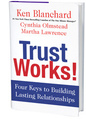
I’ve written more than a few books over the years, but I still get excited when a new one comes out. We’ve just released a new book I coauthored with Cynthia Olmstead and Martha Lawrence called Trust Works! Four Keys to Building Lasting Relationships. We think it will make a difference in people’s lives while giving them a smile.
The first part of the book is written as a parable about a dog and a cat and how they learn to trust each other. It’s interesting—we asked people for feedback on one of our first drafts, and some dog lovers were offended because it seemed as if the dog had to do all the work to get the trust from the cat. We realized that we needed to emphasize that trust is a two-way street. So in our finished story, not only is the dog trying to get the cat to trust him, but the cat has to get the dog to trust her too. Of course, the story is a metaphor for any relationship where people need to create and build trust with one another. Readers will be able to apply it to their working relationships as well as their relationships with family and friends.
Cindy Olmstead spent years developing the wonderful ABCD Trust Model™ we use in the second part of the book to highlight the four behaviors that need to be present in order to build trust. If even one of these behaviors is absent, trust erodes.
First, you have to prove that you’re Able. You are competent to solve problems and get results. You strive to be the best at what you do and you use your skills to help others.
Next, you have to be Believable. You act with integrity and honesty. You show respect for others, admit your mistakes, keep confidences, and avoid talking behind others’ backs.
You also have to be Connected. You care about others, which includes showing interest, asking for input, and listening. You praise the efforts of others and share information about yourself.
Finally, you need to be Dependable. You do what you say you will do. You are organized and responsive. People know you will follow up and be accountable.
How would you assess your trustworthiness in these four key areas? Go to http://www.trustworksbook.com and take the self-assessment. While you’re at it, ask the people you work with to evaluate you as well.
That’s how I learned that my lowest score in these four areas was in the Dependable category. What an eye opener! I never thought of myself as undependable but since my executive team and I understood the four factors, we were able to have that conversation and zero in on the problem. Turns out that my desire to please everyone showed up in real life as a tendency to over-commit myself—which resulted in people ultimately being disappointed because I couldn’t meet their expectations.
Using the ABCD Trust Model™, my team came up with a great solution for me. Now when opportunities come up, instead of saying yes without thinking, I hand out my executive assistant’s card so she can make sure I have the time and resources to follow through. As a result, my Dependable score has soared!
In most organizations, trust issues are simply avoided until they reach a breaking point. You can’t just assume that trust will grow over time—sometimes the exact opposite happens.
Trust is hard to define. You can tell when it’s absent—but how do you create it and build it when it doesn’t exist? Trust Works! provides a common language for trust—and essential skills for building, repairing, and sustaining it. Building trust is one of the most needed skills for leaders today. Don’t leave trust to chance in your organization.
Ken Blanchard
.
Blog
.
<span class='date ' tip=''><i class='icon-time'></i> Sep 05, 2015 01:21am</span>
|
|
I’ve talked often of the importance that values play in achieving your corporate vision. Your purpose as an organization tells you where you want to go as a company, but values tell you how you are going to get there. Clearly defined values provide guidelines for how to make daily decisions that impact your future success—or failure.
I recently had the chance to hear Stephen M.R. Covey talk about the impact that the lack of trust has on all of us, and I realized something: there is another layer of underlying behavior that impacts our ability to live by our values. Trust and values actually work hand in hand to create a strong company.
As I listened, I realized that the Four Cores of Credibility™ for self trust, as defined in Stephen’s book The Speed of Trust, align very closely to our own corporate values. When we practice our values, we build trust with each other and with our customers—and the trust we build makes our values even stronger.
Covey’s first two cores of credibility deal with character—they are Integrity and Intent. Integrity is about making and keeping commitments. Intent focuses on how motives and agenda drive behaviors. The second two cores deal with competence—they are Capabilities and Results. Capabilities are talents, attitudes, skills, and knowledge. Results are past performance, present performance, and potential future performance.
Our prioritized values at The Ken Blanchard Companies are:
Ethical Behavior—doing the right thing.
Relationships—developing mutual trust and respect.
Success—operating a profitable and well-run organization.
Learning—always growing, inquiring, and developing.
Our first two values deal with character and the last two deal with competence, similar to Covey’s cores of credibility for self trust.
Our first value, Ethical Behavior, ties in directly with Covey’s element of Integrity. To most people, integrity means honesty. This value is reinforced by what we call our "Ethics Check." When in doubt about whether something is ethical, answer these three questions: Is it legal? Is it fair? Would you be proud to see your actions reported in the news?
Our second value, Relationships, is about treating people with respect—very similar to Covey’s element of Intent. If your intentions are good, you are likely to build mutually beneficial relationships.
Our third value of Success ties closely to Covey’s element of Results. Success and results are measures of financial achievement as well as being indications of the development of personal relationships, processes, products, and services.
Our fourth value, Learning, relates to Covey’s element of Capabilities. Particularly in today’s changing economic environment, it is essential to keep learning new techniques and building skills.
According to Covey, trust always affects two outcomes—speed and cost. When trust goes down, speed goes down and costs go up: consider the time and cost of airport security after 9/11. Similarly, the way values are applied can impact trust. If values drive consistent decisions and behaviors, trust goes up. But if values are just some forgotten document posted on a wall and not followed, trust goes down.
Values and trust are profound, necessary principles when they occur individually. When combined, they become far more powerful—and can create a huge competitive advantage for any organization. I’m not sure you can have one without the other—what do you think? I’d love to hear your stories.
Ken Blanchard
.
Blog
.
<span class='date ' tip=''><i class='icon-time'></i> Sep 05, 2015 01:19am</span>
|
|
I’ve been reading an interesting book by Richard J. Leider and David A. Shapiro called Whistle While You Work: Heeding Your Life’s Calling. The authors explain that in many instances our calling comes to us when we are removed from everyday routine—that’s when we are able to listen to what authentically moves us from the inside.
Each summer, my wife, Margie, and I spend time at our lake home in upstate New York, where we are removed from our everyday routine and obligations in San Diego. This change of scenery allows me to do just what the authors of the book describe: I get time to think about where I want to make a difference in the world. In fact, I do most of my writing at the lake. I have time to think about the issues leaders are facing around the world and spend time researching and writing articles and books that offer solutions to those challenges.
So what’s your calling—and how do you discover it? In addition to taking the time to quiet yourself by removing yourself from routine, I also think it is important to identify the activities that cause you to lose track of time—that’s a hallmark of a calling versus something you are driven to accomplish. For me, writing at the lake certainly ticks that box. How about you? Think about using vacation time to quiet yourself. Pay attention to what you learn. This concept goes beyond what you do to make a living—think about what you want to do in your community or with your family that will support your values and purpose.
It’s never too late to make changes in your life by taking advantage of your most precious commodity—time. Life is a very special occasion, so celebrate it by finding and honoring your authentic self!
Ken Blanchard
.
Blog
.
<span class='date ' tip=''><i class='icon-time'></i> Sep 05, 2015 01:18am</span>
|
|
Setting boundaries to help empower people might sound like a contradiction. When managed correctly, though, well placed boundaries can ensure a strong culture of empowerment for your entire company.
I’ve often said that a river without banks is a large puddle. If you empower people by setting them loose without any direction, they can lose momentum and focus—or, even worse, they can make costly mistakes or put a project at risk. Like the banks of a river, properly set boundaries will channel energy in the right direction so that people can take on more responsibility as they grow and develop.
The key to setting boundaries is to ensure people know the areas where they can be autonomous and responsible rather than focusing on things they are not permitted to do. Boundaries are based on each person’s skill level and are meant to help the person understand how their goals align with the overall vision and goals of the organization. Helping people see how their work fits into the big picture allows them to become peak performers.
It is also important for managers to explain the decision making process in an empowered culture. Some people think being empowered means they get to make all the decisions. They could be disappointed when the manager continues to make strategic decisions and leaves only some operational decisions to them. And they might hesitate to make decisions at all when they realize they will be held accountable for the results—both good and bad.
Yes, empowerment means people have the freedom to act, but it also means they are accountable for results. The right balance is to have managers continue making strategic decisions and get team members involved in making more operational decisions as they become more comfortable with assuming the potential risks involved. As people gradually accept more responsibility for decisions and consequences, managers can pull back on their involvement.
It takes a little time in the beginning for managers to establish boundaries for team members, but this investment has a huge payoff. The worst thing a manager can do is to send people off on their own with no clear direction and then punish them when they make mistakes. Don’t fall into that trap. Establish clear boundaries that will empower people to make decisions, take initiative, act like owners, and stay on track to reach both personal and organizational goals.
Ken Blanchard
.
Blog
.
<span class='date ' tip=''><i class='icon-time'></i> Sep 05, 2015 01:18am</span>
|
|
Some say the only thing you can count on in life is change itself. Often change is viewed as a negative thing, especially when it destroys plans we spent so much time on. The reason it is viewed negatively is that our plans cause us to create expectations for ourselves and create a mental model about our near future. Change makes that mental model invalid and we feel like we wasted effort by planning in the first place. Then we don’t execute our plan and never accomplish anything. Sounds pretty depressing doesn’t it?
Another point of view is that change is always a good thing. In fact if it weren’t for change, everything would just stay the same and we wouldn’t be making progress anyways. We’ve been having lots of change here at Discovery Machine recently and most of it is positive. The seasons have changed from summer to fall with winter pushing right in. (Winter is my favorite season). We actually had our first snowfall last week so I bought some new skis. We just passed the fall equivalent of Groundhog Day meaning we are now past the halfway point between the autumnal equinox and the winter solstice. At work, we have recently completed some large development projects and are making some compelling demos to show off these new capabilities. We’ll be showing these demos at the I/ITSEC conference in Orlando at the end of November. Be sure to stop by our booth 2880 if you are at the conference.
Our portfolio of products is growing as a result of this work and we are getting a lot more interest from potential customers who see more clearly the cost savings they will realize by using Discovery Machine solutions for either their training and simulation needs or commercial knowledge deployment. Our development team is starting new projects that will leverage our recently completed work in innovative ways. The next few months will be exciting as we begin to experience firsthand the benefits of using the capabilities recently developed. So change is not always a negative thing, in fact here today it is very positive.
Anna Griffith
.
Blog
.
<span class='date ' tip=''><i class='icon-time'></i> Sep 05, 2015 01:17am</span>
|
|
In a previous post, I described 4 ways Discovery Machine models human behavior. The fourth way is by building models that project potential courses of action to make nuanced decisions. There are many circumstances in which our Navy crew member models project different courses of action to make decisions. For example, one of our crew [...]
Anna Griffith
.
Blog
.
<span class='date ' tip=''><i class='icon-time'></i> Sep 05, 2015 01:17am</span>
|
|
Here at Epignosis, the company behind TalentLMS, we view the Cloud as one of the pillars of modern computing in general and educational technology in particular, both now and for the foreseeable future. Until direct to brain interfaces become popular and training material is directly implanted into our memories, that is.
Cloud computing remains a mystery for many enterprise departments and businesses, and there are plenty of myths built up around deploying and running applications on it.
Let’s wear our myth-busters suits, and clean up those myths once and for all.
Myth #1 : Everything works better in the cloud
Having a successful new technology be perceived as a silver bullet is the oldest cultural problem in IT, and Cloud has been no exception in this regard.
Truth is, the cloud might not be right for all of your IT infrastructure needs.
And even when it is, it might a private cloud (which offers more integration options and raw performance) that fits your needs better, as opposed to the public cloud.
Depending on your particular use cases, the right overall solution is often best achieved through a combination of one or more of the available options (public and private cloud, dedicated hosting, and even good, old-fashioned native applications).
Myth #2 : The cloud is not secure
Security concerns are the main barrier to cloud adoption, and they really shouldn’t be.
The key insight regarding security is to understand that no system is ever 100% secure (just ask the CIA or NASA), and that why it’s important to assess the relative risk.
Are your local computers, internal networks, and company servers better protected than cloud-based assets? Does your IT team know how to properly install and secure any third party server product you ask them to deploy?
In most cases the answer is no. And relying on "security through obscurity" is prone to fail and is actually discouraged by security advisors.
The major cloud providers invest more heavily in security (and data safety) than the average business, and can afford to have top notch administrators and security gurus on their team — people who know their Cloud offering inside out.
Myth #3: Cloud is expensive. Or cheap.
It is not always cheaper to run on the cloud, but it can often be more cost efficient. As with all business expenses, it’s not just the month-to-month costs that matter but the "total cost of ownership" (TCO).
The up-front costs of a cloud migration can often be sizeable, but the savings over time typically offset the initial expenditure. Plus, switching to an operational expenditure model rather than a capital expenditure one, can be beneficial for many businesses.
Then there’s another important metric, well known to economists and business owners: opportunity cost.
Is building and managing your own infrastructure the best use of your company’s energy and budget? For most businesses that would be like building your own office furniture or making your own printing paper from tree pulp. It just doesn’t make sense.
Myth #4 : There’s only one cloud
Words can be misleading in subtle ways. The fact that the word cloud (as in "the Cloud") is singular doesn’t really help.
There is, in fact, an innumerable number of clouds, both public and private.
Consumer cloud hosting providers do not store all their data in the same box.
As for the major players, Google, Facebook, Amazon, IBM, Apple, Microsoft etc. - they all run their own cloud.
This is obviously good: it means that you have options, that by adopting the Cloud you’re not tied to a particular vendor, unless you chose to (e.g. to take advantage of some proprietary APIs and services they might offer).
But it also means you have to do your research, as not all clouds are created equal.
Myth #5 : The cloud is a fad
Nothing could be further from the truth.
If anything, it was the isolated personal computer that has proven to be a fad.
You see, the idea that computing should be organized like a public utility goes as far back as 1961.
And for the first few decades of commercial computing, computers were in fact just like that: central behemoths serving tens or thousands of users using dumb terminals.
Then, in the eighties and early nineties, we had the short period of non-connected personal computers whose only option was to run programs natively. A period that came to an end with the emergence of commercial internet and the world wide web.
Today our browsers are once again those "dumb terminals", whose intelligence comes from being connected to massive cloud services such as Google, Facebook, Wikipedia, YouTube, Flickr, and the like.
While native applications such as Word and Excel are all well and good (and even preferable for CPU demanding tasks, such as video editing and games) there’s simply no going back to the pre-internet and pre-cloud era.
In fact, Gartner predicts that companies will spend $788 billions on public cloud services the next four years, while McKinsey forecasts that cloud technology could have an economic impact of $1.7 to $6.2 trillion a year by 2025.
Those clouds aren’t dissipating any time soon.
- - - - - - - - -
Enjoyed the myth-busting? Stay tuned, as next week we’re gonna continue with another 5 common cloud myths. Until then, have fun and carry an umbrella.
WHO’S TALKING:
Epignosis, the global eLearning solutions provider, has produced Cloud based offerings for over a decade. Not just TalentLMS, whose blog you’re reading, but also eFront, our powerful enterprise LMS for private clouds and Snappico, our latest mobile offering that leverages the cloud to make casual learning fun.
The post Top 10 Cloud myths busted, part 1 appeared first on TalentLMS Blog.
John Laskaris
.
Blog
.
<span class='date ' tip=''><i class='icon-time'></i> Sep 05, 2015 01:16am</span>
|
|
In last month’s post discussing TalentLMS’ integration options, we mentioned that our team is working hard on adding a tighter integration with the eCommerce king, Shopify.
Well, the time is now! In this post we’ll have a look at how our new integration with Shopify works, how you configure it, and what it enables you to do.
Shortcut: check the Talentlms-to-Shopify step-by-step integration guide
Shopi-what?
With over 150,000 merchants and billions in sales, Shopify, created by the Canadian company of the same name, is one of the most widely used eCommerce platforms, letting anyone set up an online shop, accept credit card payments and respond to orders.
By integrating TalentLMS with Shopify, you can use the platform as a marketplace for your TalentLMS courses, exchange and share courses and customer information between the two platforms.
Integration between the two platforms has been built on top of the powerful Zapier meta-service, so in order to set it up you need to configure your Zapier triggers and actions.
Don’t worry though, because, as with most things TalentLMS related, the process is easy. Let’s walk you through it step by step.
Because that’s what blogging friends are for, right?
(We assume that you already have a Shopify account. If not, go ahead and register for one, we’ll wait).
Sharing customer accounts
If you’re using both platforms, manually opening accounts and managing customer information from one to the other is no fun. Thankfully, you don’t have to.
Zapier integrations, regardless of source and target application, follow the pattern of connecting triggers ("when this happens") to actions ("do that").
To hook Shopify and TalentLMS up so that new Shopify accounts are copied as new TalentLMS users, you can pipe the results from "New Customer" trigger from the Zapier Shopify service to the "New User" Zapier TalentLMS action.
The only tricky part is matching the data coming out of Shopify to the information needed for a new user account creation in TalentLMS. Most fields have a straightforward relation between the two platforms — for the rest you can reuse or combine values as you fit it (e.g. use the Spotify user’s email as the username of the corresponding TalentLMS user). As there are Shopify user information fields upon registration without corresponding TalentLMS ones, if you need them, you can set them up as custom fields in TalentLMS.
Setting up the inverse procedure (from new TalentLMS user to new Shopify account) is just as easy. You just have to connect the "New User" trigger of TalentLMS to the "New Customer" action of Shopify.
Sharing course info with Shopify (and vice versa)
Sharing customer information between Shopify and TalentLMS can be useful even if you don’t sell courses. One use case for that would be offering complementary online training for buyers of your products in Shopify.
If you plan on promoting and selling your TalentLMS courses through Shopify though, you’ll want to share course information between the two platforms.
For this to happen, your Shopify products should be stand-ins for your TalentLMS courses (so, essentially courses, themselves). If that’s the case, you can connect the "New Product" trigger of the Zapier Shopify service to Zapier’s TalentLMS "New Course" action, to have TalentLMS automatically pull new products created in Shopify as new courses.
The inverse is also possible (and probably more convenient, especially if you are used to working with TalentLMS’ intuitive user interface). By using Zapier to connect TalentLMS’ "New Course" trigger to Shopify’s "New Product" action, you can have all your new TalentLMS courses automagically available as Shopify products.
Shopify orders to course registrations
Setting up your Shopify products as TalentLMS courses (or vice versa) only takes you half of the way there.
You’ll also need a way to track new course (product) orders from Shopify and convert them to TalentLMS course registrations. As almost all things in Zapier, this is all about connecting the appropriate trigger to the appropriate action. In this case, the "New Order" Shopify trigger to the "Add User to Course" TalentLMS action.
Are you sold on our Shopify integration yet?
That’s all there is to it, really.
If you’re selling eLearning courses but you’re not yet a Shopify user, we suggest you take a look at what it has to offer, starting with its large and vibrant customer base.
For our part, we’ve made integrating the two platforms a no-brainer. After all, that’s how TalentLMS got crowned as the most intuitive and easy to use LMS: by being intuitive and easy to use. That, plus bribing the judges (just kidding).
And in case you get stuck, there’s a handy "Shopify ‐ TalentLMS Zapier integration" guide , that goes into the whole process in far more detail than we have screen space and you have time for.
So what are you waiting for? Get integrating!
The post Set up shop with the new TalentLMS - Shopify integration appeared first on TalentLMS Blog.
John Laskaris
.
Blog
.
<span class='date ' tip=''><i class='icon-time'></i> Sep 05, 2015 01:14am</span>
|